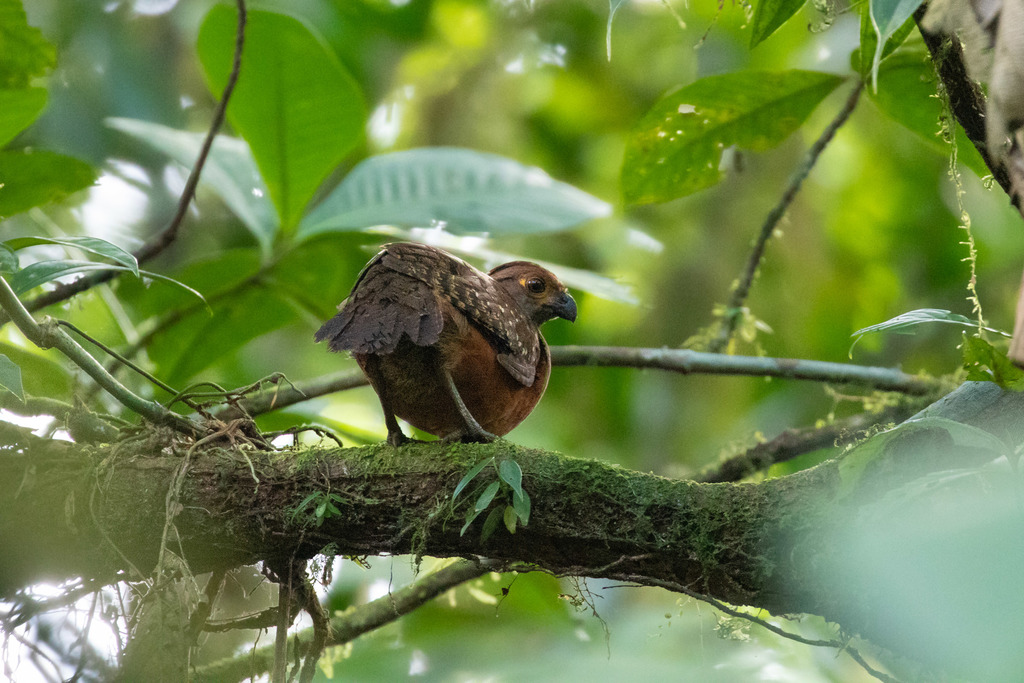
Starred Wood Quail
Photo © Thibaud Aronson
Photo © Thibaud Aronson — CC BY-SA 4.0 — Source: iNaturalist #79742810Identification
The starred wood quail is a small quail measuring 24–28 cm in length, with males slightly larger than females. Both sexes share a distinctive reddish-brown crest on the back of the head, though females' crests are darker brownish-black. The bird's face and neck are predominantly grey, while the upper parts are olive-brown with darker vermiculations and pale speckling on the wing coverts. The underparts are reddish-brown with white speckling on the breast sides and dark barring near the vent. The bill is blackish, the irises brown, and the legs grey. Juveniles are similar to adults but have an orange or reddish bill rather than blackish.
Range & Habitat
The starred wood quail is found in the western Amazon Basin, distributed across eastern Ecuador, much of Peru, western Brazil, and northern Bolivia. It inhabits subtropical and tropical moist lowland forests, typically below 1,050 m elevation (lower in Ecuador), including terre firme forests, flooding areas, and transitional forest zones. The species has a very wide distribution and is common in at least parts of its range.
Behaviour & Diet
This is a retiring and elusive species, most reliably detected by its distinctive two-syllable call, "korkorralo," which it utters repeatedly at dusk. The starred wood quail forms small coveys of five to eight birds that move through their forest habitat in single file, staying close to dense cover where they can quickly retreat if disturbed. They forage through leaf litter and the forest floor, feeding on invertebrates and fruits. Little is known about their breeding habits, though their secretive nature makes field observation challenging.
Best Time & Places to See It
The best opportunity to encounter this elusive species is at dusk, when their distinctive calling is most frequent and consistent. Within its range across Ecuador, Peru, Brazil, and Bolivia, the bird is most likely to be found in moist lowland forest habitats, particularly in areas with dense understorey cover and rich leaf litter. The extensive range and common status in parts of its distribution suggest that visits to quality lowland forest reserves within these countries offer reasonable chances of detection, particularly when listening for calls during evening hours.
Photography Tips
Photographing the starred wood quail presents significant challenges due to its retiring, elusive nature and preference for dense cover. The bird's small size and cryptic colouration require patience and careful stalking. Since the species is most vocal and active at dusk, this is when photography opportunities are most likely, though low light levels may complicate image capture. Using calls to locate birds may help, but approaching close enough for photographs will require slow, deliberate movement and remaining stationary in promising habitat. Wide-angle lens work capturing habitat context may be as rewarding as close portraiture, given the difficulty of photographing this forest specialist.
Mapinguari National Park
Brazil
+354 birds
Vast tracts of western Amazonian rainforest blanket the remote terrain of this 56,827 square kilometre national park in Amazonas state, where seasonal rivers wind through dense…
VIEW NATIONAL PARKCampos Amazónicos National Park
Amazonas, Brazil
+434 birds+7 mammals
Sprawling across the southwestern Amazon basin in Amazonas state, this 27,263-square-kilometre national park encompasses some of the region's most pristine lowland rainforest, where terra firme forest…
VIEW NATIONAL PARKSerra do Divisor National Park
Brazil
+448 birds+10 mammals
Where the western Amazon meets the Andes foothills, Serra do Divisor National Park sprawls across one of South America's most biodiverse and least accessible frontiers. Spanning…
VIEW NATIONAL PARKYanachaga–chemillén National Park
Palcazu, Peru
+639 birds+6 mammals
Where the eastern slopes of Peru's central cordillera plunge into cloud forest, Yanachaga–Chemillén National Park protects nearly three thousand square kilometres of montane wilderness that few…
VIEW NATIONAL PARKManu National Park
Manu, Peru
+892 birds+26 mammals
Across the eastern slopes of the Peruvian Andes, tropical rainforest descends into the Amazon basin with a complexity that few terrestrial ecosystems match. Manu National Park…
VIEW NATIONAL PARKSierra del Divisor National Park
Alto Tapiche, Peru
+298 birds+2 mammals
Where the western Amazon meets the Andes foothills, nearly 41,000 square kilometres of pristine rainforest rise across Peru's Alto Tapiche region in a landscape of extraordinary…
VIEW NATIONAL PARKBahuaja Sonene National Park
San Pedro de Putina Punco, Peru
+602 birds+8 mammals
Where the Madre de Dios and Heath rivers converge in southeastern Peru rises one of South America's most biodiverse wilderness regions: a vast protected realm of…
VIEW NATIONAL PARKIchigkat Muja – Cordillera del Cóndor National Park
Río Santiago, Peru
+101 birds
Where the Andes descend into the western Amazon, the Río Santiago carves through a landscape of profound biological complexity. Ichigkat Muja – Cordillera del Cóndor National…
VIEW NATIONAL PARKNo community photos yet. Log in to add the first one.
No community observations of this species yet.