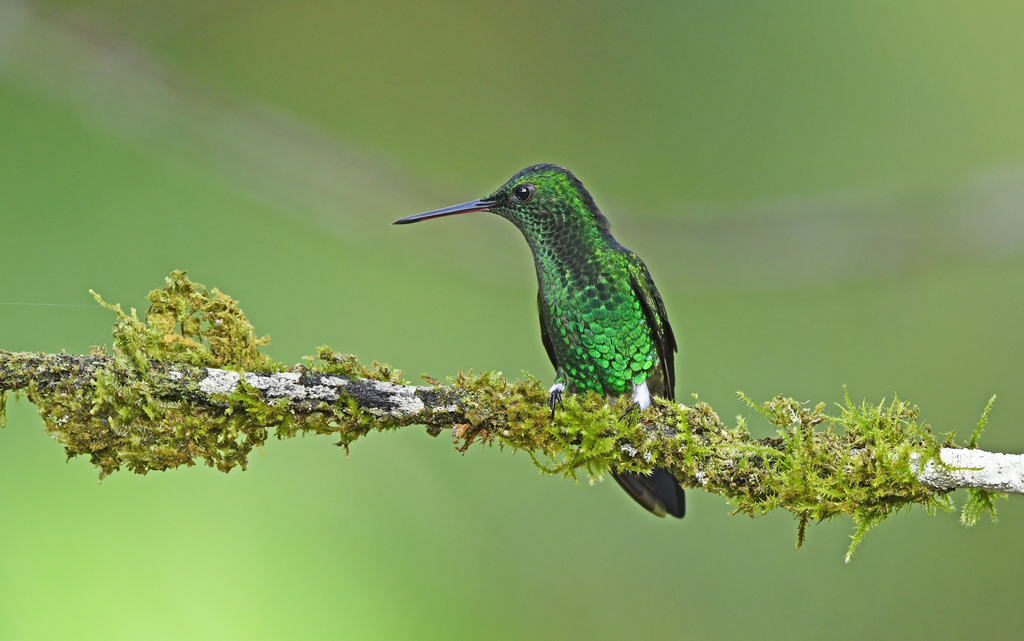
Steely-vented Hummingbird
Photo © Christoph Moning
Photo © Christoph Moning — CC BY 4.0 — Source: iNaturalist photo #237348146Identification
The steely-vented hummingbird is a small species measuring 8 to 11 cm in length and weighing approximately 4.4 to 5.0 grams. Both sexes display a black bill with a pinkish or reddish base on the mandible. Adult males of the nominate subspecies are characterized by golden-green upperparts with blue-black uppertail coverts and tail. Their underparts are dark glittering golden-green with distinctive greenish to steel blue undertail coverts—the feature from which this species derives its name. Adult females are more subdued, featuring some white on their throat feathers and grayish-brown undertail coverts. Immature birds resemble females but are overall duller, with a partly dark gray throat, grayish-brown belly, and brownish edges to back and rump feathers. The two additional subspecies show subtle differences: S. s. warscewiczi is somewhat smaller with purplish to bluish upper tail coverts, while S. s. braccata displays purplish rump tips and violet-blue to bluish uppertail coverts.
Range & Habitat
The steely-vented hummingbird is endemic to Colombia and Venezuela, with its range divided among three subspecies. S. s. warscewiczi occupies the northernmost portion, found in northern Colombia from Sucre Department eastward into western Zulia state in northwestern Venezuela. The nominate subspecies S. s. saucerottei inhabits western and north-central Colombia on the western slope of the Western Andes and throughout the Cauca River valley. S. s. braccata is restricted to the Andes of western Venezuela in Trujillo and Mérida states. This species favors semi-open to open landscapes including scrublands, savanna, forest edges, secondary forest, plantations, and gardens, particularly in somewhat arid regions. Most populations occur between sea level and 1,500 meters elevation, though S. s. braccata ranges up to 2,000 meters and occasionally reaches 3,000 meters.
Behaviour & Diet
The steely-vented hummingbird is essentially sedentary, though individuals may make local movements in response to flowering plant availability. Little detailed information exists regarding its feeding ecology, but it is known to forage for nectar at low bushes and trees and exhibits somewhat territorial behavior. The species appears to breed year-round throughout Colombia, though breeding phenology remains poorly documented. A single nest observation described it as a simple cup-shaped structure saddled on a tree limb approximately 8 meters above ground. Egg characteristics, incubation period, and fledging duration have not been scientifically described. The species produces distinctive vocalizations, including sharp, high-pitched calls described as tsits or chits, often delivered in rapid sputtering series, though its full song remains undocumented.
Best Time & Places to See It
The steely-vented hummingbird is fairly common to common throughout most of its range and numerous in certain habitats, making it a reliable species for observers in appropriate locations. With year-round breeding in Colombia, the species is present throughout the year, eliminating seasonal constraints on viewing opportunities. Open scrubland and savanna habitats with scattered flowering plants and trees offer the best chances of encounter. The species occurs in at least one protected area, which may provide accessible viewing opportunities for travelers. Garden settings and plantation edges within its range frequently attract this species, making it possible to observe individuals in human-modified landscapes.
Photography Tips
Photographing the steely-vented hummingbird requires patience and attention to lighting, as capturing the species' distinctive steely-blue undertail coverts is crucial for positive identification. Position yourself near flowering plants or scrubby vegetation where individuals forage, maintaining a low profile to avoid disturbing their feeding. The small size of this hummingbird demands a telephoto lens with fast autofocus capabilities. Early morning light often best reveals the iridescent green and blue plumage of males. Focus on capturing the undertail coverts and tail characteristics to document subspecific variation, which can aid in contributing to citizen science initiatives. Patience in semi-open habitats will reward photographers with opportunities to document this species' characteristic low-level foraging behavior.
Guided Birding Tour
Nothing matches these filters.
Nothing matches these filters.
No community photos yet. Log in to add the first one.
No community observations of this species yet.