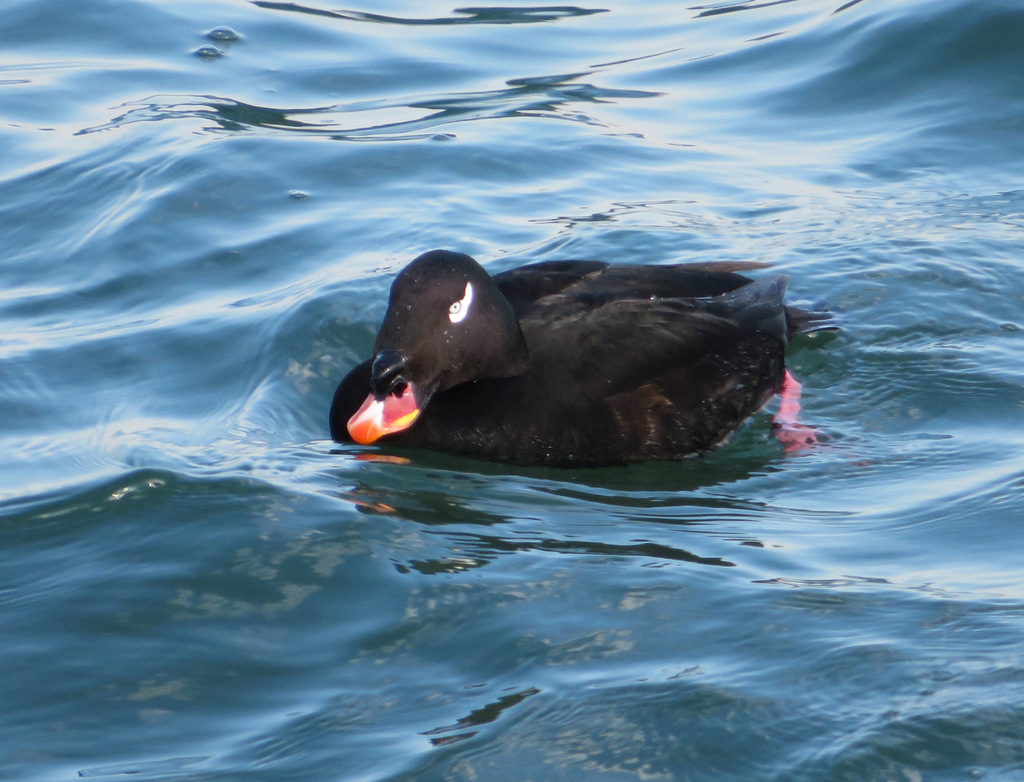
Stejneger’s Scoter
Photo © Marco Mussita
Photo © Marco Mussita — CC BY 4.0 — Source: iNaturalist #68305193Identification
Stejneger's scoter is a large sea duck with distinctly black plumage in males, featuring a striking orange-yellow bill topped with a very tall knob at its base. The key to distinguishing this species from the similar white-winged scoter lies in subtle but important differences. Stejneger's scoter males display a long "Roman nose" profile—reminiscent of a common eider—that contrasts sharply with the "two-stepped" head profile of white-winged scoters. Additionally, the feathering along the upper mandible forms an acute angle on Stejneger's scoter, whereas it creates a right angle on white-winged scoters. These distinctions in head shape and bill feathering pattern are essential for accurate field identification.
Range & Habitat
Stejneger's scoter breeds across the far north of Asia, east of the Yenisey Basin, in remote arctic regions. During winter, the species migrates south to temperate zones throughout Asia, ranging as far south as China. The species favors suitable coastal waters where it congregates in large, tightly packed flocks that tend to take off together as a coordinated group.
While traditionally rare in North America, this scoter may be a regular visitor and possible breeder in Western Alaska, with documented sightings at Nome, Saint Paul Island, and Gambell. The species is also a rare vagrant to Europe, with records from France, Finland, Poland, Iceland, Ireland, Norway, Scotland, and Sweden. A single confirmed occurrence south of Alaska was documented in Helena Valley, Montana, between April and May 2015.
Behaviour & Diet
Stejneger's scoter is primarily a diving duck that feeds differently depending on its environment. In freshwater habitats, the species primarily feeds on crustaceans and insects. When in saltwater areas, it shifts its diet to molluscs and crustaceans. The species is notably gregarious, forming large flocks on coastal waters where individuals maintain close proximity to one another.
Best Time & Places to See It
For North American observers, Western Alaska offers the most reliable opportunities, particularly around Nome, Saint Paul Island, and Gambell. Birdwatchers and travelers should focus on coastal waters during migration and winter months. In Asia, suitable coastal waters throughout the wintering range, particularly in temperate zones, offer chances to observe this species. European sightings are exceptional and unpredictable, making them valuable records for local birding communities.
Photography Tips
Photograph males in good light to capture the distinctive orange-yellow bill and prominent knob at its base, as well as the characteristic "Roman nose" head profile. The tightly packed nature of their flocks provides opportunities for compelling group compositions. Capture the species in its typical coastal water habitat to provide context. Pay careful attention to bill feathering angles and head shape details, as these diagnostic features are essential for documenting the species accurately and distinguishing it from white-winged scoters.
Baikal National Park
Ольхонский район, Russia
+184 birds+11 mammals
Where the world's deepest freshwater lake meets ancient Siberian taiga, Baikal National Park sprawls across 66,203 square kilometers of one of Earth's most singular ecosystems. The…
VIEW NATIONAL PARKKhangai Nuruu National Park
Erdenetsogt, Mongolia
+136 birds+7 mammals
Where granite ridges pierce Mongolia's central steppe, alpine meadows give way to dense coniferous forests that climb toward windswept summits. Khangai Nuruu sweeps across 1.2 million…
VIEW NATIONAL PARKAltai Tavan Bogd National Park
Tsengel, Mongolia
+146 birds+3 mammals
Where the Altai Mountains rise in jagged defiance along Mongolia's western frontier, the terrain transforms into a realm of alpine tundra, rocky plateaus, and glacier-carved valleys…
VIEW NATIONAL PARKKhoridol Saridag National Park
Khatgal, Mongolia
+164 birds+6 mammals
Where granite peaks thrust skyward across Mongolia's remote southeastern reaches, a landscape of raw geological drama unfolds. Deep river gorges carved through ancient stone create a…
VIEW NATIONAL PARKNortheast China Tiger and Leopard National Park
Mu Dan Jiang Shi, China
+202 birds+19 mammals
Across the temperate forests of northeastern China, where winters grip the landscape in subzero silence and summers remain cool and brief, the Mudanjiang region supports a…
VIEW NATIONAL PARKAlaska Maritime National Wildlife Refuge
Alaska, United States
+391 birds+58 mammals
Where the North Pacific collides with Alaska's rugged coastline, a sprawling archipelago of islands, rocky outcrops, and coastal headlands forms one of North America's most remote…
VIEW WILDLIFE SANCTUARYNo community photos yet. Log in to add the first one.
No community observations of this species yet.