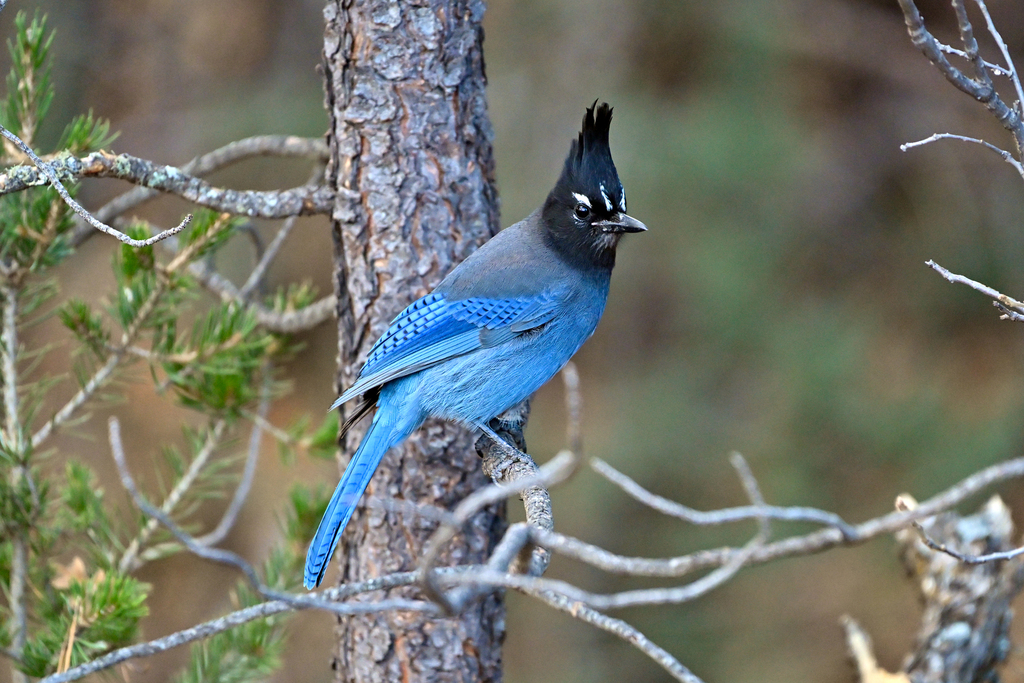
Steller’s Jay
Photo © Tom Kennedy
Photo © Tom Kennedy — CC BY 4.0 — Source: iNaturalist photo #599515791Identification
Steller's jay is a striking crested jay measuring 30–34 cm (12–13 in) long and weighing 100–140 g. It is the only crested jay found west of the Rocky Mountains. Compared to its eastern relative, the blue jay, Steller's jay has a more slender bill, longer legs, and a much more pronounced crest, particularly in northern populations. The species shows considerable regional variation across its range: northern birds display blackish-brown heads that gradually become bluer-headed toward the south. The head features lighter streaks on the forehead, while the shoulders and lower breast transition to silvery blue. The primaries and tail are rich blue with darker barring. Head markings also vary geographically—birds in the east along the Great Divide show white markings over the eyes, central populations have light blue markers, and Pacific Coast birds have small, faint, or no white markings at all.
Range & Habitat
Steller's jay is native to western North America and the mountains of Central America, ranging from southern Alaska south to northern Nicaragua. It completely replaces the blue jay across forested areas of the west, though its density is lower in the central Rocky Mountain region and Great Basin deserts. The species occurs in most forested areas as far east as the eastern foothills of the Rocky Mountains, with some hybridization with blue jays reported in Colorado and other eastern foothills locations. In Mexico, it inhabits the interior highlands from Chihuahua and Sonora southward to Jalisco, with patchy populations elsewhere. Central American populations are found in south-central Guatemala, northern El Salvador, Honduras, and Nicaragua. The species primarily inhabits coniferous and pine-oak forests but adapts to other forest types and is common in residential and agricultural areas adjacent to forests, ranging from low to moderate elevations and occasionally reaching the tree line.
Behaviour & Diet
Steller's jays are omnivorous, with their diet comprising approximately two-thirds plant matter and one-third animal matter. They forage both on the ground and in trees, feeding on a wide range of seeds, nuts, berries, and other fruits. They consume many invertebrate species, small rodents, eggs, and nestlings—including those of the marbled murrelet—and occasionally eat small reptiles such as snakes and lizards. Acorns and conifer seeds are staple foods during the non-breeding season and are cached in the ground or trees for later consumption. These intelligent birds readily exploit human-provided food sources, frequently scavenging picnics and campsites where they compete with Canada jays. At feeders, they prefer black-oil sunflower seeds, white striped sunflower seeds, cracked corn, shelled and whole raw peanuts, and consume suet, particularly during winter. Steller's jays breed in monogamous pairs.
Best Time & Places to See It
Steller's jay is readily encountered year-round throughout its range in forested habitats of western North America. Your best chances come in coniferous and mixed forests from the Pacific Coast through the Rocky Mountains, and in mountain forests of Mexico and Central America. The species is common in residential areas with adjacent forests, making it accessible even near towns and lodges. Look for them in pine-oak forests and at forest edges. During the non-breeding season, when birds cache seeds and nuts, they are particularly active and visible as they forage on the ground and in trees. Visit popular picnic areas and campgrounds where they habitually scavenge, or set up near bird feeders in forested regions.
Photography Tips
Steller's jay's bold crested profile and striking blue and dark coloration make it highly photogenic. Capture the distinctive head markings that vary by subspecies—particularly the white or pale markings over the eyes in eastern populations. The bird's pronounced crest is most visible when the jay is alert or calling; wait for moments of activity to showcase this characteristic feature. Use feeders stocked with peanuts to attract birds to predictable locations and distances. The rich blue tones of the primaries and tail photograph beautifully in good light; shoot during early morning or late afternoon to enhance these colors. Include habitat context—coniferous forest backgrounds reinforce the species' ecological niche and add visual interest to your images.
Arches National Park
Bear River Migratory Bird Refuge
Big Bend National Park
Black Canyon of the Gunnison National Park
Bosque del Apache National Wildlife Refuge
Bryce Canyon National Park
Canyonlands National Park
Capitol Reef National Park
Carlsbad Caverns National Park
Nothing matches these filters.
No community photos yet. Log in to add the first one.
No community observations of this species yet.