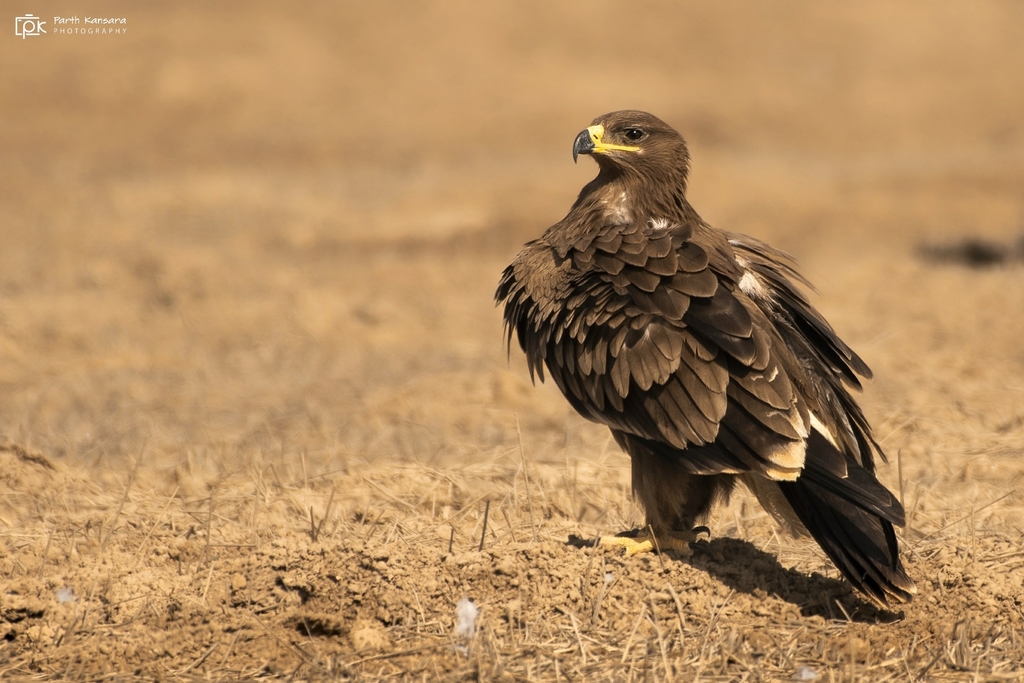
Steppe Eagle
Photo © Parth Kansara
Photo © Parth Kansara — CC BY 4.0 — Source: iNaturalist photo #156507147Identification
The Steppe Eagle is a large bird of prey belonging to the "Booted eagles"—a subfamily distinguished by well-feathered legs that extend down to the talons. Like other members of the genus Aquila, it tends toward darker plumage and inhabits open landscapes. The species was historically confused with the sedentary Tawny Eagle, and the two were once considered a single species. They were formally split based on pronounced differences in morphology, anatomy, coloring, and behavior, a distinction supported by molecular studies.
Range & Habitat
The Steppe Eagle is a highly migratory species, undertaking massive movements across its entire breeding range. It passes in large numbers through major migration flyways, particularly in the Middle East, along the Red Sea, and over the Himalayas. The species breeds in open steppe habitats and winters in African and Asian regions, where it occupies areas also used seasonally by the resident Tawny Eagle.
Remarkably, Steppe Eagles are the only eagle species to nest primarily on the ground. In the treeless expanses of steppe habitat, they construct rather flat nests on slight rises, often near rock outcrops, or even on completely flat, open ground. Typically, one to three eggs are laid, with successful nests producing one to two fledglings.
Behaviour & Diet
The Steppe Eagle is a specialized predator of ground squirrels on its breeding grounds, supplementing this diet with other small mammals and prey species when ground squirrels are less abundant. During the breeding season, it displays bold and active hunting behavior. In striking contrast, during winter the species exhibits remarkably sluggish and passive feeding ecology, scavenging on insect swarms, landfills, carrion, and the young of various animals—a stark departure from the predatory demeanor of related eagle species.
Best Time & Places to See It
The Steppe Eagle is still observed by the thousands at migration sites during seasonal movements, appearing in larger numbers than most other migrating eagles in these regions. The Middle East, Red Sea region, and Himalayan passes represent prime locations for observing this species during migration periods. However, the species is now classified as Endangered by the IUCN, with its entire population having declined precipitously. Increasing steppe fires, climatic pressures on nesting areas, human persecution, livestock trampling of nests, and particularly electrocution on electrical wires and pylons—especially in Kazakhstan—have all contributed to declines exceeding 50 percent.
Photography Tips
Photographing Steppe Eagles during migration offers the best opportunities, as concentrations at key flyways provide reliable viewing and shooting chances. The species' large size and dark plumage should be captured against open landscapes typical of steppe and semi-arid environments. Given the species' conservation status and sensitivity to disturbance, photographers should maintain respectful distances from nesting birds and follow ethical wildlife photography practices. During migration periods, position yourself along known flyways during peak movement times to maximize encounters with this increasingly rare and remarkable eagle.
Kanha Tiger Reserve
Lake Mburo National Park
Mabamba Swamp
Murchison Falls National Park
Queen Elizabeth National Park
Aberdare National Park
Abijata-Shalla Lakes National Park
Altai Tavan Bogd National Park
Arusha National Park
Nothing matches these filters.
No community photos yet. Log in to add the first one.
No community observations of this species yet.