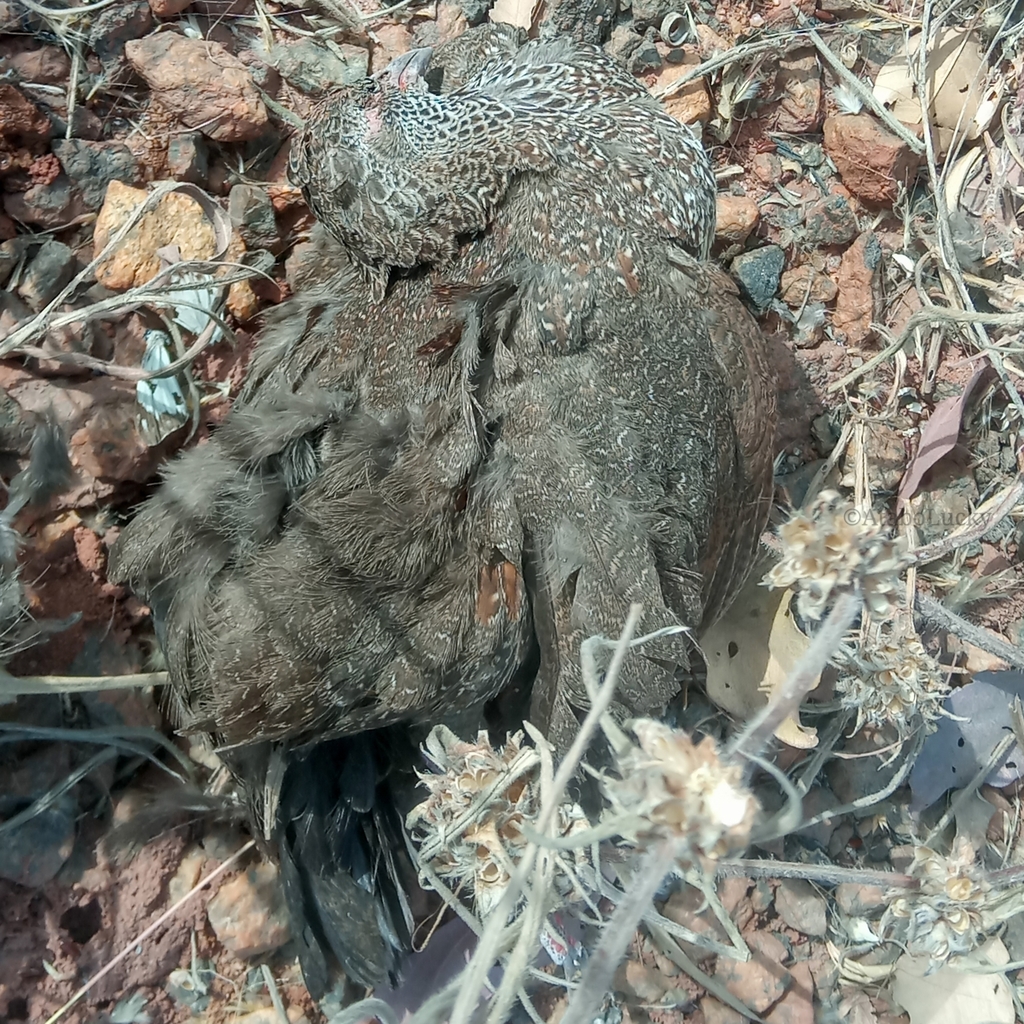
Stone Partridge
Photo © Lucky Okpanachi Atabo
Photo © Lucky Okpanachi Atabo — CC BY 4.0 — Source: iNaturalist #106694094Identification
The stone partridge is a small gamebird, measuring just 20–25 cm in length, with a predominantly earthy chocolate-brown plumage above adorned with sparse, pale cream-grey spotting. Its head, neck, and chest are paler brown with broad cream edging to the feathers, creating a distinctive scaled appearance. A characteristic feature is the bird's habit of raising its crown feathers to form a rudimentary crest, which is more prominent in females than males. The sexes differ notably in their underparts: males display orange-cream coloring on the lower chest and belly, while females are very pale cream throughout. This species is exceptional among gamebirds in appearing more visually striking in females than males. Juveniles are darker chocolate-brown overall before moulting into adult plumage after several weeks.
Range & Habitat
The stone partridge is widespread and common across a large range spanning from Kenya and Ethiopia westward to Gambia, with much of its distribution falling within the Sudanian Savanna. The species is recognized in four subspecies, distributed across different regions from West Africa through to East Africa. This bird favors scrubland and lightly wooded habitats, typically in areas with rocky outcrops or stony ground—terrain that inspired both its common and scientific names (petrosus meaning "rocky" in Latin).
Behaviour & Diet
The stone partridge is characterized by its habit of commonly holding its tail in a raised position. In captive birds, males play a major role in both incubation and rearing of young, demonstrating involved parental behavior by offering small food items to chicks through picking up, dropping, and calling behaviors. Eggs are pale pink, fading to cream in color.
Best Time & Places to See It
The stone partridge's widespread and common status throughout its range makes it a reliable species for wildlife observers across sub-Saharan Africa. The best opportunities to encounter this bird exist in scrubland and lightly wooded habitats with rocky terrain from West Africa through East Africa, particularly within Sudanian Savanna ecosystems. Its status as "least concern" on the IUCN Red List reflects healthy populations across its distribution.
Photography Tips
Photographers should look for the stone partridge in rocky scrubland and sparse woodland where its brown plumage provides natural camouflage. The bird's distinctive raised-tail posture and rudimentary crest offer recognizable photographic features. The scaled appearance created by cream-edged feathers on the head, neck, and chest provides detail for close-up photography. Females' more prominent crests and pale underparts offer subtle but distinguishable characteristics for documenting both sexes.
Kidepo Valley National Park
Uganda
+478 birds+24 mammals
Where the Narus and Kidepo rivers carve through northeastern Uganda's semi-arid lowlands, a landscape of sparse acacia woodland, grassland, and riverine thickets creates one of East…
VIEW NATIONAL PARKSamburu National Reserve
Samburu, Kenya
+430 birds+42 mammals
Across the arid plains of northern Kenya, where scattered acacia woodland gives way to rocky outcrops and dry riverbeds, Samburu National Park unfolds as one of…
VIEW NATURE RESERVENo community photos yet. Log in to add the first one.
No community observations of this species yet.