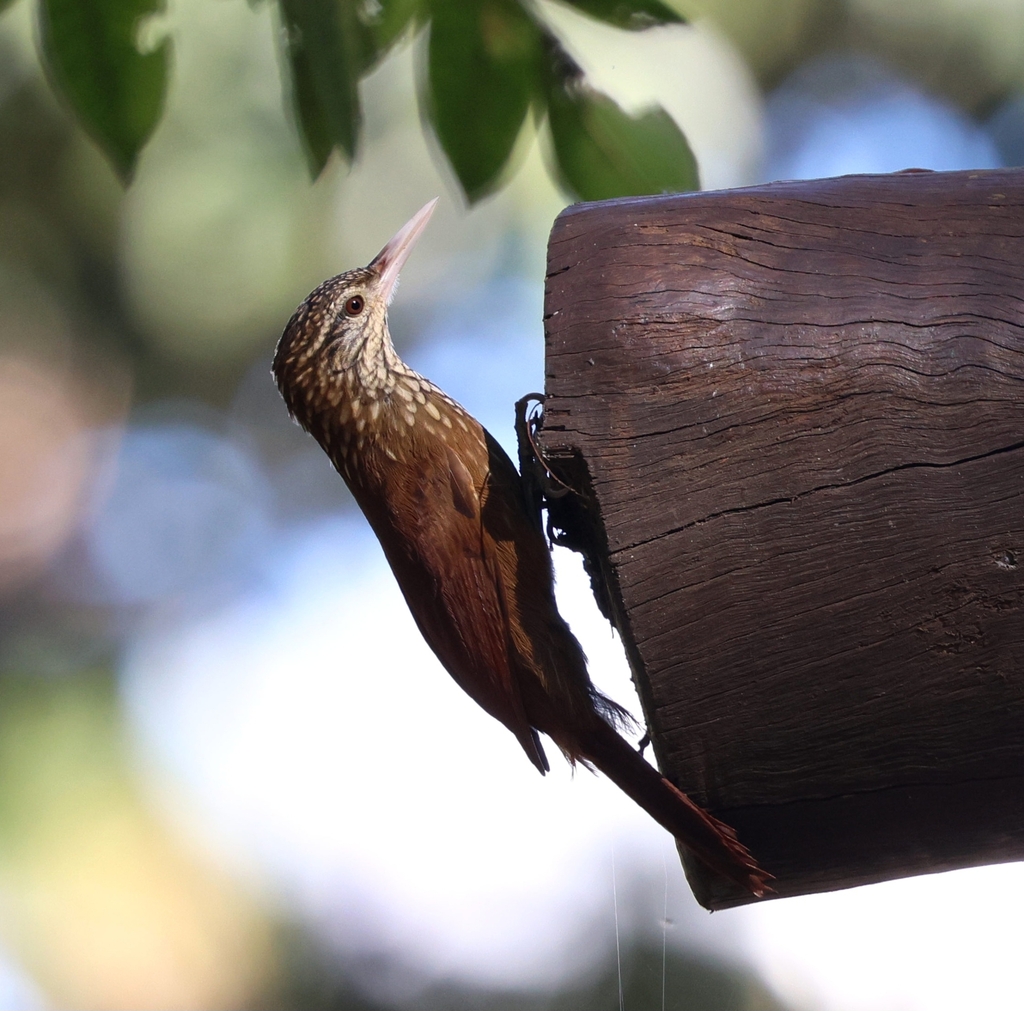
Straight-billed Woodcreeper
Photo © Miguel
Photo © Miguel — CC BY-SA 4.0 — Source: iNaturalist photo #562441784Identification
The straight-billed woodcreeper is a slim, medium-sized woodcreeper measuring 18 to 22 cm in length. Its most distinctive feature is its bill: straight along the upper edge (culmen) with an upward-curving mandible that sets it apart from other woodcreepers. Males weigh 34 to 42 grams, while females typically range from 33 to 45 grams, with some Trinidad birds reaching 51 grams.
The species exhibits subtle plumage variations across its thirteen recognized subspecies. The nominate subspecies displays an indistinct pale supercilium and eyering, dark brown to blackish crown and nape with buffy-white streaks, and warm olive-brown to reddish-brown upperparts. The lower back, rump, flight feathers, and tail are rufous-chestnut. Its underparts feature a distinctive buffy-white chin and throat with dark brown scaling that extends onto the upper breast, becoming more linear lower down. The iris is reddish-brown to dark brown, and the bill is light grayish-horn or dull whitish with a dusky or blackish base on the maxilla. Legs and feet are highly variable, ranging from green to gray and brownish. Juveniles are darker overall with smaller, more extensive streaks and a shorter, darker bill than adults.
Range & Habitat
The straight-billed woodcreeper is found across a vast range spanning Panama, Trinidad, and every mainland South American country except Chile, Argentina, Paraguay, and Uruguay. Thirteen subspecies occupy different regions throughout this distribution, with northern subspecies found from central and eastern Panama through northwestern Colombia, while southern populations extend through Venezuela, Guyana, Suriname, French Guiana, Brazil, Bolivia, and Peru.
The species exhibits geographic variation, with some subspecies occupying Pacific slopes in Central America and others inhabiting coastal regions, river valleys, and inland areas throughout South America. The diversity of subspecies reflects adaptation to various local conditions across this extensive range.
Behaviour & Diet
Like other members of the Dendrocolaptinae subfamily, the straight-billed woodcreeper is adapted for climbing and foraging on tree trunks and branches. Its straight bill distinguishes it functionally from curved-billed relatives and represents a specialized adaptation for its particular foraging niche. However, detailed information about its specific feeding behavior, diet composition, and social habits remains limited in available sources.
The species' presence across such diverse habitats and its persistence as thirteen distinct subspecies suggests successful ecological flexibility, though further field studies would illuminate its behavioral ecology and ecological role within different regional ecosystems.
Best Time & Places to See It
The straight-billed woodcreeper's extensive range offers multiple opportunities for observation across tropical South America, Central America, and Trinidad. Birders and nature travelers exploring Panama, Colombia, Venezuela, the Guianas, Brazil, Bolivia, or Peru may encounter this species within its appropriate range. The multiplicity of subspecies means that populations in different regions may show distinct characteristics, making regional guides valuable for identification.
As with many woodland species in tropical regions, early morning and late afternoon typically offer the best visibility and activity levels, though specific seasonal patterns and local abundances for this species would benefit from consultation with regional field guides and local birding communities in target destinations.
Photography Tips
Photographing the straight-billed woodcreeper presents both challenges and rewards. The bird's slim profile and climbing behavior mean that positioning yourself to capture its distinctive straight bill profile is important for definitive identification photography. The subtle plumage details—including the pale supercilium, ear covert streaking, and breast scaling—reward close-focus capabilities and good light conditions.
The rufous-chestnut lower back and tail provide striking contrast to document, while the variable leg coloration offers an interesting diagnostic feature. Given the subspecific variation across its range, photographers should aim to capture both overall plumage patterns and bill structure details. Since the bird forages on tree trunks and branches, anticipate climbing behavior and position yourself accordingly, using patience and subtle movements to avoid alarming this woodland resident.
Yasuní National Park
Aguarico, Ecuador
+601 birds+43 mammals
Where the western Amazon basin converges with Ecuador's Orellana Province, lowland rainforest reaches toward the horizon in an unbroken canopy of staggering botanical density. Yasuní National…
VIEW NATIONAL PARKNatural Serranía de los Yariguíes National Park
El Carmen de Chucurí, Colombia
+320 birds+3 mammals
Where the northern cordilleras of Colombia rise toward cloud forest, the Serranía de los Yariguíes unfolds across nearly 1,820 square kilometers of some of the most…
VIEW NATIONAL PARKMorrocoy National Park
Municipio Silva
+290 birds
Where the Caribbean coast of northwestern Venezuela meets protected coastal waters, a mosaic of mangrove forests, sandy beaches, and coral reef systems defines Morrocoy National Park.…
VIEW NATIONAL PARKNatural Sierra de la Macarena National Park
Vista Hermosa, Colombia
+566 birds+15 mammals
Across nearly 20,000 square kilometres of Colombia's Meta Department, the terrain rises from lowland savanna into Andean foothills through a mosaic of gallery forests, palm-fringed wetlands,…
VIEW NATIONAL PARKAmacayacu National Park
Leticia, Colombia
+567 birds+25 mammals
Where the Rio Amazonas curves through the tri-border region where Colombia, Peru, and Brazil converge, Amacayacu National Park sprawls across more than 5,250 square kilometres of…
VIEW NATIONAL PARKUbajara National Park
Brazil
+122 birds+1 mammals
Granite peaks rise sharply from the humid tropical forests of northeastern Brazil, where Ubajara's 234 square kilometres straddle the transition between Atlantic rainforest and drier cerrado…
VIEW NATIONAL PARKViruá National Park
Brazil
+389 birds+6 mammals
Across the northern frontier of Roraima, where the forest canopy rises from ancient Amazonian lowlands, Viruá National Park protects nearly 3,700 square kilometres of terra firme…
VIEW NATIONAL PARKSerra do Teixeira National Park
Brazil
+160 birds+5 mammals
Rugged plateaus and deep escarpments define this 3,112-square-kilometre sweep of the Brazilian Northeast, where the crystalline bedrock of the Borborema Plateau rises abruptly from the surrounding…
VIEW NATIONAL PARKSerra do Pardo National Park
Brazil
+153 birds
Vast upland forests and weathered plateaus define this 7,129-square-kilometre protected expanse in the heart of Pará's remote interior, where ancient bedrock and swollen rivers have carved…
VIEW NATIONAL PARKPau Brasil National Park
Brazil
+211 birds
Tropical Atlantic forest cloaks the rolling terrain of northeastern Bahia, where Pau Brasil National Park protects nearly 390 square kilometers of one of Brazil's most biodiverse…
VIEW NATIONAL PARKSete Cidades National Park
Brazil
+125 birds+1 mammals
Sete Cidades sprawls across 113 square kilometres of northeastern Brazil's interior plateau, where weathered sandstone formations rise dramatically from the cerrado landscape. The park's geology tells…
VIEW NATIONAL PARKChapada dos Guimarães National Park
Brazil
+450 birds+1 mammals
Where weathered sandstone plateaus rise above the cerrado grasslands of central Brazil, Chapada dos Guimarães National Park protects 624 square kilometres of ecological transition zone that…
VIEW NATIONAL PARKPantanal Matogrossense National Park
Brazil
+322 birds+17 mammals
Where the flooded forests of central Brazil meet vast seasonally inundated grasslands, Pantanal Matogrossense National Park sprawls across nearly 2,900 square kilometers of one of the…
VIEW NATIONAL PARKChapada Diamantina National Park
Brazil
+346 birds+5 mammals
Where granite peaks and sandstone cliffs rise abruptly from the Brazilian interior, Chapada Diamantina National Park sprawls across 4,215 square kilometers of some of Brazil's most…
VIEW NATIONAL PARKAmazônia National Park
Brazil
+439 birds+6 mammals
Where the Rio Amazonas and its tributaries weave through the heart of Pará state, a vast tapestry of rainforest stretches across 23,611 square kilometers of unbroken…
VIEW NATIONAL PARKMapinguari National Park
Brazil
+354 birds
Vast tracts of western Amazonian rainforest blanket the remote terrain of this 56,827 square kilometre national park in Amazonas state, where seasonal rivers wind through dense…
VIEW NATIONAL PARKJaú National Park
Brazil
+354 birds+3 mammals
Vast floodplain forests and blackwater rivers define this remote corner of western Amazonas, where the Rio Negro and its tributaries have carved an intricate mosaic of…
VIEW NATIONAL PARKPacaás Novos National Park
Brazil
+279 birds+1 mammals
Across the border between Rondônia and Amazonas, vast tracts of humid tropical forest rise and fall in gentle undulations, carved by clear-flowing rivers that feed into…
VIEW NATIONAL PARKAnavilhanas National Park
Brazil
+468 birds+8 mammals
Across the Rio Negro in central Amazonas, an archipelago of over a thousand islands rises from the world's largest rainforest river system, creating a labyrinth of…
VIEW NATIONAL PARKCampos Amazónicos National Park
Amazonas, Brazil
+434 birds+7 mammals
Sprawling across the southwestern Amazon basin in Amazonas state, this 27,263-square-kilometre national park encompasses some of the region's most pristine lowland rainforest, where terra firme forest…
VIEW NATIONAL PARKSerra do Divisor National Park
Brazil
+448 birds+10 mammals
Where the western Amazon meets the Andes foothills, Serra do Divisor National Park sprawls across one of South America's most biodiverse and least accessible frontiers. Spanning…
VIEW NATIONAL PARKPico da Neblina National Park
Brazil
+103 birds
Where the Amazon's western rampart rises into perpetual mist, Pico da Neblina National Park sprawls across more than 33,000 square kilometres of some of Earth's least…
VIEW NATIONAL PARKYanachaga–chemillén National Park
Palcazu, Peru
+639 birds+6 mammals
Where the eastern slopes of Peru's central cordillera plunge into cloud forest, Yanachaga–Chemillén National Park protects nearly three thousand square kilometres of montane wilderness that few…
VIEW NATIONAL PARKManu National Park
Manu, Peru
+892 birds+26 mammals
Across the eastern slopes of the Peruvian Andes, tropical rainforest descends into the Amazon basin with a complexity that few terrestrial ecosystems match. Manu National Park…
VIEW NATIONAL PARKSierra del Divisor National Park
Alto Tapiche, Peru
+298 birds+2 mammals
Where the western Amazon meets the Andes foothills, nearly 41,000 square kilometres of pristine rainforest rise across Peru's Alto Tapiche region in a landscape of extraordinary…
VIEW NATIONAL PARKBahuaja Sonene National Park
San Pedro de Putina Punco, Peru
+602 birds+8 mammals
Where the Madre de Dios and Heath rivers converge in southeastern Peru rises one of South America's most biodiverse wilderness regions: a vast protected realm of…
VIEW NATIONAL PARKTingo Maria National Park
Mariano Dámaso Beraún, Peru
+423 birds
Where the eastern slopes of the Peruvian Andes descend toward the Amazon basin, the landscape fractures into a maze of limestone ridges, humid gorges, and cloud-wrapped…
VIEW NATIONAL PARKSoberanía National Park
Cristóbal, Panama
+495 birds+34 mammals
Rainforest and riverine woodland blanket the rolling terrain of this 714-square-kilometre national park in Colón Province, where the Caribbean watershed feeds a maze of streams and…
VIEW NATIONAL PARKChagres National Park
Caimitillo, Panama
+486 birds+19 mammals
Where the Chagres River carves through the humid tropics of central Panama, a vast montane and lowland forest sprawls across more than 2,300 square kilometers, anchoring…
VIEW NATIONAL PARKDarién National Park
Tucutí, Panama
+534 birds+13 mammals
Where the spine of Central America crumbles into wetland and rainforest, Darién National Park sprawls across more than 20,000 square kilometres of some of the tropics'…
VIEW NATIONAL PARKNo community photos yet. Log in to add the first one.
No community observations of this species yet.