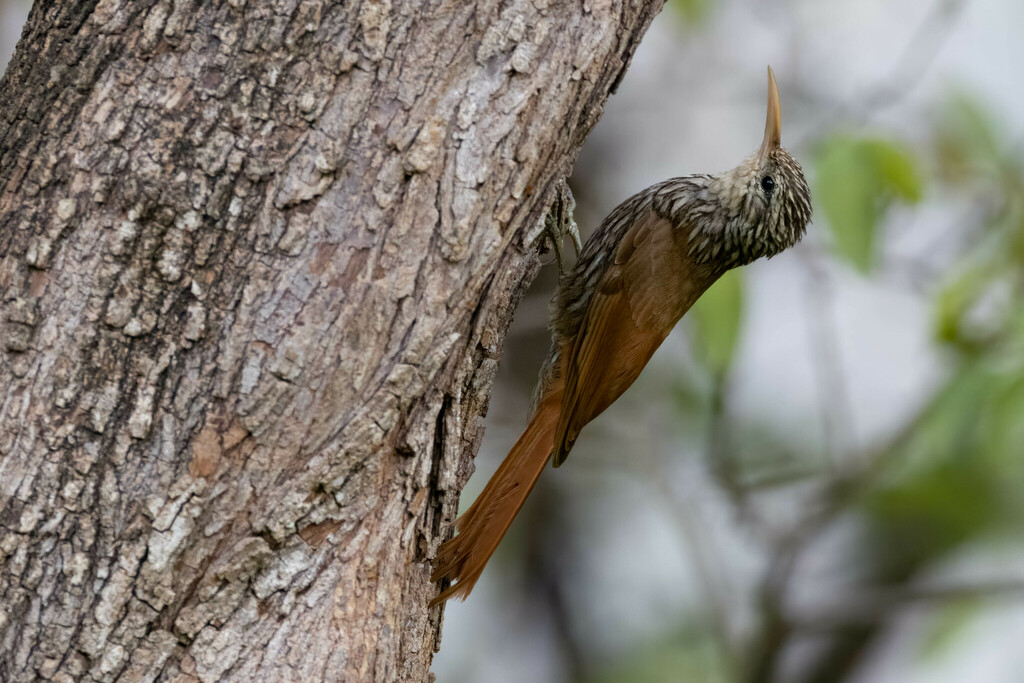
Streak-headed Woodcreeper
Photo © Ryan F. Mandelbaum
Photo © Ryan F. Mandelbaum — CC BY 4.0 — Source: iNaturalist photo #323098300Identification
The Streak-headed Woodcreeper is a slim, medium-sized woodcreeper measuring 19-21 cm in length and weighing 23-31 g. Its most distinctive feature is its finely streaked head: bold whitish-buff streaks on a dark brown crown and nape often extend onto the upper back, framed by a whitish-buff supercilium and eyering. The face itself shows thinner whitish-buff and dark brown streaks, with heavier streaking on the sides of the neck. The body is rufous-olive to cinnamon-brown above, with cinnamon-rufous to rufous-chestnut flight feathers, rump, and tail. Below, grayish-olive to buffy-brown underparts are marked with black-edged whitish-buff streaks—wide on the breast and sides, narrower on the belly and flanks. The bird has a longish, slender, decurved bill (pale brown or horn-coloured with a bluish-pink mandible), pale brown iris, and grayish olive-green legs. Sexes are identical in plumage; juveniles show dusky spots rather than streaks on the underparts.
Seven subspecies occur across the range, differing subtly in streak width, rufous intensity, and overall coloration. These variations reflect the bird's broad geographic distribution from Mexico through Central America and into South America.
Range & Habitat
The Streak-headed Woodcreeper is distributed from Mexico's Sierra Madre del Sur south through Central America, into Colombia, Venezuela, Ecuador, Peru, Guyana, and Brazil, with populations also on Trinidad. It is a year-round resident throughout its range. The species tolerates a variety of wooded landscapes, preferring semi-open to open habitats including deciduous and semi-humid forest, gallery forest, secondary growth, plantations, forest edges, and open areas with scattered trees. It also occurs locally in mangrove and arid scrublands. Elevation varies by region: up to 1,500 m in Mexico, 1,850 m in northern Central America, and 1,600 m in Venezuela; in Ecuador, it mostly stays below 800 m but occasionally reaches 1,800 m in Loja Province.
Behaviour & Diet
This woodcreeper forages mostly singly or in pairs, moving through all levels of the forest by hitching up trunks and branches in typical woodcreeper fashion. It does not join mixed-species feeding flocks. Its diet consists primarily of non-flying arthropods obtained by flaking bark and probing into crevices and moss clumps; crabs and small fruits are minor dietary components. The bird is generally solitary outside the breeding season but forms pairs to breed. Breeding season timing varies geographically: June-July in Mexico, April-October in Colombia. Nests are typically placed in tree cavities—either natural or woodpecker-excavated—3-25 m above the ground, padded with wood chips and bark pieces; nest boxes are occasionally used. Clutch size is two eggs, with an incubation period of about 15 days; both parents incubate and provision nestlings.
Best Time & Places to See It
The Streak-headed Woodcreeper is a common resident throughout most of its range and can be found year-round. Look for it in open and semi-open woodlands, along forest edges, in plantations, and in secondary growth at appropriate elevations for your region. During the breeding season, listening for its distinctive song will help locate pairs. Since it forages singly or in pairs at all forest levels, scan trunks and branches carefully; it is most active during early morning hours. Coastal regions, lowland forests, and foothill zones offer the best opportunities depending on subspecies and locality.
Photography Tips
Patience and early-morning visits are essential for photographing this active forager. Position yourself along forest edges or in semi-open woodlands where the bird is most visible against the sky or lighter backgrounds. The streaked head and underparts offer fine detail worth capturing; use a telephoto lens (400-600 mm) to frame the bird as it hitches along trunks and branches. The contrast between the rufous-chestnut flight feathers and back plumage is most striking when the bird stretches or flies between feeding sites. Backlighting can enhance the pale throat and underpart streaks. Recording its descending trill will help confirm the species and may attract responsive individuals for closer views.
Arenal Volcano National Park
Barbilla National Park
Barra del Colorado National Wildlife Refuge
Baru Volcano National Park
Braulio Carrillo National Park
Cahuita National Park
Caño Negro National Wildlife Refuge
Carara National Park
Cerros de Amotape National Park
Nothing matches these filters.
No community photos yet. Log in to add the first one.
No community observations of this species yet.