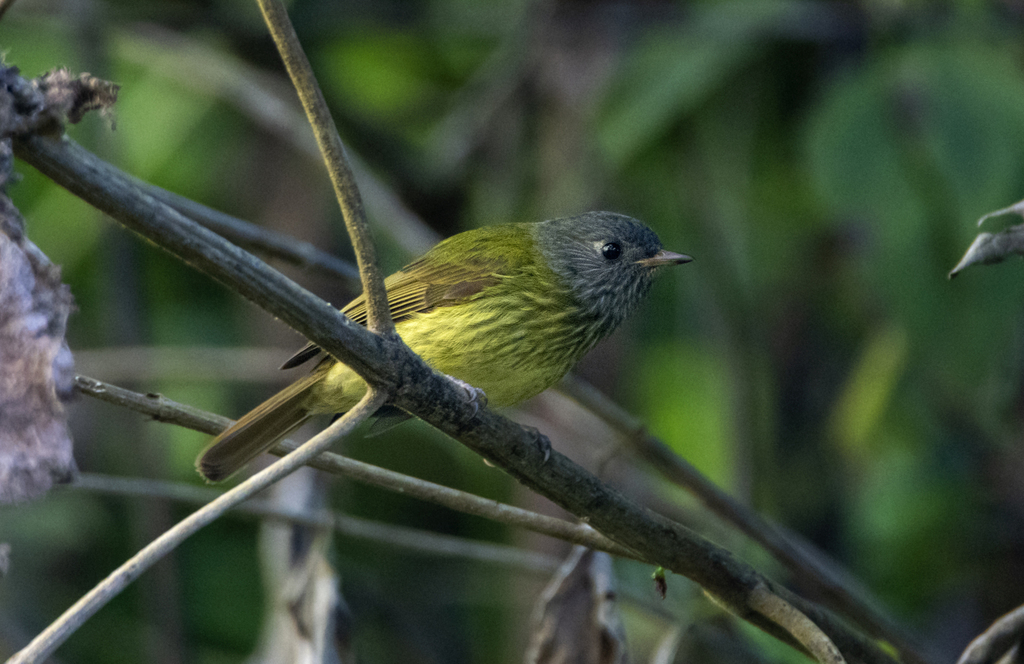
Streak-necked Flycatcher
Photo © David F. Belmonte
Photo © David F. Belmonte — CC BY 4.0 — Source: iNaturalist photo #216487408Identification
The streak-necked flycatcher is a small tyrant flycatcher, measuring 13 to 13.5 cm long and weighing 13 to 17 g. Males and females share identical plumage. The nominate subspecies displays a distinctive dark gray face with white streaks and a small white spot behind the eye, paired with a slaty-gray crown and nape. The upperparts are dark olive, while the wings and tail are olive with sometimes faint buffish olive wing bars. The throat and upper breast are slate-gray with white streaks, the lower breast and flanks are streaked with dark olive and yellow, and the belly is bright yellow. All subspecies share a dark brown iris, a long dark brownish-gray bill with a pinkish base to the mandible, and dark gray legs and feet. Other subspecies show subtle variations in crown and face coloration, but all retain the characteristic white streaking on the throat and upper breast.
Range & Habitat
This species is found across the Andes of Colombia, Ecuador, Peru, and Bolivia, with four recognized subspecies occupying different regions along the eastern and western Andean slopes. The streak-necked flycatcher inhabits humid montane forest in the upper tropical and lower temperate zones, typically between 1,500 and 2,700 m elevation, though it ranges as low as 500 m on Peru's east slope and as high as 3,300 m. It favors forest edges and secondary forest, remaining a year-round resident throughout its range.
Behaviour & Diet
This is an insectivorous species that also supplements its diet with small fruits. The streak-necked flycatcher forages deliberately from the understory to the sub-canopy, typically perching upright on a branch before making short sallies to hover-glean prey from leaves and twigs. It occasionally takes flying insects on the wing and usually forages singly, though it sometimes joins mixed-species feeding flocks. Breeding season varies geographically: January to April in Colombia and September to December in southern Peru. Males display at leks with synchronized head-swinging and singing; females build distinctive hanging bag nests made of plant fibers and moss, typically suspending them 0.8 to 3 m above ground near watercourses. Clutches contain two or three eggs, with an incubation period of about 19 days and fledging occurring roughly 18 days after hatching.
Best Time & Places to See It
The streak-necked flycatcher is widespread throughout its range and considered common in Colombia and fairly common but inconspicuous in Ecuador and Peru. It occurs in protected areas across its entire distribution, making it accessible to dedicated birdwatchers. Look for it year-round in humid montane forests along both Andean slopes. The species' inconspicuous habits and preference for understory vegetation make it easier to locate by listening for its squeaky vocalizations, which are performed almost exclusively at breeding leks during the appropriate season for your region.
Photography Tips
Photographing the streak-necked flycatcher presents moderate challenges due to its small size and preference for shaded forest understory habitats. Position yourself near watercourses where nesting birds are often found, as these locations increase encounter probability. The subtle but distinctive white streaking on the face and throat provides good identification markers to focus on in images. Early morning light during the breeding season may reveal displaying males at leks, offering opportunities to capture their characteristic synchronized head-swinging behavior. A telephoto lens is essential for capturing detail from a distance without disturbing this year-round forest resident.
Antisana National Park
Bahuaja Sonene National Park
Cordillera Azul National Park
Cotopaxi National Park
Guácharos Cave National Natural Park
Llanganates National Park
Manu National Park
Natural Chingaza National Park
Natural Farallones de Cali National Park
Nothing matches these filters.
No community photos yet. Log in to add the first one.
No community observations of this species yet.