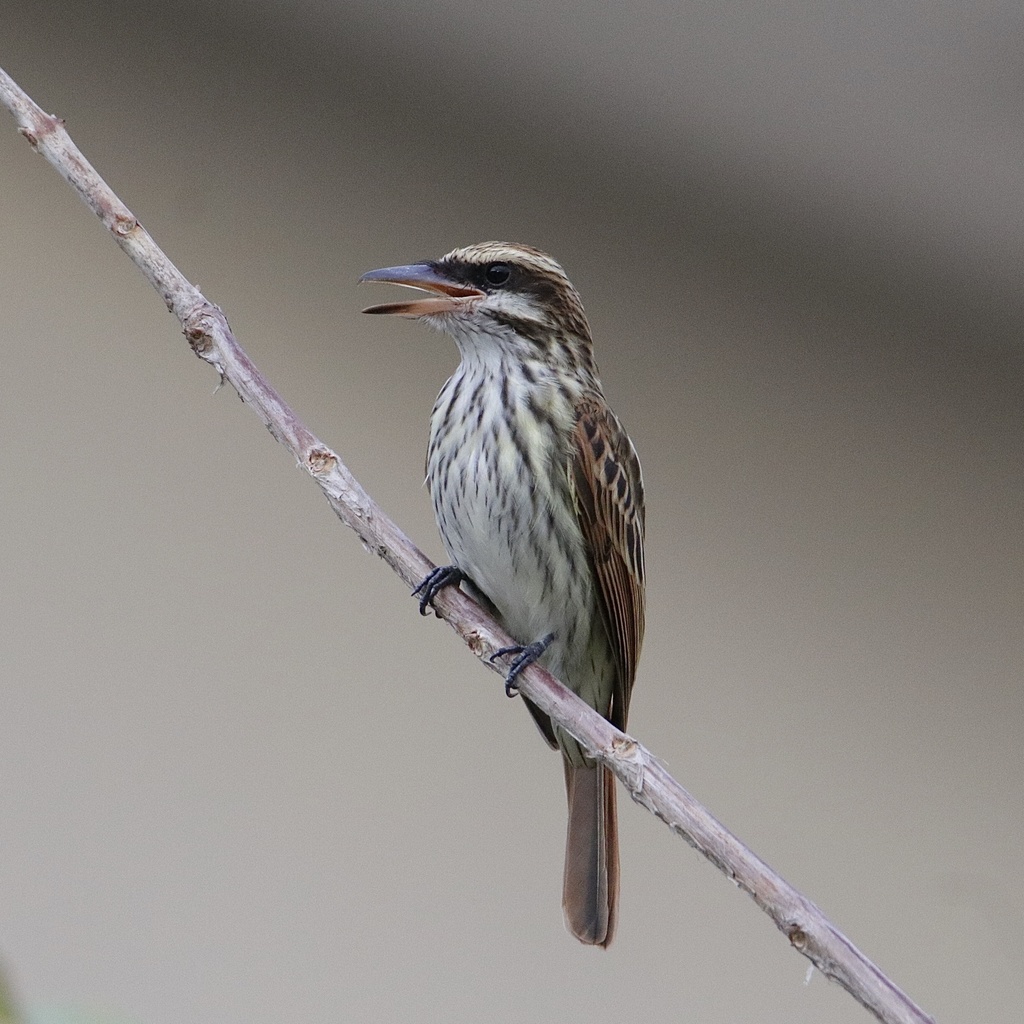
Streaked Flycatcher
Photo © Aitor
Photo © Aitor — CC BY 4.0 — Source: iNaturalist #38147069Identification
The Streaked Flycatcher is a medium-sized tyrant flycatcher measuring 20.5 to 23 cm in length. Adults display distinctive field marks: a partially hidden bright yellow to orange-yellow crown patch, a dark "mask" formed by black lores and ear coverts, and a white streak below the mask. The upperparts are grayish-brown to olive with dusky streaks, while the lower rump and uppertail coverts are cinnamon-rufous with black streaks. Wings and tail are mostly cinnamon-rufous with dusky shafts. The underparts are white with yellowish flanks, a streaked throat, and heavily streaked breast and flanks. All subspecies share a brown to dark brown iris, black bill with pinkish mandible base, and gray to black legs. Juveniles lack the distinctive crown patch and show more rufous on tail feathers. Seven subspecies occur across the range, showing subtle variations in overall coloration, streaking intensity, and the prominence of the supercilium.
Range & habitat
The Streaked Flycatcher ranges from southern Mexico through Central America and across every mainland South American country, with populations occurring in Trinidad and Tobago. The species inhabits the canopy and forest edges of tropical and lower subtropical zones, including evergreen and deciduous forests, gallery forest, várzea forest, and mangroves. In Mexico and Central America, it occurs from sea level to 1,750 m, mostly below 1,500 m in northern Central America and 1,200 m in Costa Rica. Colombian and Venezuelan populations range from sea level to 2,000 m, Brazilian birds to 1,500 m, and Ecuadorian populations to 1,000 m. The species is only a vagrant to Chile and has been recorded on Bonaire.
Behaviour & diet
As a member of the tyrant flycatcher family, the Streaked Flycatcher is an aerial insectivore, catching prey in flight from the forest canopy and edges. The species frequents forested areas with clearings that contain tall trees, suggesting it forages in open understory spaces within otherwise dense vegetation. The bird's streaked plumage and preference for canopy levels make it well-adapted to hunting in dappled light among leafy branches.
Best time & places to see it
The Streaked Flycatcher is widely distributed across tropical America, making it accessible in numerous locations. Look for it in the canopy of lowland and foothill forests throughout Central and South America, particularly in areas with mixed forest and clearings. In Mexico and Central America, explore coastal lowlands and foothills up to moderate elevations. In South America, the species is present in the Amazon basin, northwestern regions, and Atlantic forest zones. Observing this canopy-dwelling flycatcher requires patience and binoculars, as birds typically remain in the upper story where they forage for insects.
Photography tips
Photographing the Streaked Flycatcher presents the challenges inherent to canopy birds: often backlit, relatively small, and active. Use a longer telephoto lens (at least 400 mm) to capture detail from a distance. Early morning light often provides better conditions for canopy subjects. The bird's yellow crown patch and streaked plumage offer distinctive field marks to capture, though the crown patch is often hidden when the bird is perched. Patience and tracking the bird's flight paths will increase opportunities for sharp shots. The contrast between the dark mask and pale supercilium provides good compositional elements when the bird is side-lit.
Amacayacu National Park
Amazônia National Park
Anavilhanas National Park
Araucárias National Park
Arenal Volcano National Park
Bahuaja Sonene National Park
Baritú National Park
Barra del Colorado National Wildlife Refuge
Baru Volcano National Park
Nothing matches these filters.
No community photos yet. Log in to add the first one.
No community observations of this species yet.