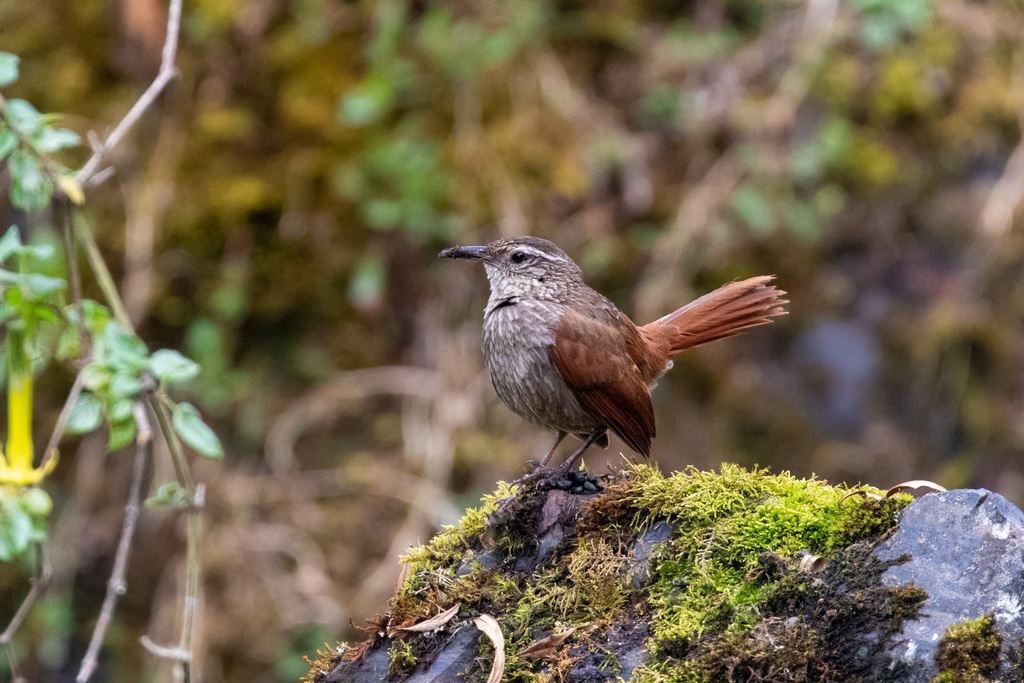
Striated Earthcreeper
Photo © Thibaud Aronson
Photo © Thibaud Aronson — CC BY-SA 4.0 — Source: iNaturalist #66067530Identification
The Striated Earthcreeper is a large earthcreeper measuring 18 to 20.5 cm in length and weighing 41 to 52 g. It features a long, slightly decurved bill and sexes are alike in plumage. Adults of the nominate subspecies display a whitish buff supercilium, a dusky brown crown with narrow whitish buff streaks on the forehead, and dark brown sides to the neck and back with thin whitish buff streaking. The rump is dark rufous brown, and the tail dull rufous, with wings rufous in colour. The throat is dirty white with dusky scaling, while the breast and belly are dull gray-brown or olive-brown with whitish buff streaks. The iris is dark brown, the bill black or horn-coloured, and the legs and feet gray or brown. Juveniles show a scaled appearance on the breast and faint barring on the upper belly. The southern subspecies, G. s. huancavelicae, exhibits much darker upperparts and darker, grayer underparts with little warm brown colouration.
Range & Habitat
The Striated Earthcreeper is endemic to Peru, with two subspecies occupying different regions. The nominate subspecies ranges through the Andes of northern and central Peru from Cajamarca south to Lima and Junín departments, while G. s. huancavelicae is restricted to the southern Peruvian Andes in Huancavelica department. Unlike most earthcreepers, this species favours areas of denser woody vegetation, occurring primarily in arid montane scrublands, on rocky slopes with bushes, and notably in Polylepis woodlands. Elevations typically range between 3,000 and 4,600 m, though it occurs locally at lower altitudes.
Behaviour & Diet
The Striated Earthcreeper is a year-round resident throughout its range. It typically forages singly or in pairs, spending most of its time on the ground where it probes, gleans, and flicks aside leaf litter in search of arthropods, which form the major component of its diet. In Polylepis woodlands, it also probes bark crevices for prey. Breeding appears to span at least October to January. The known nest description places one specimen in a burrow in a pebbly earth bank, though the species has also nested in adobe walls. The species produces two distinct vocalisations: a song described as a harsh slowing trill introduced by three notes lasting approximately four seconds, and a call noted as a single, drawn-out, somewhat wheezy sound.
Best Time & Places to See It
The Striated Earthcreeper can be found year-round throughout its Peruvian range. To locate this species, focus on arid montane scrublands and rocky slopes between 3,000 and 4,600 metres elevation in the central and northern Andes. Polylepis woodlands are particularly productive habitat. The bird's preference for denser woody vegetation than other earthcreepers makes it somewhat easier to find in suitable habitat, though patient observation will be rewarded as it forages methodically on the ground.
Photography Tips
The Striated Earthcreeper's ground-foraging behaviour offers opportunities for low-angle photography that captures the rugged montane terrain. Early morning light works well in high-altitude scrubland environments. The species' subtle plumage of buffs, browns, and greys requires careful exposure metering to retain detail in both highlights and shadows. Its habit of working singly or in pairs means you need only track one or two individuals. Use a telephoto lens to avoid disturbing birds during foraging, and position yourself to photograph against natural backdrops of rocky slopes or sparse vegetation rather than sky.
No community photos yet. Log in to add the first one.
No community observations of this species yet.