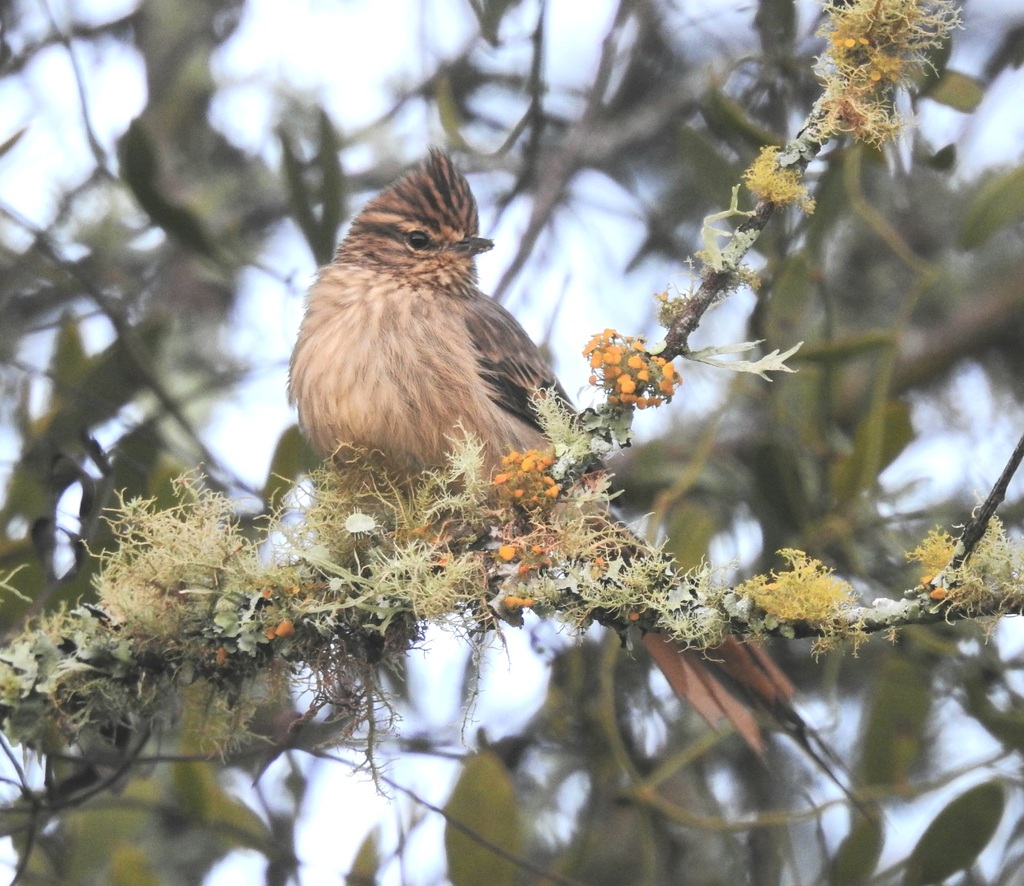
Striolated Tit-Spinetail
Photo © Marcelo Schmidt Roberti
Photo © Marcelo Schmidt Roberti — CC BY 4.0 — Source: iNaturalist #274923775The striolated tit-spinetail (Leptasthenura striolata) is a species of bird in the Furnariinae subfamily of the ovenbird family Furnariidae. It is endemic to Brazil. == Taxonomy and systematics == The striolated tit-spinetail is monotypic. It is locally called grimpeirinho. == Description == The striolated tit-spinetail is 15 to 16 cm (5.9 to 6.3 in) long and weighs 10 to 11 g (0.35 to 0.39 oz). It is a small, long-tailed furnariid with a short bill. The sexes have the same plumage. Adults have a buff-whitish supercilium on an otherwise grayish face. Their crown is black with buff streaks and their upperparts brown with obvious buff streaks on the back. Their wings are dark brown with paler feather edges. Their tail is mostly brown with some rufous on the outermost feathers; the tail is graduated and appears forked due to the central feather's having reduced inner webs. Their underparts are dull pale ochraceous with brownish speckles on the throat and upper breast. Their iris is dark brown, their bill black with a pinkish gray base to the mandible, and their legs and feet greenish. Juveniles have less distinct streaking and a shorter, less deeply forked, tail than adults. == Distribution and…
São Joaquim National Park
Brazil
+222 birds+9 mammals
Where the southern Brazilian highlands rise above the Atlantic Forest, São Joaquim National Park protects nearly 1,000 square kilometers of montane terrain that shifts between temperate…
VIEW NATIONAL PARKAraucárias National Park
Brazil
+231 birds+3 mammals
Where the southern Brazilian highlands rise into cool temperate forest, Araucárias National Park protects one of the Atlantic Forest's most distinctive ecosystems across 506 square kilometres…
VIEW NATIONAL PARKSerra Geral National Park
Brazil
+211 birds+2 mammals
Where basalt cliffs and sandstone escarpments rise above the subtropical forests of southern Brazil, Serra Geral National Park preserves one of the Atlantic region's most dramatic…
VIEW NATIONAL PARKNo community photos yet. Log in to add the first one.
No community observations of this species yet.