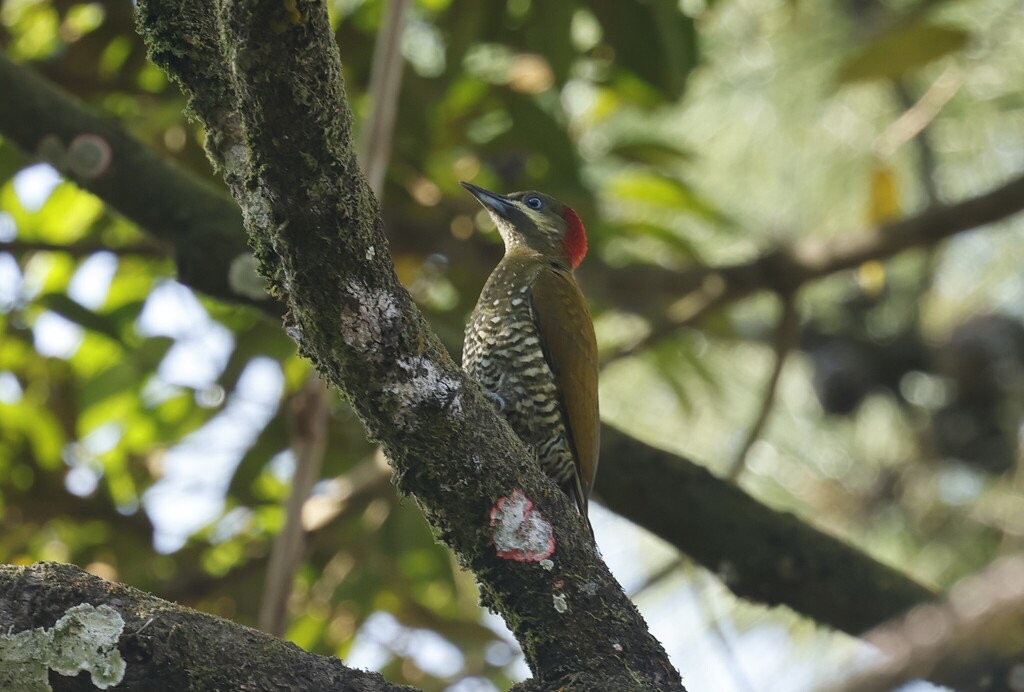
Stripe-cheeked Woodpecker
Photo © Don Wellmann
Photo © Don Wellmann — CC0 1.0 — Source: iNaturalist photo #618223980Identification
The stripe-cheeked woodpecker is a compact woodpecker, measuring about 17 cm (6.7 inches) in length. Both sexes share most plumage characteristics, though males display distinctive head markings: bright red colouring extending from the forehead to the hindneck and across much of the malar region (cheek), with a buffy-white stripe above. Females show red only from the rear crown to the hindneck. The rest of the face is olive in both sexes. The bird's upperparts are bronze-green, while flight feathers display mostly cinnamon-rufous plumage with dark brown barring. The tail is blackish with some cinnamon-rufous on outer feathers. The throat and upper breast are greenish-olive with yellowish spotting, and the remaining underparts are buffy-white with greenish-olive barring. The relatively short, blackish bill has a paler mandible, the iris is sky-blue to pale gray, and the legs are olive-gray. Juveniles appear duller overall, with mottled throat and breast markings and uneven underpart barring.
Range & Habitat
The stripe-cheeked woodpecker is endemic to Panama, found from Veraguas Province in west-central Panama eastward to Darién Province, with most records from the Caribbean side of the country. Though sightings have occurred very near the Colombian border, this species has no confirmed records from Colombia. It inhabits the interior and edges of humid forest, preferring elevations between 300 and 900 metres (1,000–3,000 feet). The species is considered a year-round resident throughout its range.
Behaviour & Diet
The stripe-cheeked woodpecker typically forages alone or in pairs and frequently joins mixed-species feeding flocks. It searches for food at lower to mid-forest levels, employing a pecking technique to extract prey from the substrate. While details of its diet remain incomplete, ants are confirmed food items. The species' breeding season includes at least April and May, though full seasonal details are unknown. The few discovered nest cavities have been located in dead trees approximately 3.4–6 metres (10–20 feet) above ground. Further breeding details—including clutch size, incubation period, fledging time, and parental care—remain undocumented.
Best Time & Places to See It
Given that the stripe-cheeked woodpecker is uncommon and local, patience and knowledge of prime habitat are essential. The bird is found throughout the humid forest interior and forest edges of Veraguas and Darién Provinces. Elevation between 300–900 metres (1,000–3,000 feet) is optimal. April and May may offer increased activity during breeding season. As a year-round resident, the species can theoretically be seen in any season, but sightings remain challenging due to its restricted range and low population density.
Photography Tips
Photographing this elusive woodpecker requires patience and attention to its vocalizations—its primary call is a nasal bi-syllabic "nyeeeh-wheet" that may aid location. The bird's preference for lower to mid-canopy levels makes it more accessible than canopy specialists, though it remains difficult to spot in dense forest. Listen for scolding notes or fast chattering series, which may indicate excitement or breeding activity. Early morning foraging sessions at lower forest levels offer the best opportunities. The bird's distinctive facial markings and colourful plumage reward persistence with striking photographic subjects.
Chagres National Park
Caimitillo, Panama
+486 birds+19 mammals
Where the Chagres River carves through the humid tropics of central Panama, a vast montane and lowland forest sprawls across more than 2,300 square kilometers, anchoring…
VIEW NATIONAL PARKDarién National Park
Tucutí, Panama
+534 birds+13 mammals
Where the spine of Central America crumbles into wetland and rainforest, Darién National Park sprawls across more than 20,000 square kilometres of some of the tropics'…
VIEW NATIONAL PARKPortobelo National Park
Portobelo, Panama
+366 birds+9 mammals
Where the Caribbean's turquoise waters meet the Darién's verdant shore, Portobelo National Park sprawls across 570 square kilometers of coastal forest, mangrove wetland, and coral-fringed islands…
VIEW NATIONAL PARKNo community photos yet. Log in to add the first one.
No community observations of this species yet.