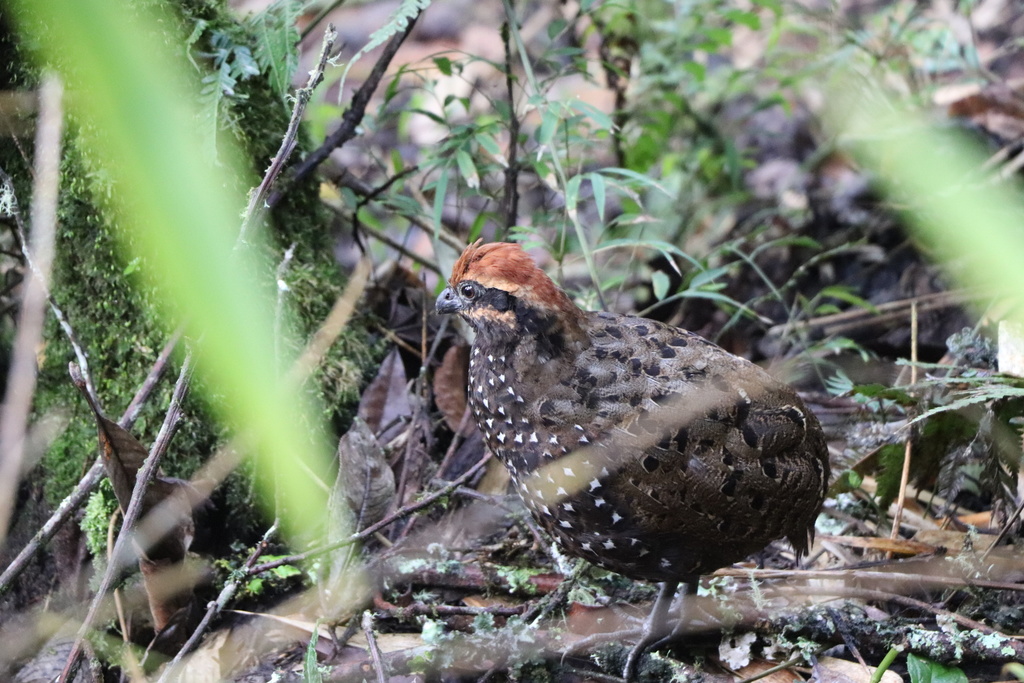
Stripe-faced Wood Quail
Photo © Robert Sorenson
Photo © Robert Sorenson — CC BY 4.0 — Source: iNaturalist #34989691Identification
The stripe-faced wood quail is a compact quail, measuring 26 to 28 cm in length, with males weighing approximately 311 g and females slightly heavier at 324 g. The most distinctive feature is the male's striking facial pattern: a brown face with a prominent patch of bare red skin encircling the eye, underlined by a bold black stripe. The crown and crest are rich chestnut with a buff border, while the back and rump display brown plumage with fine black vermiculation. The throat is buff with white streaks, and the breast and belly are brown with characteristic white diamond-shaped spots. Females are similar in structure but noticeably paler brown above and more rufous below, making them somewhat less dramatically marked than their male counterparts.
Range & Habitat
This species is endemic to the eastern slope of the Andes, occurring in southeastern Peru's Cuzco and Puno Provinces and western Bolivia's La Paz and Cochabamba Departments. It is a bird of the montane forest zone, typically found between 1,000 and 3,300 metres elevation, though occasionally descending to 800 metres in Peru. The stripe-faced wood quail favours subtropical montane forests characterized by dense tree ferns, bamboos, and epiphytes, inhabiting both primary and young secondary forest as well as stunted cloudforest. The species also ventures into adjacent clearings, wet meadows, and gulleys where suitable forest structure persists.
Behaviour & Diet
Very little has been documented about the daily habits of this elusive species. Its foraging behaviour and diet remain virtually unknown to science, presenting an opportunity for dedicated field observers. The stripe-faced wood quail is vocal, however, particularly during the breeding season. Both males and females produce an advertising call described as a rapidly repeated "whydlyi-i, whydlyi-i" phrase, and the species has been noted singing regularly during May in Bolivia. When alarmed, the birds utter a harsh rattling call, and they also produce softer chirps that appear to serve as contact calls between individuals.
Best Time & Places to See It
May is the most promising month for encountering this species, as singing activity peaks during this period in Bolivia. The stripe-faced wood quail inhabits the montane forests of the Peruvian and Bolivian Andes, particularly in the regions of Cuzco, Puno, La Paz, and Cochabamba. Birdwatchers should focus on cloudforest and montane forest at elevations between 1,000 and 3,300 metres, paying particular attention to areas with dense understory vegetation, bamboo thickets, and fern-rich sections where the species prefers to forage and shelter.
Photography Tips
The stripe-faced wood quail's cryptic forest habitat and ground-dwelling nature make photography challenging. Early morning visits to suitable forest during May offer the best chance of locating birds through their distinctive vocalizations. A telephoto lens is essential, as the species will typically remain at distance in dense vegetation. The male's striking facial markings and chestnut crest are the primary photographic subjects, so patience and positioning to capture good light on the face are crucial. Given how little is known about this species' behaviour, any successful documentation contributes valuable information to our understanding of Andean montane forest birds.
Yanachaga–chemillén National Park
Palcazu, Peru
+639 birds+6 mammals
Where the eastern slopes of Peru's central cordillera plunge into cloud forest, Yanachaga–Chemillén National Park protects nearly three thousand square kilometres of montane wilderness that few…
VIEW NATIONAL PARKManu National Park
Manu, Peru
+892 birds+26 mammals
Across the eastern slopes of the Peruvian Andes, tropical rainforest descends into the Amazon basin with a complexity that few terrestrial ecosystems match. Manu National Park…
VIEW NATIONAL PARKNo community photos yet. Log in to add the first one.
No community observations of this species yet.