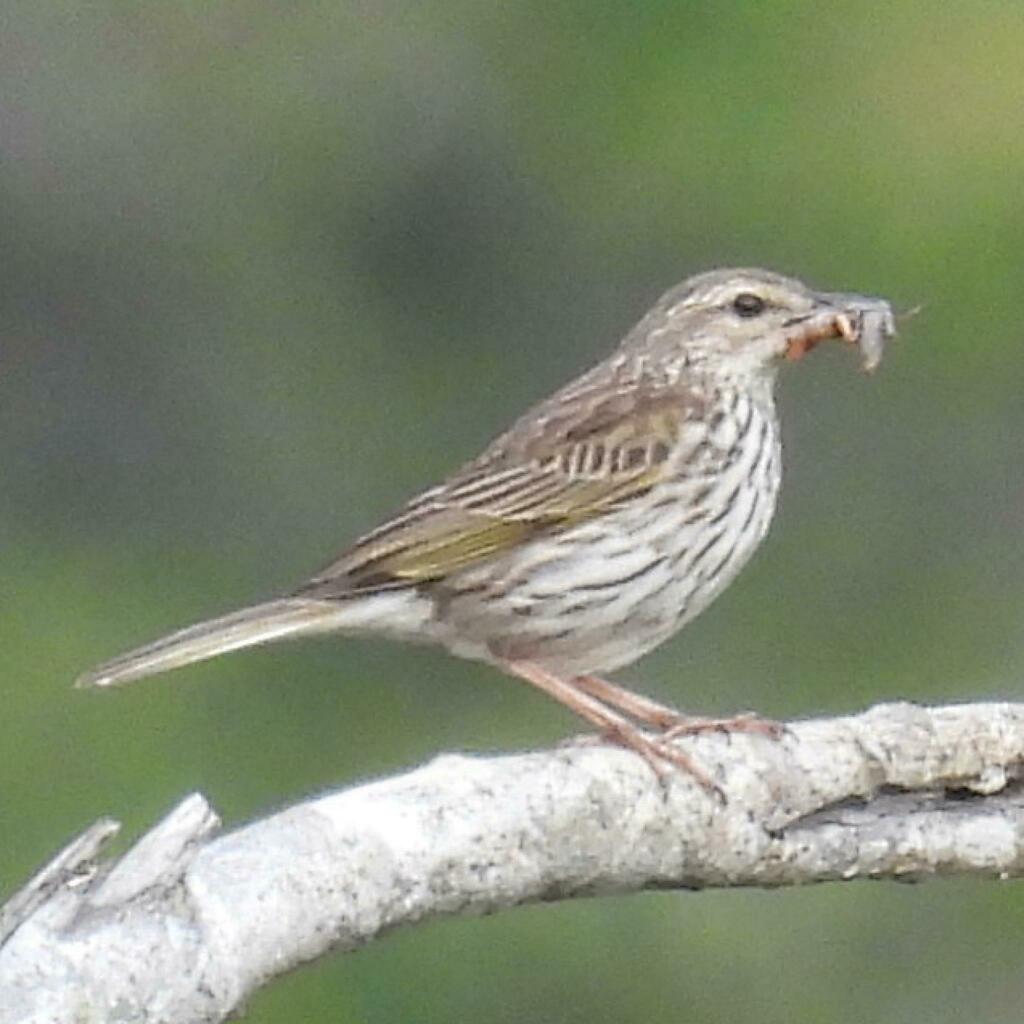
Striped Pipit
Photo © Henry de Lange
Photo © Henry de Lange — CC BY 4.0 — Source: iNaturalist #259518340The striped pipit (Anthus lineiventris) is a species of bird in the family Motacillidae, which is native to Africa southwards of the equator. == Range and habitat == It is found in Angola, Botswana, Burundi, DRC, Eswatini, Kenya, Malawi, Mozambique, Rwanda, South Africa, Tanzania, Zambia, and Zimbabwe. Its natural habitat is rocky areas in dry to mesic savanna. == Taxonomy and systematics == The striped pipit forms a species complex with the African rock pipit. === Subspecies === There are two subspecies: A. l. stygium Clancey, 1952 – Angola, Kenya, DRC, Zambia, Botswana, Zimbabwe, Mozambique, South Africa A. l. lineiventris Sundevall, 1851 – Botswana, South Africa and Eswatini == Description == It is a large pipit, ranging from 17 to 18 centimeters in length and weighing 31-37 grams. The wing coverts have yellow-green edges, and the underparts are olive brown with dark brown streaking. === Voice === A loud, penetrating, thrush-like song, uttered from a rock or perch. == Diet == It feeds on insects and other arthropods, particularly grasshoppers.
Mapungubwe National Park
Musina Local Municipality, South Africa
+358 birds+29 mammals
Where the Limpopo River cuts through sandstone ridges at the convergence of South Africa, Botswana, and Zimbabwe, Mapungubwe National Park preserves a landscape of profound ecological…
VIEW NATIONAL PARKLake Mburo National Park
Uganda
+505 birds+24 mammals
Rolling acacia woodland and scattered lakes define this intimate savanna preserve in southwestern Uganda, where the rift valley's geological drama shapes every water source and grassland.…
VIEW NATIONAL PARKTsavo West National Park
Mwatate, Kenya
+513 birds+49 mammals
Where volcanic ridges and weathered lava flows meet the semi-arid lowlands of south-central Kenya, Tsavo West National Park unfolds across a landscape sculpted by fire and…
VIEW NATIONAL PARKTarangire National Park
Tanzania
+527 birds+50 mammals
Acacia woodland and grassland sweep across the Manyara Region where the Tarangire River carves through low hills and volcanic soils, creating one of East Africa's most…
VIEW NATIONAL PARKNgorongoro Conservation Area
Tanzania
+626 birds+55 mammals
Volcanic calderas and open grassland dominate this high plateau in northern Tanzania, where the landscape rises above 2,000 metres and ancient geological forces have shaped both…
VIEW WILDLIFE MANAGEMENT AREAPilanesberg National Park
Moses Kotane Local Municipality, South Africa
+364 birds+49 mammals
Granite peaks and volcanic ridges rise unexpectedly from the savanna floor across this 734-square-kilometre expanse in the North West province, creating a landscape of profound ecological…
VIEW NATIONAL PARKKruger National Park
Ba-Phalaborwa Local Municipality, South Africa
+540 birds+91 mammals
Across the low-lying savanna of northeastern South Africa unfolds one of Africa's largest and most ecologically intact protected areas, where acacia woodlands merge into mopane scrub…
VIEW NATIONAL PARKAddo Elephant National Park
Sundays River Valley Local Municipality, South Africa
+388 birds+55 mammals
Where the Eastern Cape's semi-arid scrublands meet transitional woodland, Addo sprawls across 13,478 square kilometres of one of southern Africa's most biodiverse landscapes. The terrain rises…
VIEW NATIONAL PARKIthala Game Reserve
uPhongolo Local Municipality, South Africa
+328 birds+26 mammals
Rolling thornbush savanna and acacia woodland dominate the landscape of this 494-square-kilometre national park in KwaZulu-Natal's uPhongolo Local Municipality, where granite outcrops punctuate grassland plateaus and…
VIEW NATIONAL PARKMarakele National Park
Modimolle Local Municipality, South Africa
+341 birds+36 mammals
Granite ridges and sprawling grasslands dominate this 1,176-square-kilometre reserve in Limpopo's heartland, where bushveld transitions between rocky outcrops and open savanna. The park's rugged topography creates…
VIEW NATIONAL PARKNo community photos yet. Log in to add the first one.
No community observations of this species yet.