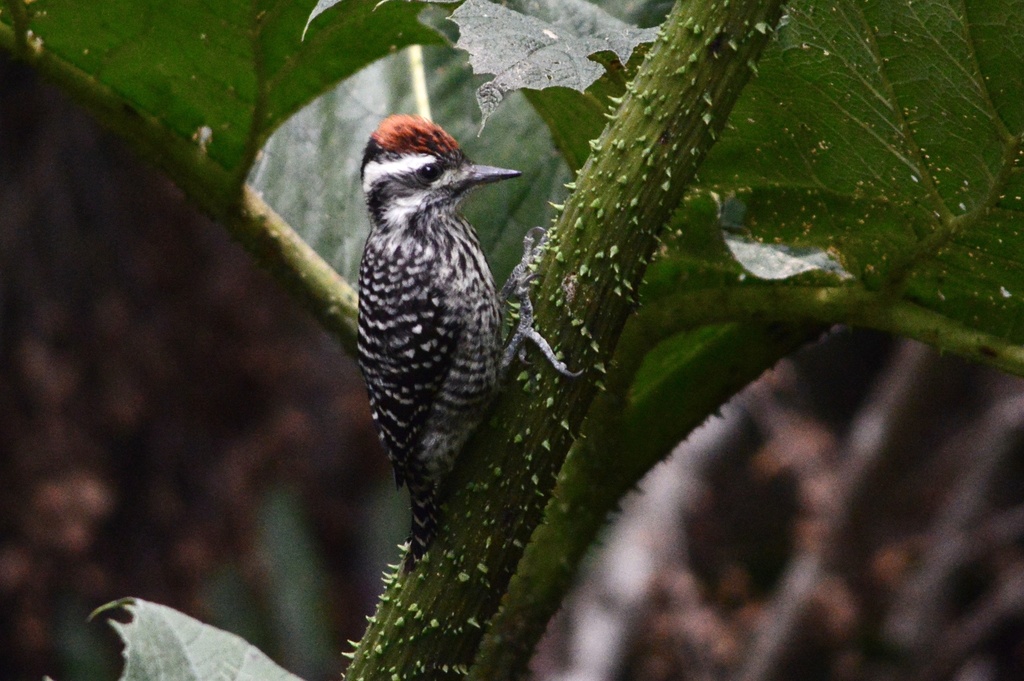
Striped Woodpecker
Photo © Duban Espinoza
Photo © Duban Espinoza — CC BY 4.0 — Source: iNaturalist photo #251536610Identification
The striped woodpecker is a small woodpecker, measuring 15 to 16 cm in length and weighing 35 to 39 grams. The most distinctive feature is its striking head pattern: both sexes display a black forehead and crown with a blackish stripe running back and down from the eye, combined with a black malar stripe and generally white face. Males are readily distinguished by a red to orange-red nape and some streaking or spotting on the crown, while females have an entirely black nape and typically a solid black crown, though juveniles of both sexes may show a small red patch.
The upperparts are brownish-black with white markings that vary geographically: northern populations show white scallops while southern birds display narrow white bars. Flight feathers are barred black and white, and the dark tail bears narrow white or buff-white bars. The white or buff-tinged underparts feature black streaks on the breast and belly, with black barring on the flanks and undertail coverts. Juveniles appear duller and browner overall, with irregular barring above and heavy streaking below.
Range & Habitat
The striped woodpecker is found in two disjunct populations across the southern Andes: one in west-central and southern Bolivia extending to extreme northern Argentina, and another in central and southern Chile and southwestern Argentina. Elevations range from 1,600 to 4,000 metres in Bolivia, up to 1,800 metres in Chile, and to 2,700 metres in Argentina.
This adaptable species inhabits a diverse range of semi-open to open forest environments. These include moist to humid forests dominated by Nothofagus or Podocarpus trees, Polylepis woodlands, and drier areas with cacti and scattered trees. In northern regions, it penetrates the interior of mature wet forest with watercourses, while throughout its range it readily uses lightly treed pastures, orchards, plantations, and gardens.
Behaviour & Diet
The striped woodpecker is a year-round resident throughout its range, though it undergoes some elevational shifts between seasons. It typically forages alone but occasionally joins mixed-species feeding flocks. The bird feeds primarily on adult and larval insects, employing a versatile foraging technique that includes gleaning and probing as well as pecking and hammering to access food below the substrate surface.
Breeding occurs between June and September in Bolivia and October to January in Chile and Argentina. Both sexes excavate nest cavities in trees or cacti, typically 2 to 12 metres above ground, and both parents provision the nestlings. Clutches contain three to five eggs. The species is vocal, producing a loud "peek" call and a trill used as a long-distance signal.
Best Time & Places to See It
The striped woodpecker's year-round residency makes it potentially observable throughout the year, though local elevational movements between seasons may affect sightings. The species occurs in several national parks in Chile and Argentina, making these protected areas promising destinations for encounter.
Look for this woodpecker in semi-open forest habitats, gardens, orchards, and lightly treed pastures across its Andean range. Its preference for gleaning and probing means it often forages on smaller branches and vegetation where it is more visible than woodpeckers that focus on large trunk hammering. The striking head pattern, particularly the distinctive facial striping, makes identification relatively straightforward once located.
Photography Tips
The striped woodpecker's small size and often solitary foraging behaviour demand patience and a telephoto lens. Focus on capturing the distinctive head pattern—the contrasting black and white facial markings and the sexually dimorphic nape colouration are key diagnostic features worth isolating in your frame.
This species' tendency to forage in open semi-woodland and gardens offers better photographic opportunities than many woodpeckers, with less obscuring foliage. Early morning and late afternoon light will enhance the subtle white barring on the upperparts and the contrast between the dark and light plumage. Keep in mind that the Bolivian population differs from southern populations in several ways, potentially offering regional variation for comparison photography.
Chiloé National Park
Dalcahue, Chile
+122 birds+6 mammals
Temperate rainforest cloaks the Chiloé archipelago's northwestern reaches, where granite ridges thrust through dense, moisture-laden canopy and freshwater streams carve ravines toward the Pacific. Across approximately…
VIEW NATIONAL PARKAlerce Costero National Park
Corral, Chile
+34 birds
Where temperate rainforest descends to the Pacific coast in southern Chile, Alerce Costero National Park protects one of the continent's rarest and most ancient ecosystems across…
VIEW NATIONAL PARKTorres del Paine National Park
Torres del Paine, Chile
+143 birds+10 mammals
Where granite spires pierce the Patagonian sky, Torres del Paine commands one of South America's most dramatic landscapes. Across 4,106 square kilometres of southern Chile, jagged…
VIEW NATIONAL PARKLaja National Park Lagoon
Antuco, Chile
+123 birds+1 mammals
Where the Andes descend into the Biobío Region's temperate forests, a vast lagoon fills the caldera of the extinct Antuco volcano, cradled by steep native woodland…
VIEW NATIONAL PARKPuyehue National Park
Puyehue, Chile
+110 birds+4 mammals
Across the volcanic spine of the Los Lagos Region, where the Andes descend toward temperate rainforest, Puyehue National Park encompasses nearly 2,600 square kilometers of one…
VIEW NATIONAL PARKVicente Pérez Rosales National Park
Puerto Varas, Chile
+109 birds+8 mammals
Where the Andes descend toward the temperate rainforests of Chile's Lake District, nearly 4,641 square kilometers of pristine wilderness unfolds across Vicente Pérez Rosales National Park.…
VIEW NATIONAL PARKCerro Castillo National Park
Coyhaique, Chile
+89 birds+3 mammals
Granite peaks and windswept steppe converge across this vast Patagonian landscape, where the Andes' eastern flank drops into terrain sculpted by ice age glaciers and relentless…
VIEW NATIONAL PARKPatagonia National Park
Cochrane, Chile
+133 birds+8 mammals
Where the Andes meet the Patagonian steppe, vast grasslands and shrublands sweep across rolling terrain carved by ancient glaciation, their contours softened by distance and dramatic…
VIEW NATIONAL PARKParque Provincial Península de Magallanes
Argentina
+125 birds+4 mammals
Granite peaks and windswept steppe converge across this 415-square-kilometre peninsula jutting into the cold Atlantic waters of southern Patagonia, where the Magallanes landscape embodies the raw,…
VIEW NATIONAL PARKParque Municipal Llao Llao
San Carlos de Bariloche, Argentina
+73 birds+1 mammals
Where the Andes meet the Patagonian lakes, granite peaks rise above temperate rainforest in a landscape of startling contrasts. Parque Municipal Llao Llao, sprawling across 23…
VIEW NATIONAL PARKLos Glaciares National Park
Argentina
+121 birds+3 mammals
Where granite peaks and sprawling ice fields dominate the landscape, Los Glaciares National Park encompasses over ten thousand square kilometres of Patagonian wilderness in southern Argentina.…
VIEW NATIONAL PARKPerito Moreno National Park
Argentina
+78 birds
Where the Patagonian steppe descends into a landscape carved by ancient ice, Perito Moreno National Park sprawls across nearly 1,590 square kilometres of some of South…
VIEW NATIONAL PARKNahuel Huapi National Park
Argentina
+124 birds+11 mammals
Where the Andes descend toward Patagonia, vast glacial lakes cut through a landscape of southern beech forest and granite peaks, creating one of South America's most…
VIEW NATIONAL PARKLanín National Park
Argentina
+128 birds+7 mammals
Where the volcanic spine of the Andes plunges into Patagonian steppe, Lanín National Park sprawls across nearly 4,700 square kilometers of one of Argentina's most visually…
VIEW NATIONAL PARKLago Puelo National Park
Argentina
+109 birds+1 mammals
Where temperate forests descend to crystalline waters in the foothills of the Andes, Lago Puelo National Park sprawls across nearly 300 square kilometers of pristine wilderness…
VIEW NATIONAL PARKNo community photos yet. Log in to add the first one.
No community observations of this species yet.