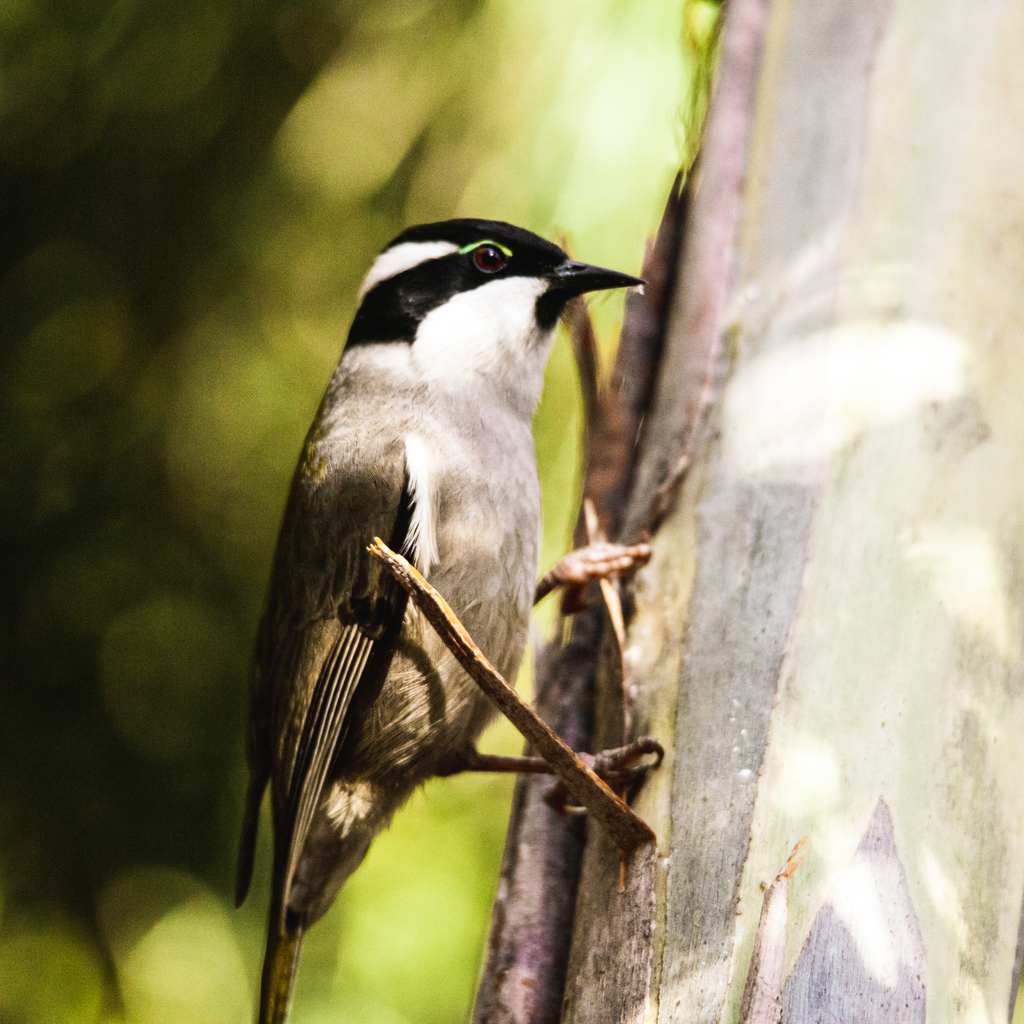
Strong-billed Honeyeater
Photo © Ink-Kawinwit Kittipalawattanapol
Photo © Ink-Kawinwit Kittipalawattanapol — CC0 1.0 — Source: iNaturalist #73000163The strong-billed honeyeater (Melithreptus validirostris) is a species of bird in the family Meliphagidae. It is one of two species of the genus Melithreptus endemic to Tasmania. Its natural habitat is temperate forest. == Taxonomy == The strong-billed honeyeater was first described by ornithologist John Gould in 1837. Its specific name is derived from the Latin words validus 'strong', and rostrum 'bill'. It is a member of the genus Melithreptus, with several species of similar size and (apart from the brown-headed honeyeater) black-headed appearance, in the honeyeater family, Meliphagidae. Molecular markers show that the strong-billed honeyeater separated from the common ancestor of the brown-headed and black-chinned honeyeaters between 6.7 and 3.4 million years ago. The next closest relative outside the genus is the much larger, but similarly marked, blue-faced honeyeater. More recently, DNA analysis has shown honeyeaters to be related to the Pardalotidae (pardalotes), Acanthizidae (Australian warblers, scrubwrens, thornbills, etc.), and the Maluridae (Australian fairy-wrens) in the large superfamily Meliphagoidea. == Description == A mid-sized honeyeater at 16.5–17.5 cm (6.5–7 in) in length, it is olive-brown above and pale grey-brown below, with a black head, nape and throat, a pale blue to off-white patch over the eye, and a white…
Cradle Mountain-Lake St Clair National Park
Australia
+72 birds+8 mammals
Where glacial valleys plunge between quartzite peaks, Tasmania's Cradle Mountain-Lake St Clair National Park unfolds as a temperate wilderness of uncommon grandeur. The park's terrain ranges…
VIEW NATIONAL PARKFreycinet National Park
Coles Bay, Australia
+115 birds+9 mammals
Granite peaks rise abruptly from the Tasmanian coast where Coles Bay opens into the Freycinet Peninsula, sculpting one of southeastern Australia's most dramatically vertical national parks.…
VIEW NATIONAL PARKNo community photos yet. Log in to add the first one.
No community observations of this species yet.