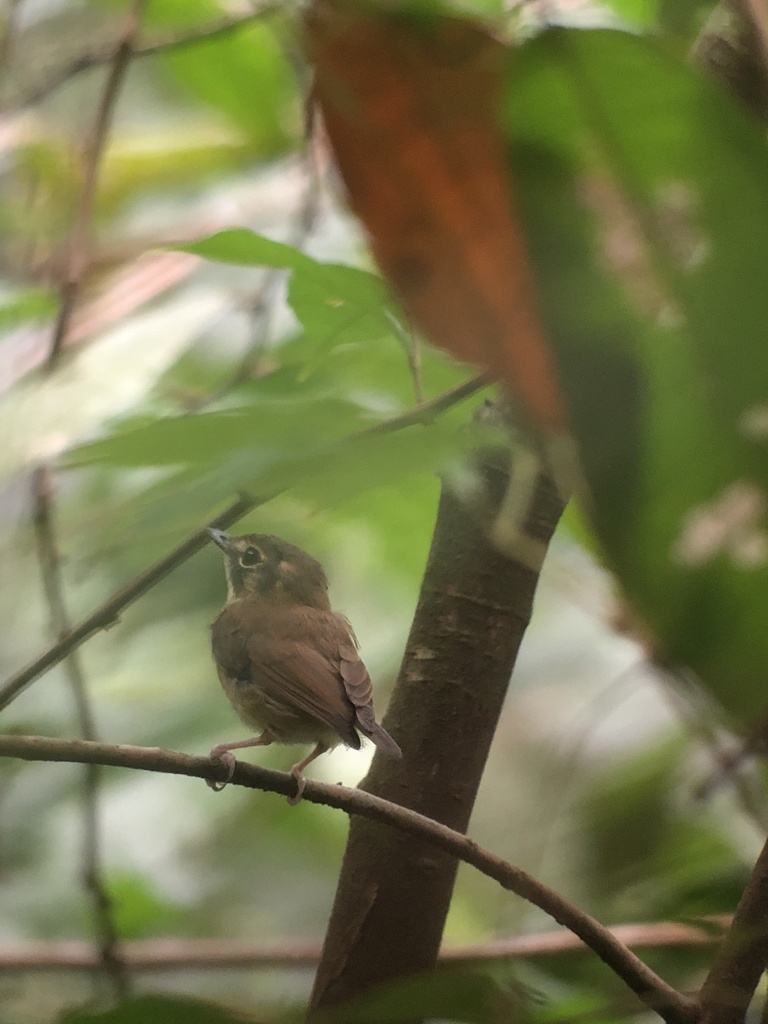
Stub-tailed Spadebill
Photo © Roger A. Morales-Flores
Photo © Roger A. Morales-Flores — CC BY 4.0 — Source: iNaturalist #133651589Identification
The stub-tailed spadebill is a tiny flycatcher, measuring up to 9.5 cm long and weighing no more than 12 grams. Its most distinctive features are its short, stubby tail and broad, flat bill—characteristic of the Platyrinchus genus. The plumage is predominantly brown on the head, mantle, and wings, contrasting with a white throat and yellow breast (particularly bright in males). Look for striking yellow postocular stripes framing the face and pinkish feet. A remarkable feature is the nearly complete absence of a crown, which distinguishes it from closely related species.
Despite its striking markings, this bird can be surprisingly difficult to spot in dense forest foliage. However, its distinctive nasal, rapid call—a shaky "ki-di-di-di-rrril"—often given after short flights, makes it far easier to locate by ear than by eye. This vocalization is one of the most reliable ways to identify the species in the field.
Range & Habitat
The stub-tailed spadebill is found throughout Central America, ranging from southern Mexico through Belize, Guatemala, Honduras, Nicaragua, and Costa Rica, with recent records from northwestern Panama. The species occupies tropical dry forests and tropical moist lowlands at elevations from sea level up to 1,500 meters, though it is most commonly encountered below 500 meters. It favors the undergrowth and lower strata of rainforests, particularly areas with dense shrubs, medium-height trees, and epiphytic growth that provide both foraging opportunities and shelter from predators.
Behaviour & Diet
The stub-tailed spadebill is primarily an insectivore, gleaning arthropods such as spiders, beetles, ants, and homopteran bugs from foliage in the forest understory. It supplements this diet with low-hanging berries and fruits found at its preferred foraging height. The species may be encountered singly or in pairs, and it frequently joins mixed-species foraging flocks with other forest birds—a behavior thought to provide protection from predation, though the precise advantages remain poorly understood.
Breeding pairs construct distinctive deep, cone-shaped nests from scavenged fibers. The species is categorized as of least concern by the IUCN, with an estimated population of 50,000 to 500,000 individuals, though populations show a declining trend due to deforestation and habitat fragmentation.
Best Time & Places to See It
The stub-tailed spadebill is a year-round resident throughout its range and can be encountered at any season. Search the undergrowth and lower canopy levels of humid tropical forests, particularly in areas with good structural complexity—dense vegetation, epiphytes, and fruiting shrubs. The species is most reliably located by listening for its distinctive call, which often betrays its presence before it can be seen. Early morning often provides the most active vocalization periods.
Photography Tips
Photographing this diminutive species presents real challenges. Its preference for shadowy undergrowth and tendency to skulk in dense foliage means that fast film speeds and image stabilization are essential. Position yourself to backlight the bird against gaps in the canopy to illuminate the yellow breast and postocular stripes. Patient stalking of calling birds offers the best chance of close approach. Use a fast shutter speed to freeze movement as the bird picks through vegetation, and focus on capturing the distinctive stubby tail and broad bill profile to secure a definitive identification image.
Carara National Park
Curú National Wildlife Refuge
Guanacaste National Park
Laguna del Tigre National Park
Lagunas de Montebello National Park
Montes Azules
Rincón de la Vieja National Park
Santa Rosa National Park
Sian Ka’an
Nothing matches these filters.
No community photos yet. Log in to add the first one.
No community observations of this species yet.