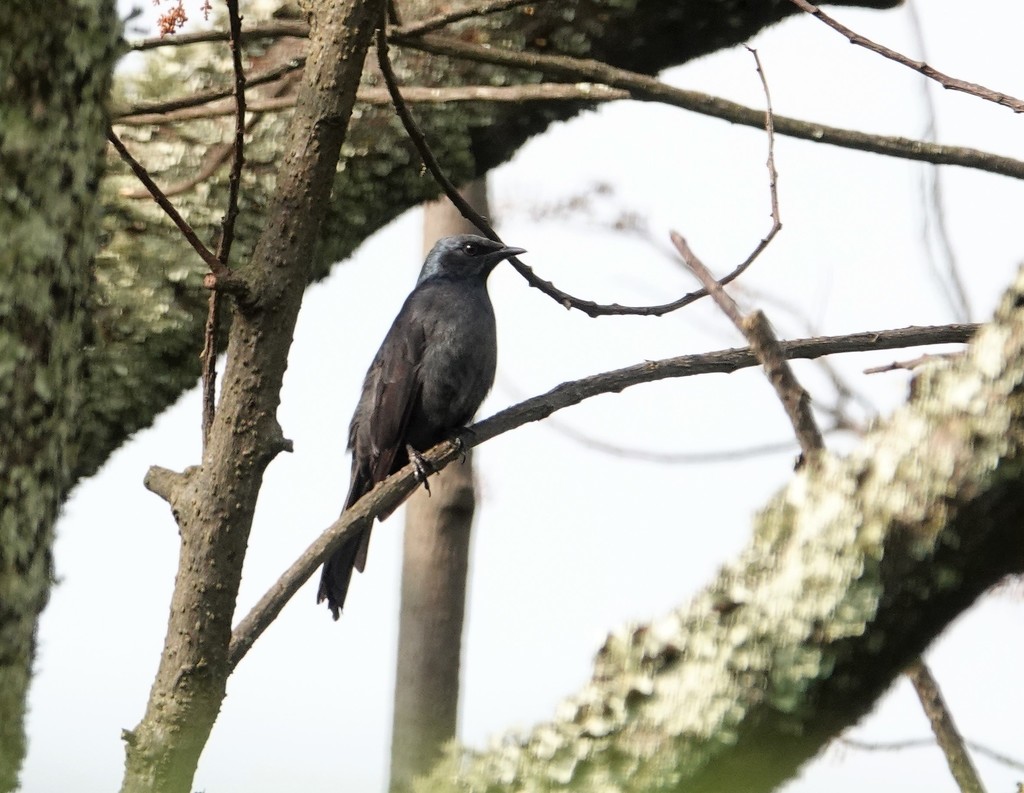
Stuhlmann’s Starling
Photo © Paul Prior
Photo © Paul Prior — CC BY 4.0 — Source: iNaturalist #16133186Stuhlmann's starling (Poeoptera stuhlmanni) is a species of starling in the family Sturnidae. It is native to the Albertine rift montane forests, the East African montane forests, the Imatong Mountains and the southwestern Ethiopian montane forests. Their length is usually around 19 cm, and they feed on seed, grain, arthropods and larvae. Fruits of the genus Ficus are also notable inclusions in their diet. == Description == Stuhlmann's starling is a blue-black to blue-grey bird, with males appearing slightly darker and glossier on average than females. Female birds and subadults of both sexes have reddish markings on the undersides of the primary feathers. The eyes are typically a dark brown in adults, and both sexes have black bills and legs. The calls include whistling, trilling, and "jay-like" sounds.
Bwindi Impenetrable National Park
Kanyashogi, Uganda
+603 birds+26 mammals
Steep ridges cloaked in montane forest rise from Uganda's southwestern borderlands, where the landscape grows so dense and tangled that early explorers named it impenetrable. At…
VIEW NATIONAL PARKMgahinga Gorilla National Park
Cyanika, Uganda
+429 birds+6 mammals
Where the Virunga Mountains rise steeply from the Uganda–Rwanda–Democratic Republic of Congo frontier, montane forest cloaks the volcanic slopes in a dense, moisture-laden embrace. Mgahinga Gorilla…
VIEW NATIONAL PARKToro-Semliki Proposed National Park
Uganda
+474 birds+5 mammals
Where the Albertine Rift's western escarpment rises above the Semliki River valley, a vast mosaic of forest, savanna and wetland converges to create one of East…
VIEW NATIONAL PARKQueen Elizabeth National Park
Uganda
+672 birds+30 mammals
Across the southwestern escarpment of Uganda, where the Western Rift Valley descends through ancient volcanic terrain, Queen Elizabeth National Park sprawls across more than 8,300 square…
VIEW NATIONAL PARKNo community photos yet. Log in to add the first one.
No community observations of this species yet.