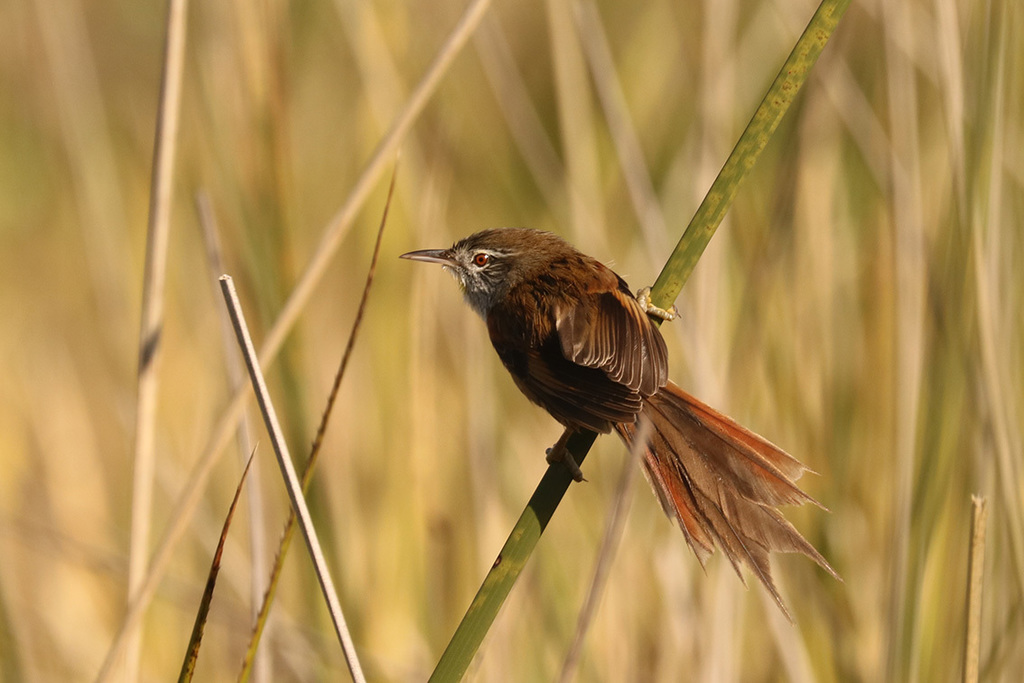
Sulphur-bearded Reedhaunter
Photo © Holger Braun
Photo © Holger Braun — CC BY 4.0 — Source: iNaturalist photo #199537408The sulphur-bearded reedhaunter or sulphur-throated spinetail (Limnoctites sulphuriferus) is a species of bird in the Furnariinae subfamily of the ovenbird family Furnariidae. It is found in Argentina, Brazil, and Uruguay. == Taxonomy and systematics == The sulphur-bearded reedhaunter was long placed in genus Cranioleuca, and for a time by itself in genus Limnornis, but a study published in 2011 placed it in genus Limnoctites. There it joined its sister species the straight-billed reedhaunter (L. rectirostris). The South American Classification Committee of the American Ornithological Society, the International Ornithological Committee, and the Clements taxonomy adopted the new genus starting in about 2019. However, as of November 2023 BirdLife International's Handbook of the Birds of the World retains it as Cranioleuca sulphurifera with the English name sulphur-throated spinetail. The sulphur-bearded reedhaunter is monotypic. == Description == The sulphur-bearded reedhaunter is 15 to 16 cm (5.9 to 6.3 in) long and weighs 12 to 14 g (0.42 to 0.49 oz). The sexes have the same plumage. Adults have a buffish white supercilium on an otherwise grayish-streaked whitish face. Their crown, back, rump, and uppertail coverts are olive-brown. Their tail feathers are sharply pointed; the central pair are brownish and longer than the others…
Peixe National Park Lagoon
Brazil
+293 birds+4 mammals
Where the coastal plains of Rio Grande do Sul meet the Atlantic, Peixe National Park Lagoon sprawls across nearly 2,200 square kilometres of shallow waters, reed…
VIEW NATIONAL PARKCampos del Tuyú National Park
Argentina
+169 birds+5 mammals
Subtropical forest graces the borderlands where Misiones Province meets Paraguay, a landscape shaped by the Paraná Plateau's weathered topography and the warm, humid climate of northeastern…
VIEW NATIONAL PARKNo community photos yet. Log in to add the first one.
No community observations of this species yet.