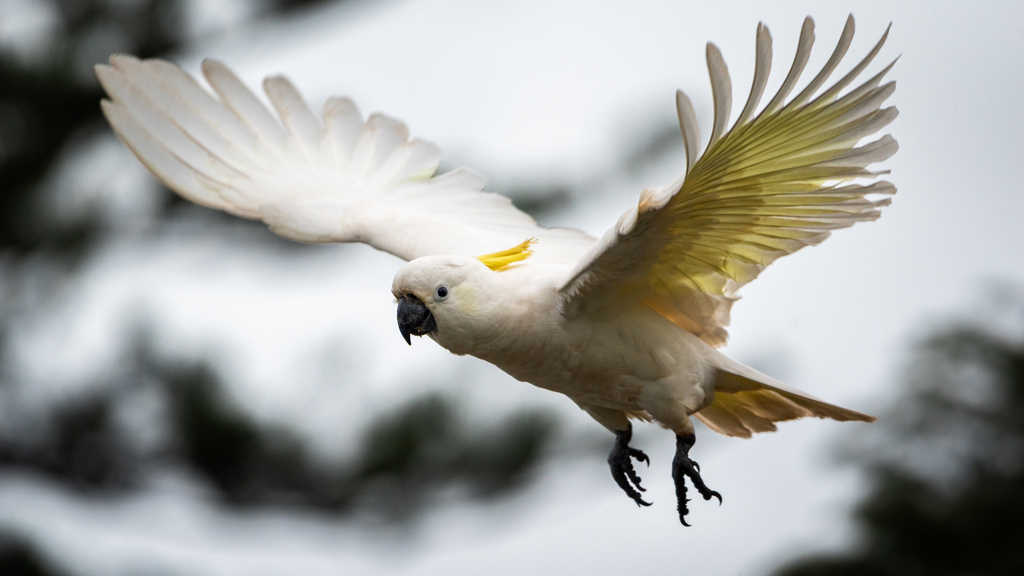
Sulphur-crested Cockatoo
Photo © Austen Armstrong
Photo © Austen Armstrong — CC BY 4.0 — Source: iNaturalist photo #508608907Identification
The sulphur-crested cockatoo is a large white parrot, measuring 44–55 cm in length, with Australian birds larger than their New Guinean counterparts. Its most distinctive feature is the prominent yellow erectile crest, which contrasts strikingly with the pure white plumage. Look for the yellow tinge on the underwings and tail, the black bill, grey legs, and whitish eye-ring. Males display almost black eyes, while females have distinctly reddish or brown eyes—though optimal light is needed to observe this difference. The bird's overall appearance is similar to Australian corellas, but corellas are considerably smaller, lack the impressive yellow crest, and have pale bills rather than black ones.
Range & Habitat
This species inhabits wooded areas across Australia, New Guinea, and Indonesian islands, thriving in tropical and subtropical rainforests. Within Australia, they occur naturally across large regions, though they have also been introduced to Perth outside their traditional range. Introduced populations exist in Singapore (500–2000 birds), New Zealand (fewer than 1000), Palau, and possibly Hawaii. The birds have adapted remarkably well to European settlement and now live in many Australian urban areas alongside their forest populations.
Behaviour & Diet
Sulphur-crested cockatoos are highly intelligent, naturally curious birds famous for their raucous, loud calls—an adaptation for communication through dense forest environments. Their intelligence is evident in urban settings, where Sydney populations have learned to open garbage bins for food, a behaviour that spreads through imitation. These birds are exceptional long-lived creatures, reaching over 70 years in captivity but only 20–40 years in the wild. They produce fine powder for waterproofing rather than oil, and have been observed practising geophagy (eating clay) to detoxify food. A remarkable 2009 study demonstrated their ability to synchronise movements to musical beats, and they use distinctive facial expressions with their feathers to display positive emotions.
Best Time & Places to See It
Sulphur-crested cockatoos are year-round residents across their range, though breeding seasons vary geographically. In southern Australia, breeding occurs from August to January, while northern populations breed from May to September. They are commonly observed in wooded habitats, rainforests, and increasingly in parks and gardens of major Australian cities. Their local abundance in some regions makes sightings relatively reliable, particularly in early morning and late afternoon when they are most active.
Photography Tips
The striking white plumage and yellow crest make this species visually dramatic, but the white feathers require careful exposure metering to avoid blown highlights. Photograph early morning or late afternoon when the crest is most elevated and colours are richest. Capturing the bird with its crest raised, or in flight showing the yellow underwing colouration, creates compelling images. The distinctive eye colour difference between sexes is a worthwhile detail to capture, though requires close range and excellent light. Look for flock scenes to capture their behavioural adaptations, particularly the characteristic guard bird perched high in trees while the flock feeds below.
Annan River (Yuku Baja-Muliku) National Park
Bald Rock National Park
Barrington Tops National Park
Belair National Park
Ben Boyd National Park
Blue Mountains National Park
Boodjamulla National Park
Bouddi National Park
Bribie Island National Park
Nothing matches these filters.
No community photos yet. Log in to add the first one.
No community observations of this species yet.