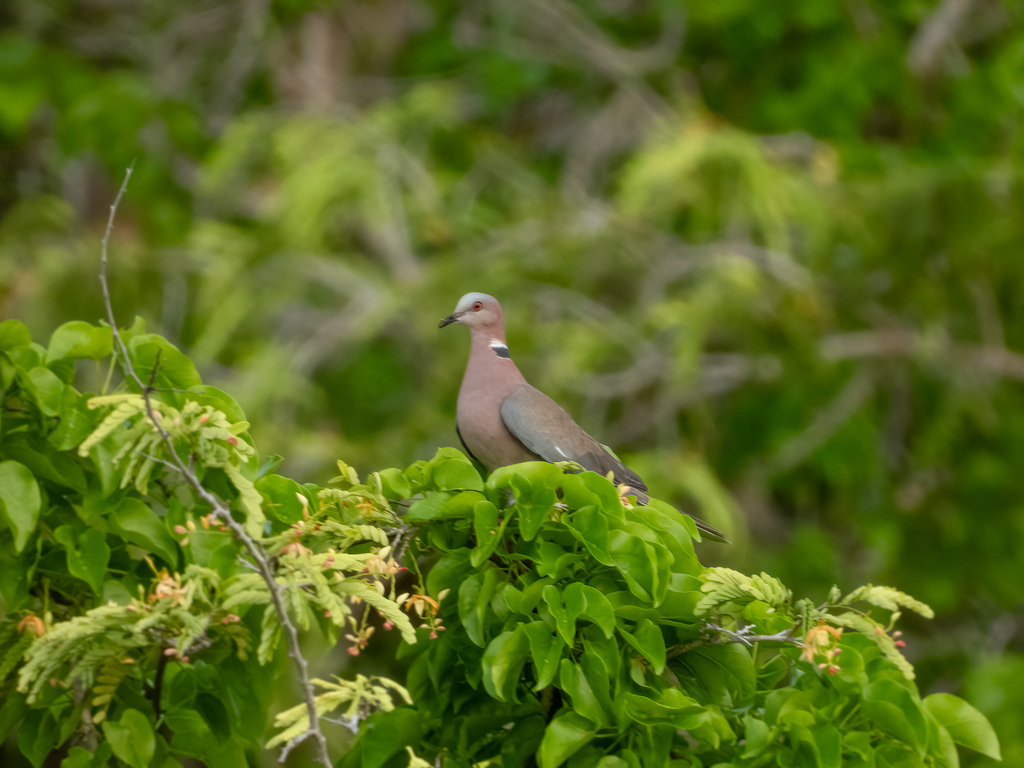
Sunda Collared Dove
Photo © Jason Alexander
Photo © Jason Alexander — CC BY 4.0 — Source: iNaturalist #259736783Identification
The Sunda collared dove is a small to medium-sized dove with distinctive plumage that sets it apart from its close relatives. The most striking feature is a dusty black band that covers half the bird's neck, with a white highlight visible above it. The head, neck, and chest display a light, rosy hue that gradually fades into caramel tones across the underside, transitioning to cream at the base of the tail. The wings begin with a light grey tone and deepen to a steely grey toward the wingtips, while the undertail feathers are distinctively eggshell white. The rounded eye is a warm orange-caramel color, typical of pigeons and doves. Though sometimes confused with the more cosmopolitan Eurasian collared dove, careful attention to the coloring and neck markings will distinguish this Indonesian species.
Range & Habitat
The Sunda collared dove is endemic to the tropical islands of Indonesia, with a range extending from Java and Bali eastward through Komodo, Lombok, Sumbawa, Timor, Flores, Solor, and the Lesser Sunda Islands. This bird shows a strong preference for subtropical and tropical forest environments, particularly moist lowland forests and mangrove forests where it can forage among low vegetation and dense understory growth.
Behaviour & Diet
Like other collared doves, the Sunda collared dove exhibits seasonal variations in appetite and foraging behavior. It primarily feeds on cereal grains and seeds gleaned from the ground while searching through low-lying vegetation. During autumn months, berries become an important dietary supplement. Occasionally, the species has been observed feeding on caterpillars, aphids, and other invertebrates when preferred food sources are unavailable or during different times of the year. Much remains unknown about this species' complete behavioral repertoire, as scientific documentation has been limited.
Best Time & Places to See It
The Sunda collared dove inhabits remote Indonesian islands where it remains relatively localized and less documented than its more widespread Eurasian cousin. Travelers visiting Java, Bali, Komodo, Lombok, or the Lesser Sunda Islands may encounter this species in suitable forest habitats, particularly in moist lowland forests and mangrove areas. However, sightings are not guaranteed, and the bird's preference for dense vegetation and remote island locations makes it a challenging species to observe. Local guides familiar with Indonesian bird populations will prove invaluable for tracking down this elusive dove.
Photography Tips
Photographing the Sunda collared dove requires patience and attention to its forest habitat preference. The bird's muted earth tones—rosy chest, caramel underparts, and grey wings—photograph best in soft, diffused light typical of forest environments. Focus on capturing the distinctive black neck band with its white highlight, which provides the most reliable identification feature. Early morning hours when doves are most active offer the best opportunities. A telephoto lens will be essential given the bird's tendency to remain in dense vegetation and its wariness of human observers. The eggshell-white undertail coverts are particularly striking and worth emphasizing in your compositions when the bird is in flight or with tail visible.
Taman Nasional Baluran
Situbondo, Indonesia
+189 birds+9 mammals
Across the northeastern tip of East Java, where monsoon winds sweep down from the Bali Strait, a landscape of contrasts unfolds within 374 square kilometres of…
VIEW NATIONAL PARKTaman Nasional Meru Betiri
Jember, Indonesia
+93 birds+1 mammals
Across East Java's southeastern coast, where the Indian Ocean meets a landscape of volcanic soils and monsoon-fed forests, sprawls a national park that epitomizes the ecological…
VIEW NATIONAL PARKWest Bali National Park
Gerokgak, Indonesia
+240 birds+8 mammals
Across West Bali's northwestern reaches, where the Indian Ocean meets volcanic slopes and limestone cliffs plunge toward turquoise shallows, sprawls a protected realm of roughly 325…
VIEW NATIONAL PARKMount Merapi National Park
Hargobinangun, Indonesia
+150 birds+3 mammals
Where the volcanic slopes of central Java rise into mist and montane forest, Mount Merapi National Park guards one of Indonesia's most dynamic landscapes. Spanning roughly…
VIEW NATIONAL PARKKomodo National Park
Komodo, Indonesia
+155 birds+14 mammals
Where volcanic peaks rise dramatically from turquoise waters, a primordial landscape unfolds across three main islands and countless smaller ones scattered throughout the Lesser Sunda archipelago.…
VIEW NATIONAL PARKNo community photos yet. Log in to add the first one.
No community observations of this species yet.