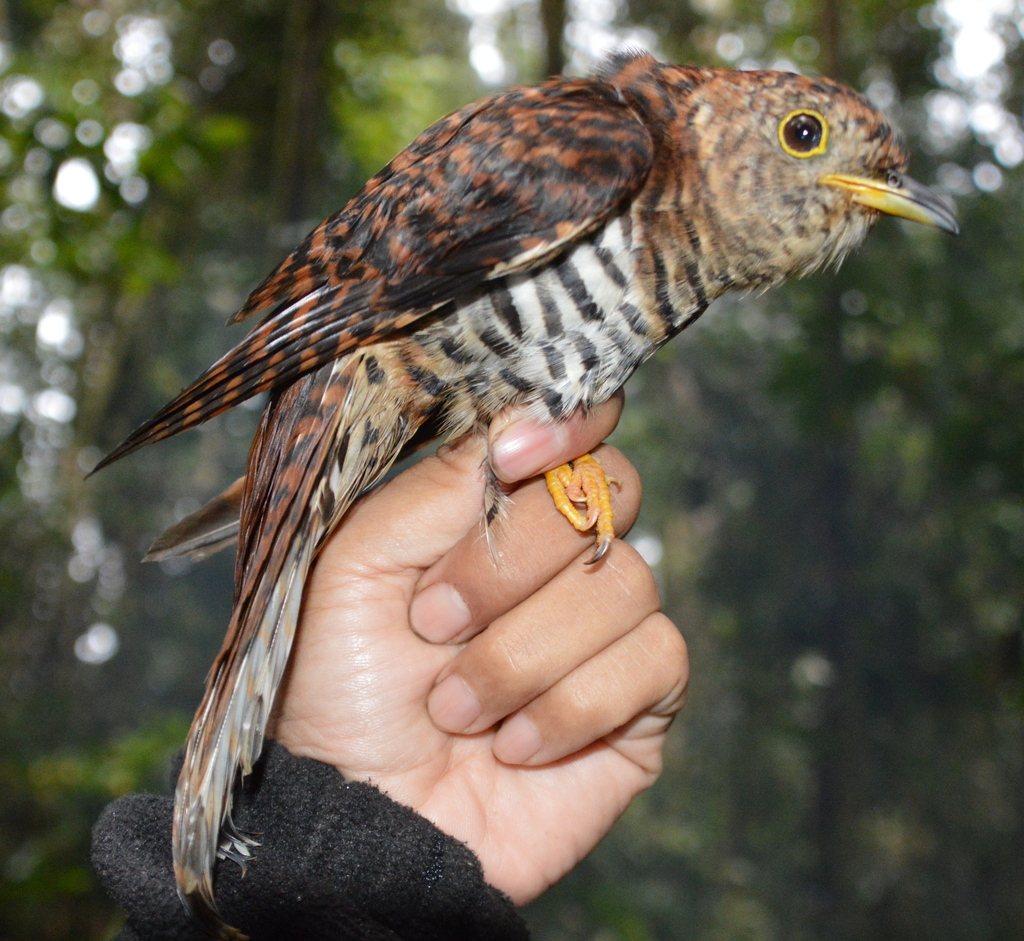
Sunda Cuckoo
Photo © Subir B. Shakya
Photo © Subir B. Shakya — CC BY 4.0 — Source: iNaturalist #255004659Identification
The Sunda cuckoo is a compact species measuring 29–30 cm in length. The nominate form displays dark grey upperparts, throat and upper breast, with buff underparts heavily barred in black. Its blackish tail is distinctively spotted with white. Females present two colour morphs: the standard grey form matches males, while an alternative rufous form features reddish-brown upperparts with paler, barred underparts. The subspecies C. l. insulindae, found in Borneo, is noticeably darker below than the widespread nominate form C. l. lepidus.
The Sunda cuckoo closely resembles the Himalayan cuckoo and Oriental cuckoo, though both are paler overall with less buff coloration and narrower black barring. The bird's song is a reliable identification tool: it typically begins with a short note followed by two or three longer, lower "hoop" notes—distinctly higher-pitched than the three or four "hoop" notes of the Himalayan cuckoo.
Range & Habitat
This South-east Asian resident is non-migratory and endemic to the region, with a range spanning the Malay Peninsula, Borneo, Sumatra, Java, Bali, Seram and the Lesser Sunda Islands eastward to Timor. Unlike the migratory Himalayan and Oriental cuckoos that overlap its range during the northern winter, the Sunda cuckoo remains year-round throughout its distribution.
The species shows a strong preference for mountainous forest habitats. Altitudinal ranges vary by location: 950–1700 m in the Malay Peninsula, 1300–2700 m in Borneo, and above 1000 m in Java, Sumatra and Wallacea. Though believed to be slowly declining, the Sunda cuckoo maintains a sizable range and population, earning a conservation status of Least Concern.
Behaviour & Diet
The Sunda cuckoo is primarily insectivorous, feeding mainly on caterpillars while also consuming fruit. As a brood parasite, it lays its whitish, brown-spotted eggs in the nests of host species, which vary by region. In the Malay Peninsula it uses the chestnut-crowned warbler; in Sabah, the mountain leaf warbler and yellow-breasted warbler; and in Java, the mountain leaf warbler, Sunda warbler and Sunda bush warbler.
The species is notably secretive and difficult to locate except when vocalising, making direct observation challenging for field naturalists.
Best Time & Places to See It
Since the Sunda cuckoo is resident year-round throughout its range, there is no seasonal migration to time. The bird is best found in montane forests across the Malay Peninsula, Borneo, Sumatra, Java and the Lesser Sunda Islands. Higher elevations within these regions—particularly above 1000 m—offer the greatest likelihood of encounters. However, the species' secretive nature means listening for its distinctive call remains the most reliable detection method.
Photography Tips
Photographing the Sunda cuckoo presents considerable challenges due to its shy, skulking behaviour in dense montane forest. Patience and early morning visits when birds are most vocal will increase your chances. Focus on listening for the distinctive call pattern—a short note followed by two to three lower "hoop" notes—to locate individuals. The bird's striking barred underparts and spotted tail are key features to capture, along with the rufous female form if encountered. Work with local guides familiar with the species' microhabitat preferences within mountain forests to maximise your opportunities.
Taman Negara National Park
Kampong Samas, Malaysia
+393 birds+48 mammals
Where ancient rainforest meets limestone peaks, one of Southeast Asia's oldest protected wilderness preserves sprawls across 4,343 square kilometers of primordial landscape. Dipterocarp giants tower overhead,…
VIEW NATIONAL PARKGunung Mulu National Park
Long Seridan, Malaysia
+280 birds+39 mammals
Where granite monoliths pierce the rainforest canopy of Sarawak, an ancient limestone karst landscape reveals one of Southeast Asia's most biodiverse strongholds. Soaring peaks cloaked in…
VIEW NATIONAL PARKTaman Nasional Baluran
Situbondo, Indonesia
+189 birds+9 mammals
Across the northeastern tip of East Java, where monsoon winds sweep down from the Bali Strait, a landscape of contrasts unfolds within 374 square kilometres of…
VIEW NATIONAL PARKWest Bali National Park
Gerokgak, Indonesia
+240 birds+8 mammals
Across West Bali's northwestern reaches, where the Indian Ocean meets volcanic slopes and limestone cliffs plunge toward turquoise shallows, sprawls a protected realm of roughly 325…
VIEW NATIONAL PARKGunung Ciremai National Park
Majalengka, Indonesia
+116 birds+1 mammals
Volcanic slopes rise sharply from West Java's interior, where Gunung Ciremai's 3,078-metre summit dominates a landscape carved by geological upheaval and shaped by equatorial monsoon rainfall.…
VIEW NATIONAL PARKGunung Merbabu National Park
Magelang, Indonesia
+61 birds+2 mammals
Where volcanic slopes rise sharply from the plateau of Central Java, Gunung Merbabu National Park encompasses nearly 200 square kilometers of montane forest that transitions through…
VIEW NATIONAL PARKMount Merapi National Park
Hargobinangun, Indonesia
+150 birds+3 mammals
Where the volcanic slopes of central Java rise into mist and montane forest, Mount Merapi National Park guards one of Indonesia's most dynamic landscapes. Spanning roughly…
VIEW NATIONAL PARKMutis Timau National Park
Timor Tengah Selatan, Indonesia
+77 birds
Where the volcanic highlands of Timor Tengah Selatan rise above the surrounding lowlands, Mutis Timau National Park unfolds across approximately 224 square kilometres of mountain forest…
VIEW NATIONAL PARKKerinci Seblat National Park
Kerinci, Indonesia
+228 birds+16 mammals
Across nearly 67,000 square kilometres of Sumatra's spine, a mountainous realm of equatorial rainforest rises from steaming lowlands to volcanic peaks shrouded in cloud. Kerinci Seblat…
VIEW NATIONAL PARKKomodo National Park
Komodo, Indonesia
+155 birds+14 mammals
Where volcanic peaks rise dramatically from turquoise waters, a primordial landscape unfolds across three main islands and countless smaller ones scattered throughout the Lesser Sunda archipelago.…
VIEW NATIONAL PARKNo community photos yet. Log in to add the first one.
No community observations of this species yet.