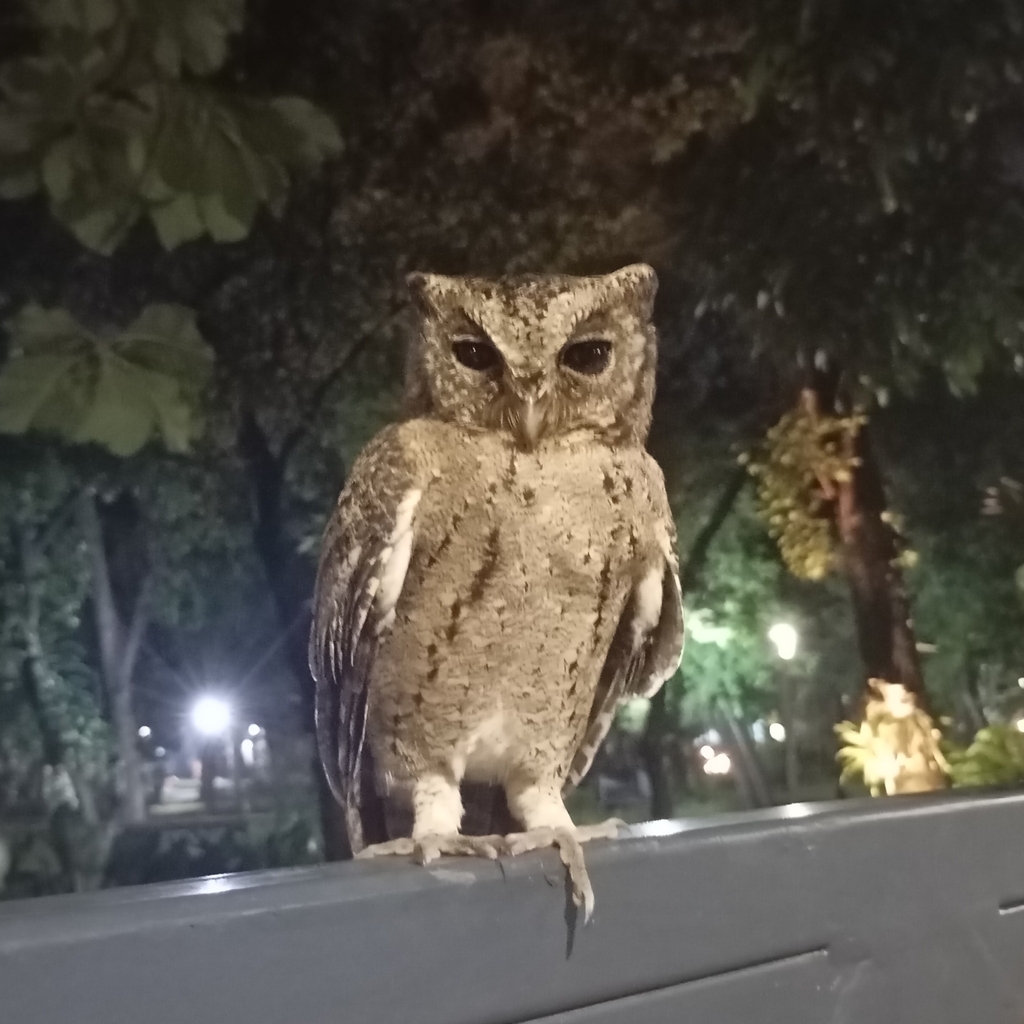
Sunda Scops Owl
Photo © Hamas Fathani
Photo © Hamas Fathani — CC BY-SA 4.0 — Source: iNaturalist #269443666Identification
The Sunda Scops Owl is a diminutive owl measuring 20–25 cm in length and weighing 100–170 g, making it one of Southeast Asia's smallest raptors. Its plumage is predominantly brown, speckled with black on the upper parts and streaked with black below. A distinctive light collar and dark eyes are key field marks that separate this species from related scops owls such as the Reddish, Mountain, Oriental, and Rajah scops owls, which typically show reddish tones or lighter eyes.
Range & Habitat
This owl is endemic to the Sunda Islands region, with its range spanning the Malay Peninsula, Singapore, Borneo, Sumatra, and Java. It shows a strong preference for forested areas and gardens, though it occasionally ventures into built environments and can be attracted to buildings. The species remains common throughout suitable habitat across its range.
Behaviour & Diet
The Sunda Scops Owl is primarily insectivorous, though it supplements its diet with small vertebrates. Its prey includes rats (its preferred quarry), small fish, lizards, crickets, and beetle larvae. Breeding occurs from January to April, with the season sometimes extending into June or late July. Females lay up to three eggs in tree hollows lined with plant fibre and display notable aggression when defending nests and territory, responding vocally to warn intruders. Each individual possesses a unique call—a distinctive hooting yelp separated by periods of silence—which serves for territorial advertisement and individual recognition among competitors.
Best Time & Places to See It
The breeding season from January through April offers the best opportunity to locate this species, as increased vocalization makes detection easier. Look for them in lowland and foothill forests, gardens, and cultivated areas throughout the Sunda Islands, particularly in Borneo, Sumatra, Java, and the Malay Peninsula. Night visits to suitable habitat with patience for listening increase your chances of encountering this small owl.
Photography Tips
The Sunda Scops Owl's small size and nocturnal habits present significant challenges for photographers. Use high-ISO settings and fast lenses to work in low light conditions. Focus on recording the bird's distinctive light collar and dark eyes, which are crucial identification features. Playback of calls during the breeding season can draw birds into view, though this should be used sparingly and ethically. Audio recording may be equally rewarding given the species' individually distinctive vocalizations.
Bako National Park
Kuching, Malaysia
+210 birds+17 mammals
Weathered sandstone cliffs rise dramatically from the South China Sea, their ochre faces sculpted by millennia of wind and tide into a landscape of extraordinary geological…
VIEW NATIONAL PARKGunung Mulu National Park
Long Seridan, Malaysia
+280 birds+39 mammals
Where granite monoliths pierce the rainforest canopy of Sarawak, an ancient limestone karst landscape reveals one of Southeast Asia's most biodiverse strongholds. Soaring peaks cloaked in…
VIEW NATIONAL PARKWest Bali National Park
Gerokgak, Indonesia
+240 birds+8 mammals
Across West Bali's northwestern reaches, where the Indian Ocean meets volcanic slopes and limestone cliffs plunge toward turquoise shallows, sprawls a protected realm of roughly 325…
VIEW NATIONAL PARKKerinci Seblat National Park
Kerinci, Indonesia
+228 birds+16 mammals
Across nearly 67,000 square kilometres of Sumatra's spine, a mountainous realm of equatorial rainforest rises from steaming lowlands to volcanic peaks shrouded in cloud. Kerinci Seblat…
VIEW NATIONAL PARKNo community photos yet. Log in to add the first one.
No community observations of this species yet.