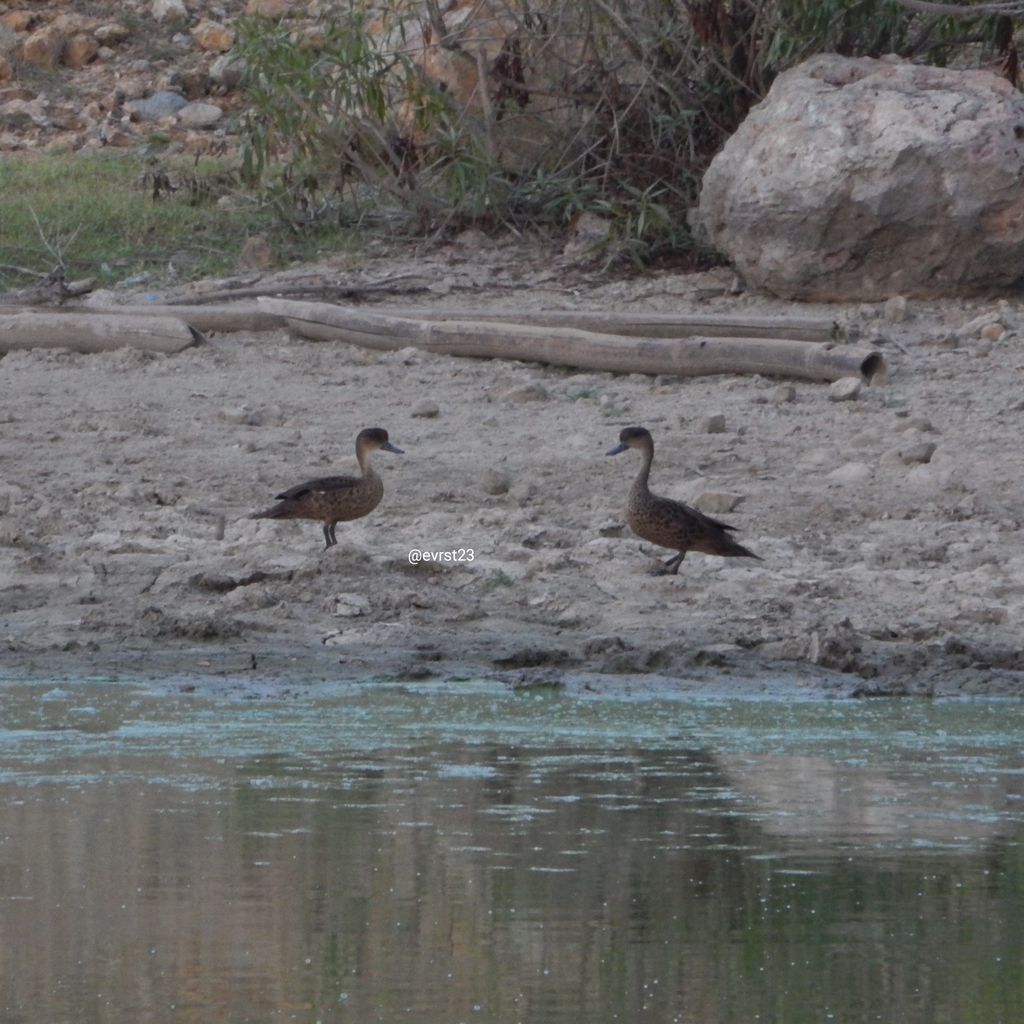
Sunda Teal
Photo © Legawa, Everest C.
Photo © Legawa, Everest C. — CC BY 4.0 — Source: iNaturalist #176307847Identification
The Sunda teal is a compact dabbling duck with distinctive mottled brown plumage and notable white and green flashes visible on its wings in flight. Both males and females share the same colouration—an unusual trait that sets this species apart from its close Australian relative, the chestnut teal, where sexual dimorphism is striking. The most reliable identification features are the duck's characteristically bulging forehead, lighter-coloured neck, and notably pale face. Juveniles appear paler than adults, particularly on the head, making age determination relatively straightforward in the field.
The Sunda teal is currently considered monotypic, though historically it included other Asian teal populations as separate subspecies. Its closest evolutionary relative is the Australian chestnut teal, a connection confirmed through molecular phylogenetic research. The nominate Sunda teal closely resembles the female chestnut teal in overall appearance, but the combination of its lighter neck, paler facial features, and bulging forehead distinguishes it reliably from that species.
Range & Habitat
The Sunda teal is endemic to Southeast Asia, with its range centred on Indonesia and Timor-Leste. This dabbling duck is strongly associated with open wetland environments, showing a clear preference for freshwater lakes and marshes where it finds both food and suitable nesting habitat.
Behaviour & Diet
The Sunda teal is notably vocal, particularly active during nocturnal hours. Males produce soft peeping calls, while females deliver loud quacking sounds—a characteristic that often betrays the species' presence even when visibility is limited. The duck nests near its preferred freshwater wetlands, demonstrating flexibility in nest-site selection. Birds may nest on the ground in typical duck fashion, but also readily use tree holes or abandoned rabbit burrows, adapting to available nesting opportunities across their range.
Best Time & Places to See It
To encounter Sunda teals, focus your visits on open freshwater lakes and marshes throughout Indonesia and Timor-Leste. Since this species is notably vocal at night, early morning and evening hours offer excellent opportunities for detection through sound alone, even before visual confirmation. The duck's preference for open wetlands makes it relatively accessible to patient observers compared to more secretive waterfowl species.
Photography Tips
The Sunda teal's mottled brown plumage provides effective camouflage against wetland backgrounds, so approach slowly and use natural cover where possible. The white and green wing flashes are most visible when birds take flight, so position yourself where you can capture birds as they launch from the water. The pale face and distinctive bulging forehead are key identification marks worth emphasizing in close-up shots. Early morning light is ideal for revealing the subtle colour tones of the brown plumage and catching any reflective glints from the white wing patches.
Taman Nasional Baluran
Situbondo, Indonesia
+189 birds+9 mammals
Across the northeastern tip of East Java, where monsoon winds sweep down from the Bali Strait, a landscape of contrasts unfolds within 374 square kilometres of…
VIEW NATIONAL PARKWest Bali National Park
Gerokgak, Indonesia
+240 birds+8 mammals
Across West Bali's northwestern reaches, where the Indian Ocean meets volcanic slopes and limestone cliffs plunge toward turquoise shallows, sprawls a protected realm of roughly 325…
VIEW NATIONAL PARKBogani Nani Wartabone National Park
Bolaang Mongondow, Indonesia
+154 birds+4 mammals
Across North Sulawesi's rugged interior, where tectonic uplift has carved steep ridges and deep valleys through ancient volcanic terrain, Bogani Nani Wartabone National Park sprawls across…
VIEW NATIONAL PARKLore Lindu National Park
Indonesia
+177 birds+4 mammals
Across the mountainous spine of Central Sulawesi spreads a wilderness of montane forest, rolling ridges, and deep valleys that rises from the island's volcanic bedrock to…
VIEW NATIONAL PARKSembilang National Park
Banyuasin, Indonesia
+56 birds+3 mammals
Where tidal mangroves grade into freshwater swamp forest and the Musi River delta spreads across more than 7,000 square kilometres, Sembilang National Park represents one of…
VIEW NATIONAL PARKKomodo National Park
Komodo, Indonesia
+155 birds+14 mammals
Where volcanic peaks rise dramatically from turquoise waters, a primordial landscape unfolds across three main islands and countless smaller ones scattered throughout the Lesser Sunda archipelago.…
VIEW NATIONAL PARKNo community photos yet. Log in to add the first one.
No community observations of this species yet.