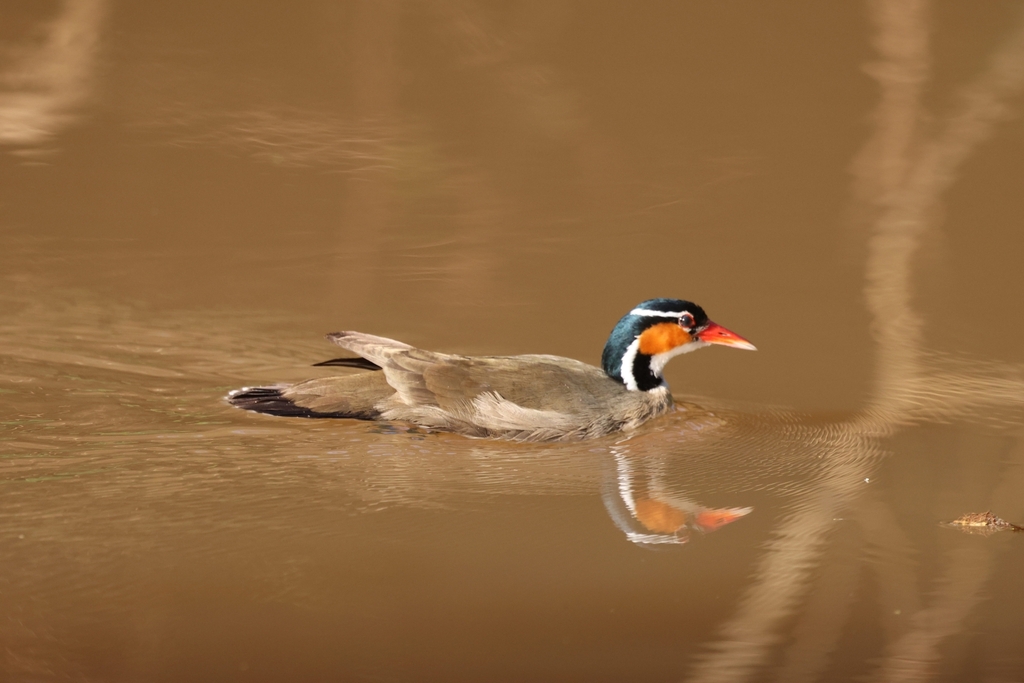
Sungrebe
Photo © Miguel
Photo © Miguel — CC BY-SA 4.0 — Source: iNaturalist photo #440161617Identification
The sungrebe is a small, striking aquatic bird with unmistakable field marks. Its most distinctive features are its boldly patterned head and neck: a black crown and nape contrasting sharply with white stripes running along the sides of the neck, white throat, and white chin. The body plumage is various shades of reddish-brown, while the legs display bold yellow and black banding, particularly visible when the bird perches or moves on land. The lobed feet—adapted for swimming—are a key identifier of this gruiform. A notably long tail, comprising almost a third of the bird's total length, extends beyond the body in flight and fans out on or just below the water's surface while swimming.
Sexual dimorphism is pronounced in sungrebes. Females are more brightly colored and slightly smaller but more powerfully built than males, with body lengths around 27 cm. The female's distinctive features include a rufous patch on the side of the face that intensifies to cinnamon-orange during breeding season, a brighter eye ring, and a lower mandible that turns from dark red to brilliant scarlet in breeding plumage. Males are similar but duller, lacking the female's bright eye ring and orange-rufous cheek patches, with their lower mandible turning only dark red during breeding. Juveniles resemble males but are slightly smaller with a grayer cast to their plumage and more white on the cheeks and neck.
Range & Habitat
Sungrebes are found throughout the tropical and subtropical Americas, from northeastern Mexico south to central Ecuador and southern Brazil. Their range extends along the Gulf and Caribbean coasts through Panama and along the Pacific coast from Panama through Central America. They inhabit the Orinoco and Amazon watersheds, the Pantanal, and Brazilian Atlantic Rainforests. They are residents throughout their range with no migration patterns, though they are occasionally recorded at higher elevations, they are typically associated with lowlands from sea level to around 500 meters elevation. Notably, sungrebes seem to be expanding their range northward in Mexico, having moved from historically ending in central Veracruz to now appearing in San Luis Potosí and Tamaulipas, with an individual recorded in New Mexico in 2008.
These birds are highly specialized in their habitat preferences, favoring heavily vegetated, freshwater wetland environments. They prefer well-covered, slow-flowing streams and secluded waterways where they can remain hidden and secure. They are non-migratory and do not seem to disperse well over saltwater, which explains their absence from most Caribbean islands, though they are found in Trinidad and Tobago.
Behaviour & Diet
Sungrebes are reclusive birds that prefer to remain hidden in dense vegetation along waterways. They are adept swimmers, propelled through the water by their specially adapted lobed feet, which are convergent in function to those of grebes or coots. They often swim partly submerged, similar to anhingas, allowing them to remain inconspicuous. The most remarkable behavior of sungrebes is their unique parental care system: males possess specialized folds of skin under their wings, creating "pouches" in which they carry their young from hatching until the chicks are able to swim independently. This extraordinary adaptation—unique among birds—has earned them the nickname "Marsupial Birds." Special feathers with their own musculature function as guard rails to prevent chicks from falling out of the pouch.
Best Time & Places to See It
Sungrebes can be found year-round throughout their range, as they are non-migratory residents. The best opportunities for observation occur during the breeding season when females display brighter plumage with more vivid eye rings and intensified facial coloration. For viewing, focus on heavily vegetated freshwater streams, slow-flowing waterways, and secluded wetland areas throughout Central and South America. Prime locations include the Amazon and Orinoco watersheds, the Pantanal, and protected wetland areas in Panama and Central America. The birds' reclusive nature means patient, quiet observation from a distance is essential for successful viewing.
Photography Tips
Photographing sungrebes presents significant challenges due to their reclusive nature and preference for dense vegetation. Early morning is often the best time for photography, when these birds are most active. Use a telephoto lens (at least 400-600mm) to maintain distance and avoid disturbing the birds. Approach slowly and quietly along secluded waterways, and remain patient—these birds will dive or disappear into vegetation if alarmed. Position yourself to capture the striking head pattern with its black crown and white neck stripes, which are the bird's most distinctive features. During breeding season, females offer the most photogenic opportunities with their brighter facial markings and intensified coloration. The long tail is another key feature to include in your composition when the bird is swimming or in flight.
Corcovado National Park
Puerto Jiménez, Costa Rica
+444 birds+48 mammals
Where the Osa Peninsula juts into the Pacific, rainforest descends almost to the tide line, and Corcovado National Park protects one of Central America's most intact…
VIEW NATIONAL PARKArenal Volcano National Park
Peñas Blancas, Costa Rica
+551 birds+21 mammals
Straddling the border between Alajuela and Guanacaste in northwestern Costa Rica, this national park rises dramatically around one of Central America's most active volcanic systems. The…
VIEW NATIONAL PARKTortuguero National Park
Roxana, Costa Rica
+420 birds+23 mammals
Canals and lagoons thread through a labyrinth of lowland rainforest where the Caribbean coast of Costa Rica meets the wetland frontier. This is terrain shaped by…
VIEW NATIONAL PARKYasuní National Park
Aguarico, Ecuador
+601 birds+43 mammals
Where the western Amazon basin converges with Ecuador's Orellana Province, lowland rainforest reaches toward the horizon in an unbroken canopy of staggering botanical density. Yasuní National…
VIEW NATIONAL PARKSangay National Park
Cebadas, Ecuador
+320 birds+10 mammals
High in Ecuador's Andean spine, where the Western Cordillera rises to touch perpetual snow, a landscape of volcanic drama and ecological intensity unfolds across Sangay National…
VIEW NATIONAL PARKNatural la Paya National Park
Puerto Leguízamo, Colombia
+262 birds+4 mammals
Where the Amazon's western reaches fold into the Andes foothills, La Paya National Park sprawls across more than 8,500 square kilometers of pristine Amazonian rainforest in…
VIEW NATIONAL PARKNatural Sierra de la Macarena National Park
Vista Hermosa, Colombia
+566 birds+15 mammals
Across nearly 20,000 square kilometres of Colombia's Meta Department, the terrain rises from lowland savanna into Andean foothills through a mosaic of gallery forests, palm-fringed wetlands,…
VIEW NATIONAL PARKAmacayacu National Park
Leticia, Colombia
+567 birds+25 mammals
Where the Rio Amazonas curves through the tri-border region where Colombia, Peru, and Brazil converge, Amacayacu National Park sprawls across more than 5,250 square kilometres of…
VIEW NATIONAL PARKPantanal Matogrossense National Park
Brazil
+322 birds+17 mammals
Where the flooded forests of central Brazil meet vast seasonally inundated grasslands, Pantanal Matogrossense National Park sprawls across nearly 2,900 square kilometers of one of the…
VIEW NATIONAL PARKAmazônia National Park
Brazil
+439 birds+6 mammals
Where the Rio Amazonas and its tributaries weave through the heart of Pará state, a vast tapestry of rainforest stretches across 23,611 square kilometers of unbroken…
VIEW NATIONAL PARKJaú National Park
Brazil
+354 birds+3 mammals
Vast floodplain forests and blackwater rivers define this remote corner of western Amazonas, where the Rio Negro and its tributaries have carved an intricate mosaic of…
VIEW NATIONAL PARKAnavilhanas National Park
Brazil
+468 birds+8 mammals
Across the Rio Negro in central Amazonas, an archipelago of over a thousand islands rises from the world's largest rainforest river system, creating a labyrinth of…
VIEW NATIONAL PARKCampos Amazónicos National Park
Amazonas, Brazil
+434 birds+7 mammals
Sprawling across the southwestern Amazon basin in Amazonas state, this 27,263-square-kilometre national park encompasses some of the region's most pristine lowland rainforest, where terra firme forest…
VIEW NATIONAL PARKSerra do Divisor National Park
Brazil
+448 birds+10 mammals
Where the western Amazon meets the Andes foothills, Serra do Divisor National Park sprawls across one of South America's most biodiverse and least accessible frontiers. Spanning…
VIEW NATIONAL PARKManu National Park
Manu, Peru
+892 birds+26 mammals
Across the eastern slopes of the Peruvian Andes, tropical rainforest descends into the Amazon basin with a complexity that few terrestrial ecosystems match. Manu National Park…
VIEW NATIONAL PARKYaguas National Park
Yaguas, Peru
+18 birds
Where the western Amazon transitions into terra firme uplands, Yaguas National Park sprawls across more than 16,000 square kilometres of northwestern Peru, a vast tract of…
VIEW NATIONAL PARKBahuaja Sonene National Park
San Pedro de Putina Punco, Peru
+602 birds+8 mammals
Where the Madre de Dios and Heath rivers converge in southeastern Peru rises one of South America's most biodiverse wilderness regions: a vast protected realm of…
VIEW NATIONAL PARKSoberanía National Park
Cristóbal, Panama
+495 birds+34 mammals
Rainforest and riverine woodland blanket the rolling terrain of this 714-square-kilometre national park in Colón Province, where the Caribbean watershed feeds a maze of streams and…
VIEW NATIONAL PARKIguazú National Park
Puerto Iguazú, Argentina
+346 birds+15 mammals
Where the Paraná Plateau plunges toward the Atlantic watershed, nearly 800 square kilometers of subtropical rainforest drape across Misiones Province in a landscape carved by millennia…
VIEW NATIONAL PARKMontes Azules
Candelaria, Mexico
+395 birds+47 mammals
Where jungle-clad limestone plateaus plunge into canyon systems carved by the Usumacinta River, Mexico's most pristine rainforest reserve unfolds across the Lacandón region of Chiapas. Montes…
VIEW BIOSPHERE RESERVETikal National Park
Tikal, Guatemala
+399 birds+16 mammals
Dense rainforest canopy rises above the limestone plateau of Petén, where archaeological wonder and ecological richness merge seamlessly across one of Central America's most biodiverse landscapes.…
VIEW NATIONAL PARKLaguna del Tigre National Park
Petén, Guatemala
+399 birds+29 mammals
Where the Petén lowlands dissolve into wetland and forest, Laguna del Tigre National Park protects one of Guatemala's most ecologically vital landscapes. This sprawling reserve encompasses…
VIEW NATIONAL PARKSierra del Lacandón National Park
Petén, Guatemala
+348 birds+7 mammals
Where the Petén rainforest rises into limestone ridges and deep ravines, Sierra del Lacandón National Park protects one of Central America's most intact tropical wilderness zones.…
VIEW NATIONAL PARKCahuita National Park
Talamanca, Costa Rica
+359 birds+15 mammals
Where the Caribbean shoreline dissolves into mangrove creeks and coral gardens, Cahuita's mosaic of habitats unfolds across the Limón coast. The park's signature feature—a living coral…
VIEW NATIONAL PARKRincón de la Vieja National Park
Liberia, Costa Rica
+451 birds+30 mammals
Where volcanic slopes rise abruptly from the Guanacaste lowlands, Rincón de la Vieja National Park sprawls across a landscape shaped by geothermal drama and seasonal extremes.…
VIEW NATIONAL PARKCaño Negro National Wildlife Refuge
Caño Negro District, Costa Rica
+486 birds+16 mammals
Where the San Juan River's seasonal floodplain opens into expansive wetlands, Caño Negro Wildlife Sanctuary sprawls across one of Central America's most productive freshwater ecosystems. This…
VIEW WILDLIFE SANCTUARYGandoca-Manzanillo National Wildlife Refuge
Manzanillo, Costa Rica
+394 birds+18 mammals
Where the Caribbean coastal plain surrenders to water-logged forest and mangrove tangles, Gandoca-Manzanillo Wildlife Sanctuary shelters one of Costa Rica's most biodiverse lowland wetland ecosystems. The…
VIEW WILDLIFE SANCTUARYBarra del Colorado National Wildlife Refuge
Tortuguero, Costa Rica
+462 birds+36 mammals
Where the Caribbean's restless waters meet the Limón Province coastline, Barra del Colorado National Wildlife Sanctuary unfolds across a landscape of extraordinary ecological complexity. This equatorial…
VIEW WILDLIFE SANCTUARYNo community photos yet. Log in to add the first one.
No community observations of this species yet.