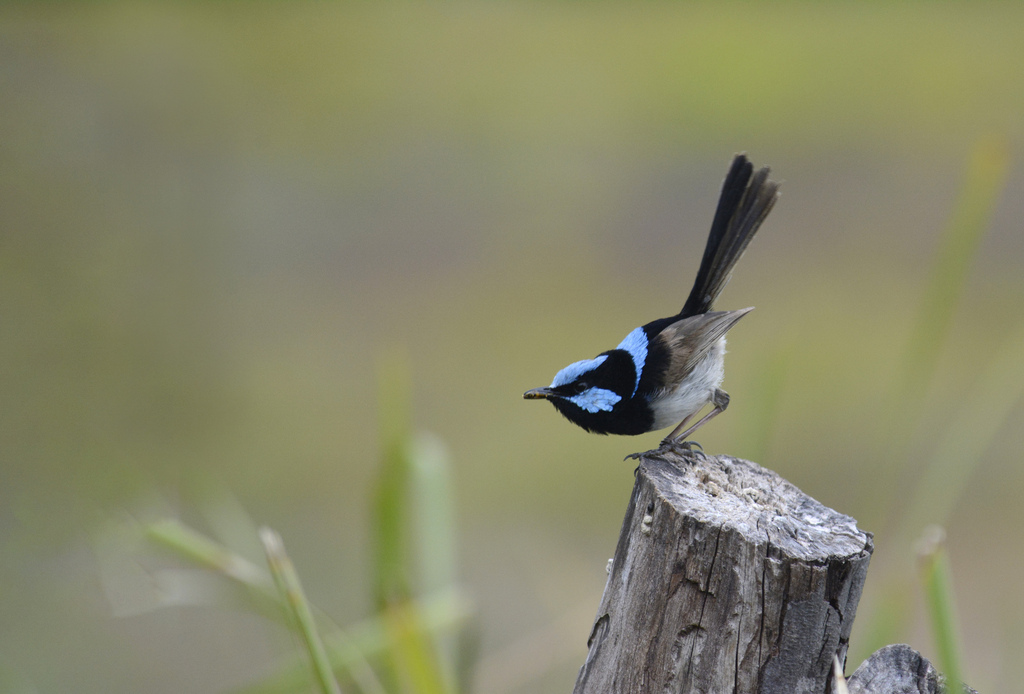
Superb Fairywren
Photo © Nathan Ruser
Photo © Nathan Ruser — CC BY 4.0 — Source: iNaturalist photo #249740626Identification
The superb fairywren is a striking small passerine with dramatic sexual dimorphism. Breeding males are unmistakable: bright blue forehead, ear coverts, mantle, and tail combine with a distinctive black mask and black or dark blue throat. Non-breeding males, females, and juveniles are predominantly grey-brown, a plumage difference that historically confused early ornithologists into believing males were polygamous. Six subspecies are recognized across the species' range, with Tasmanian birds being notably larger and darker than their mainland counterparts, while Queensland males display a pale silvery blue crown.
Range & Habitat
The superb fairywren is common and familiar across south-eastern Australia, from Tasmania to Queensland, with populations also present on Flinders Island, King Island, and Kangaroo Island. Remarkably adaptable, it inhabits almost any area with dense undergrowth, including grasslands with scattered shrubs, moderately thick forest, woodland, heaths, and domestic gardens. The species has thrived in urban environments and is now a familiar sight in suburban Sydney, Canberra, Melbourne, and Brisbane.
Behaviour & Diet
The superb fairywren exhibits fascinating social complexity: birds are socially monogamous yet sexually promiscuous, forming stable pairs while both partners mate with other individuals and even assist in raising unrelated young. A remarkable courtship behaviour involves males plucking yellow petals and displaying them to females. These sedentary, highly territorial wrens are primarily insectivorous, supplementing their diet with seeds. Like other fairywrens, they possess several unusual behavioural characteristics that distinguish them within the broader avian world.
Best Time & Places to See It
The superb fairywren's year-round presence and familiarity in suburban gardens make it accessible to most travellers visiting south-eastern Australia. Urban parks and gardens in Sydney, Canberra, Melbourne, and Brisbane offer excellent viewing opportunities, while natural areas with dense undergrowth throughout the species' range provide more pristine encounters. The bird's territorial nature means individuals often return to favoured locations, rewarding repeat visits to productive sites.
Photography Tips
Photographing breeding males offers the most dramatic opportunities, with their brilliant blue plumage and contrasting black markings providing excellent subject matter. Patient observation near dense shrubby vegetation will yield close-range opportunities, particularly in gardens where birds have become habituated to human presence. The courtship display involving yellow petal presentation, while brief, represents a genuinely unique photographic moment. Subdued light in early morning often flatters the iridescent blue plumage of males, while the cryptic grey-brown females and non-breeding males require different compositional approaches to showcase their subtle beauty.
Alpine National Park
Bald Rock National Park
Barrington Tops National Park
Belair National Park
Ben Boyd National Park
Blue Mountains National Park
Bouddi National Park
Bribie Island National Park
Budawang National Park
Nothing matches these filters.
No community photos yet. Log in to add the first one.
No community observations of this species yet.