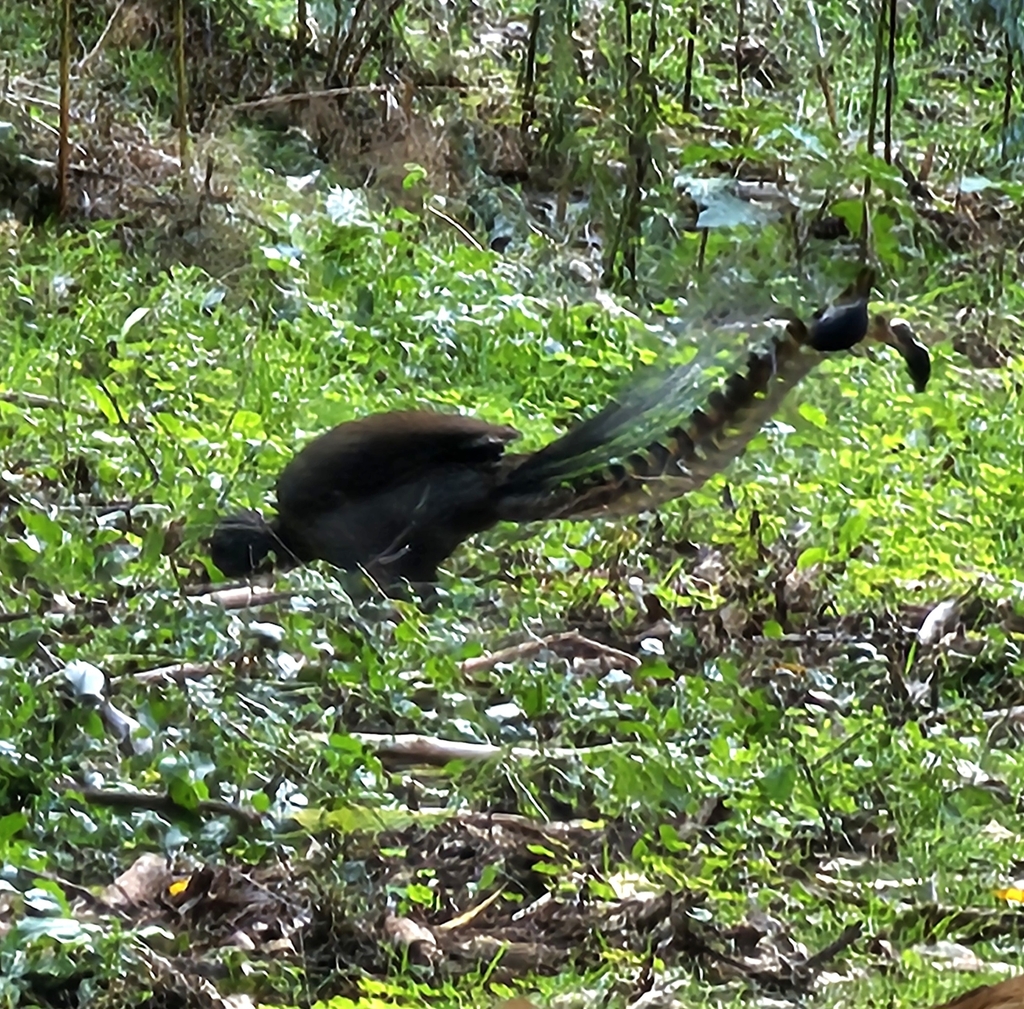
Superb Lyrebird
Photo © ianrainbow
Photo © ianrainbow — CC BY 4.0 — Source: iNaturalist #277333272Identification
The superb lyrebird is one of the world's largest songbirds, with males reaching up to 1 metre in length and females around 860 mm. Both sexes display dark brown upper plumage with greyish-brown underparts and red-tinged flight feathers. The most distinctive feature is the elaborate tail of mature males, which can extend 70 cm and consists of sixteen feathers: two broad, S-shaped outer feathers called "lyrates" (resembling a lyre), twelve flexible silvery filamentaries between them, and two silvery median feathers in the centre. Females possess shorter, less ornate tails. Juveniles of both sexes lack these ornamental tail feathers, which develop gradually through annual moults as the birds mature—males reaching full maturity at 7–9 years and females at 6–7 years.
The superb lyrebird's short, rounded wings are adapted for weak flight but excellent for balance and gliding from trees to the ground. The bird's powerful legs and strong feet, capable of moving branches up to 10 cm in diameter, reflect its ground-dwelling lifestyle.
Range & habitat
This species is endemic to southeastern Australia, ranging from southern Victoria to southeastern Queensland. Lyrebirds are ancient Australian animals, with fossils dating back approximately 15 million years. A thriving population was introduced to southern Tasmania between 1934 and 1954, and this introduced population has since grown significantly. Across its large range, the superb lyrebird remains common and is classified as least concern by the IUCN.
The bird favours wet forests and rainforests with open ground layers of moist leaf litter shaded by vegetation. It also inhabits subtropical and temperate rainforest, and wet and dry sclerophyll forest. In favourable seasons, its range extends into drier areas further from water sources.
Behaviour & diet
Superb lyrebirds are solitary, ground-dwelling birds that typically remain within small territories throughout their lives, as they are not strong fliers and have limited mobility. Young birds without territories may form small groups. The diet consists primarily of invertebrates such as earthworms and insects found on the forest floor, and there is evidence that the birds also consume fungi. They forage by scratching vigorously in the upper soil layers, disturbing topsoil and leaf litter, and prefer damp rainforest areas with open, low-complexity ground vegetation that provides good access to food.
Superb lyrebirds are renowned for their extraordinary vocal abilities. According to David Attenborough, the superb lyrebird displays one of the most sophisticated voice skills within the animal kingdom—"the most elaborate, the most complex, and the most beautiful." Males construct circular mounds of bare dirt within their territories for courtship displays and defend these mounds vigorously from rivals. The species exhibits polygyny, with a single male mating with several females; a male's territory can overlap with up to six female territories. Females select mates based on the desirability of males.
Best time & places to see it
The superb lyrebird is found across southeastern Australia's forested regions, from southern Victoria through to southeastern Queensland. Its established range, combined with the thriving Tasmanian population, offers multiple opportunities for observation. The bird's ground-dwelling habits and preference for wet rainforest with dense leaf litter mean searches should focus on these specific habitat types, particularly where moist conditions persist.
Photography tips
The superb lyrebird's ground-dwelling nature and solitary habits require patience and careful stalking. Males during courtship season are most likely to be visible at or near their display mounds, making this the optimal time for photography. Early morning light is ideal for capturing the iridescent qualities of the male's silvery tail feathers—the filamentaries and median feathers are particularly striking when backlit. The bird's weak flight capabilities mean it is less likely to flush suddenly, allowing for closer approach than many forest species.
Photographing the full tail display requires positioning yourself at ground level to capture the elaborate 70 cm tail structure in its entirety. The contrast between the dark brown plumage and the silvery filamentaries of the tail is best rendered in soft, diffused rainforest light rather than harsh direct sun.
Kinglake National Park
Australia
+164 birds+11 mammals
Where the volcanic plains of central Victoria rise into forested ridges, Kinglake National Park encompasses roughly 844 square kilometres of diverse habitat that represents one of…
VIEW NATIONAL PARKSydney Harbour National Park
Sydney, Australia
+203 birds+26 mammals
Where Sydney Harbour's sheltered waters meet the sandstone headlands of New South Wales, a mosaic of coastal heathland, eucalyptus woodland and rocky shores creates one of…
VIEW NATIONAL PARKRoyal National Park
Sydney, Australia
+296 birds+46 mammals
Where sandstone ridges plunge toward the Tasman Sea, Royal National Park unfolds across 343 square kilometres of southeastern Australian coastal wilderness. The park's defining character emerges…
VIEW NATIONAL PARKSundown National Park
Australia
+211 birds+9 mammals
Granite ridges and eucalypt woodlands define this 305-square-kilometre expanse of southeastern Queensland, where the landscape descends from sandstone plateaus into open forests and grassy clearings that…
VIEW NATIONAL PARKBald Rock National Park
Australia
+122 birds+15 mammals
Granite peaks and weathered stone dominate the landscape of this 202-square-kilometre national park in inland New South Wales, where rugged tors and rocky outcrops rise dramatically…
VIEW NATIONAL PARKGirraween National Park
Australia
+193 birds+21 mammals
Granite boulders rise like the bones of the earth across these 278 square kilometres of southeastern Queensland, where the Great Dividing Range descends towards the coastal…
VIEW NATIONAL PARKMorton National Park
Australia
+253 birds+57 mammals
Across nearly 4,800 square kilometers of New South Wales's Southern Tablelands, rugged sandstone plateaus rise above sheltered valleys where cool-climate eucalypt woodland meets grassy heath and…
VIEW NATIONAL PARKHeathcote National Park
Sydney, Australia
+119 birds+16 mammals
Sandstone ridges and eucalypt woodlands rise from the Cumberland Plain southwest of Sydney, where Heathcote National Park unfolds across 82 square kilometres of bushland shaped by…
VIEW NATIONAL PARKWilsons Promontory National Park
Australia
+210 birds+21 mammals
Where granite headlands plunge toward Bass Strait, Wilson's Promontory National Park sprawls across nearly 1,300 square kilometers of southeastern Victoria's most rugged coastal wilderness. The park's…
VIEW NATIONAL PARKBlue Mountains National Park
Australia
+220 birds+43 mammals
Dramatic sandstone cliffs rise in tiers across this mountainous plateau west of Sydney, their rust-coloured faces weathered into amphitheatres and gorges where eucalyptus forest clings to…
VIEW NATIONAL PARKKosciuszko National Park
Australia
+211 birds+52 mammals
Where the Great Dividing Range reaches its highest peaks in southeastern Australia, Kosciuszko National Park encompasses a landscape of windswept plateaus, rocky ridges, and deep river…
VIEW NATIONAL PARKBouddi National Park
Gosford, Australia
+147 birds+17 mammals
Sandstone ridges rise sharply from the Tasman Sea along the central New South Wales coast, their weathered faces etched by millennia of salt spray and storm…
VIEW NATIONAL PARKKu-ring-gai Chase National Park
Sydney, Australia
+216 birds+39 mammals
Where Hawkesbury sandstone cliffs plunge toward sheltered bays and creeks, Ku-ring-gai Chase National Park unfolds across rugged terrain just north of Sydney, a mosaic of eucalyptus…
VIEW NATIONAL PARKBarrington Tops National Park
Australia
+175 birds+47 mammals
Where the New England Plateau rises above the Hunter Valley, temperate rainforest cloaks the highest reaches of Barrington Tops, its dense canopy fed by year-round precipitation…
VIEW NATIONAL PARKDorrigo National Park
Gleniffer, Australia
+172 birds+17 mammals
Where subtropical rainforest transitions into cool temperate woodland, Dorrigo National Park rises across the volcanic tablelands of far northern New South Wales, cloaked in the perpetually…
VIEW NATIONAL PARKOxley Wild Rivers National Park
Australia
+202 birds+45 mammals
Where the New England Tablelands descend toward the coast, river gorges carve through temperate forests in a landscape of dramatic geological contrast. Oxley Wild Rivers National…
VIEW NATIONAL PARKNew England National Park
Australia
+169 birds+35 mammals
Temperate eucalypt woodlands and cool rainforest pockets define this upland reserve where granite peaks rise above the New England Plateau in northeastern New South Wales. Here,…
VIEW NATIONAL PARKBudawang National Park
Australia
+80 birds+17 mammals
Rugged sandstone ridges rise dramatically across the New South Wales Southern Tablelands, their weathered faces sculpted by millennia of wind and water into a landscape of…
VIEW NATIONAL PARKBen Boyd National Park
Eden, Australia
+255 birds+47 mammals
Where the temperate forests of the far south coast meet towering sea cliffs, Ben Boyd National Park unveils one of New South Wales' most dramatic coastal…
VIEW NATIONAL PARKAlpine National Park
Australia
+64 birds+2 mammals
High in Victoria's southeastern ranges, where cool temperate forests grip steep mountainsides and alpine grasslands stretch across windswept plateaus, Alpine National Park protects one of southeastern…
VIEW NATIONAL PARKMount Buffalo National Park
Myrtleford, Australia
+124 birds+7 mammals
Granite peaks rise abruptly from the volcanic plains of northeastern Victoria, their exposed rock faces and windswept ridges defining Mount Buffalo National Park's rugged character. The…
VIEW NATIONAL PARKCradle Mountain-Lake St Clair National Park
Australia
+72 birds+8 mammals
Where glacial valleys plunge between quartzite peaks, Tasmania's Cradle Mountain-Lake St Clair National Park unfolds as a temperate wilderness of uncommon grandeur. The park's terrain ranges…
VIEW NATIONAL PARKNo community photos yet. Log in to add the first one.
No community observations of this species yet.