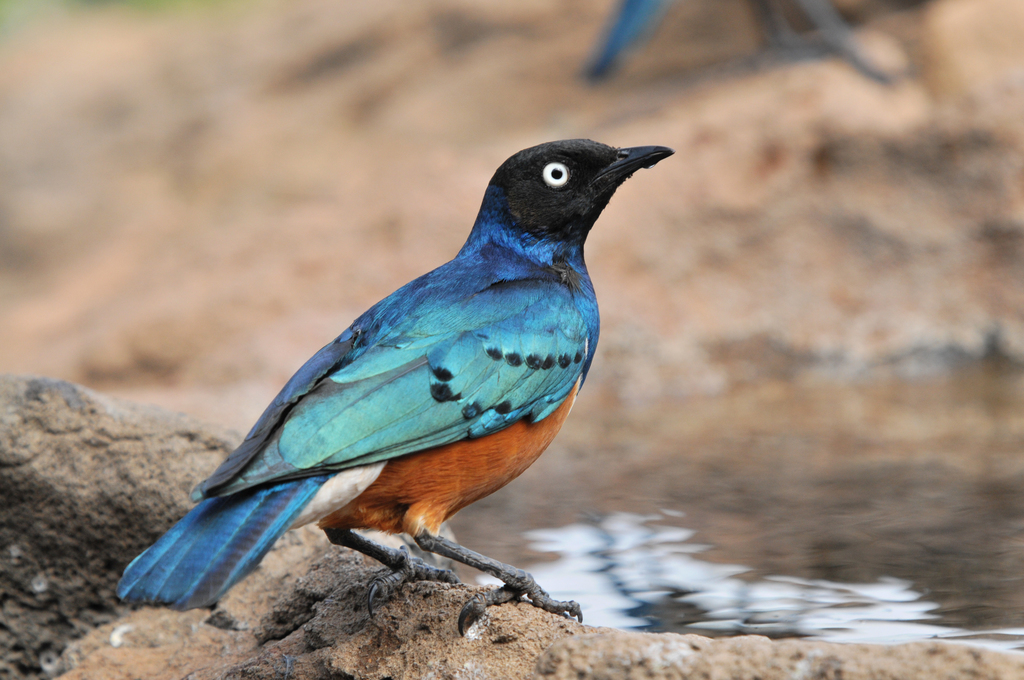
Superb Starling
Photo © William Stephens
Photo © William Stephens — CC BY 4.0 — Source: iNaturalist photo #83247072Identification
The superb starling is a small, short-tailed bird measuring 18 to 19 cm in length, featuring a long narrow bill, robust body, and strong feet. Its most striking feature is its spectacular iridescent plumage, which displays metallic blues and greens created by the structural arrangement of melanin granules in the feathers rather than pigments. Adults are distinguished by creamy-white eyes and a distinctive white breast band that separates the glossy blue-green chest from the red-orange abdomen and flanks. The crown and ear-coverts are bronzy-black, while the wings are glossy metallic-green with dark spots on the wing coverts.
This species is easily confused with Hildebrandt's starling, which shares its East African range, but can be distinguished by the superb starling's pale creamy-white eyes (compared to red eyes in Hildebrandt's) and the white breast band unique to adults. Juveniles appear duller, lacking the glossy sheen except on tail and wing feathers, with brown irises that gradually lighten to grayish-white and a pale yellowish bill. The superb starling is sexually monomorphic, with males showing a slightly wider white breastband in captive pairs.
Range & Habitat
The superb starling is commonly found throughout East Africa, including Somalia, Uganda, Kenya, South Sudan, Ethiopia, and Tanzania. This species inhabits savanna, thornbush, acacia arid areas, open woodland, and lakeshore woodlands at elevations ranging from sea level to 2,650 metres. They favour open habitats and tend to avoid humid lowland areas, instead occupying cultivated fields and gardens where suitable.
Superb starlings are highly social and typically occupy large territories often exceeding 50 hectares, living in groups that can number more than 40 individuals with approximately equal sex ratios. During the non-breeding dry season, they often join mixed-species flocks with other starling species and birds such as red-billed and white-headed buffalo weavers. In the Serengeti, they have been observed associating with these mixed flocks, behaviour that likely aids foraging and provides predator defence.
Behaviour & Diet
Superb starlings are highly vocal birds with a distinctive long and loud song consisting of trills and chatters, supplemented at midday by softer repeated phrases. They produce several harsh calls, including a characteristic complex "shrill, screeching skerrrreeee-cherrrroo-tcherreeeeeet," along with warning chirrs and a repeated "whit-chor-chi-vii" when excited. Their vocalizations are distinctive enough that vervet monkeys in Amboseli National Park, Kenya, have learned to identify and respond appropriately to their alarm calls when aerial or terrestrial predators are present.
These omnivorous birds feed primarily on the ground, often beneath or near acacia trees. They rely predominantly on insects as their main food source, including termites and grasshoppers, though they also consume moth larvae and other invertebrates. When not feeding, they typically remain on their territories or travel to water sources. These birds are notably long-lived, capable of living over 15 years in captivity.
Best Time & Places to See It
The superb starling is commonly distributed across East Africa and can be reliably found in suitable habitat throughout the region. Key locations include the Serengeti National Park in Tanzania, where they are frequently observed in mixed-species flocks, and Amboseli National Park in Kenya. The species is present year-round across its range, though behaviour varies seasonally—during the dry non-breeding season, they form larger mixed flocks that are easier to locate, while during the breeding season they become more territorial and may be encountered in smaller groups defending nesting areas.
Look for superb starlings in open acacia woodlands and thornbush savannas where they feed on the ground. Early morning is often productive for observing their vocal activity and feeding behaviour. Their striking iridescent plumage is most vibrant in good light, and their gregarious nature means that once you locate one individual, others are likely nearby.
Photography Tips
The superb starling's iridescent plumage is its most photogenic feature, but capturing this requires careful attention to lighting. Position yourself with the light source at a low angle to the bird to best reveal the structural blues and greens of the plumage. The metallic sheen is most dramatic in bright sunlight, so mid-morning through late afternoon typically offers the best conditions. The white breast band and red-orange abdomen provide excellent colour contrast that photographs well and helps distinguish this species from similar starlings.
Since these birds feed on the ground and often perch in low vegetation, shooting angles from ground level or eye-level can be more engaging than top-down perspectives. Their gregarious nature means multiple birds often appear in a single frame—use this to your advantage when composing images. The pale creamy-white eyes are a diagnostic feature worth capturing clearly, as they are key to distinguishing this species from Hildebrandt's starling. Be patient during early morning hours when they are most vocal and active, providing opportunities for both behavioural and portrait shots.
Serengeti National Park
Tanzania
+558 birds+57 mammals
Across Tanzania's northern plateau, where volcanic soils meet acacia woodland and open grassland, unfolds one of Earth's most dynamic ecosystems. The Serengeti National Park sprawls across…
VIEW NATIONAL PARKArusha National Park
Tanzania
+555 birds+16 mammals
Where the slopes of Mount Mawenzi rise above the Arusha region, a compact yet ecologically rich national park unfolds across montane forest, moorland, and alpine zones.…
VIEW NATIONAL PARKKidepo Valley National Park
Uganda
+478 birds+24 mammals
Where the Narus and Kidepo rivers carve through northeastern Uganda's semi-arid lowlands, a landscape of sparse acacia woodland, grassland, and riverine thickets creates one of East…
VIEW NATIONAL PARKMurchison Falls National Park
Uganda
+608 birds+33 mammals
Where the Victoria Nile compresses through a narrow gorge and explodes across a 45-meter precipice, the landscape speaks in thunder. Murchison Falls National Park sprawls across…
VIEW NATIONAL PARKTsavo East National Park
Athi ward, Kenya
+468 birds+50 mammals
Across the semi-arid lowlands of southeastern Kenya, where acacia woodland fragments into scrubland and the landscape rolls toward the Indian Ocean horizon, lies one of Africa's…
VIEW NATIONAL PARKTsavo West National Park
Mwatate, Kenya
+513 birds+49 mammals
Where volcanic ridges and weathered lava flows meet the semi-arid lowlands of south-central Kenya, Tsavo West National Park unfolds across a landscape sculpted by fire and…
VIEW NATIONAL PARKAmboseli National Park
Etonet/Lenkism ward, Kenya
+501 birds+43 mammals
Where the Amboseli basin opens toward the Tanzanian frontier, a shallow alkaline lake mirrors vast skies across one of East Africa's most iconic savanna landscapes. The…
VIEW NATIONAL PARKKilimanjaro National Park
Kenya
+207 birds+16 mammals
Africa's highest mountain rises not in isolation but as the centerpiece of a vast national park that sweeps across the borderlands of northern Tanzania, where savanna…
VIEW NATIONAL PARKMount-Kenya National Park
Abothuguchi west ward, Kenya
+334 birds+11 mammals
Where the slopes of Kenya's second-highest mountain rise steeply from the Meru County foothills, a landscape of profound ecological richness unfolds across Mount Kenya National Park.…
VIEW NATIONAL PARKTarangire National Park
Tanzania
+527 birds+50 mammals
Acacia woodland and grassland sweep across the Manyara Region where the Tarangire River carves through low hills and volcanic soils, creating one of East Africa's most…
VIEW NATIONAL PARKNgorongoro Conservation Area
Tanzania
+626 birds+55 mammals
Volcanic calderas and open grassland dominate this high plateau in northern Tanzania, where the landscape rises above 2,000 metres and ancient geological forces have shaped both…
VIEW WILDLIFE MANAGEMENT AREAAbijata-Shalla Lakes National Park
Ethiopia
+438 birds+7 mammals
Two crater lakes of contrasting chemistry define this remote corner of Ethiopia's Rift Valley, where soda lakes and freshwater basins create a mosaic of distinct aquatic…
VIEW NATIONAL PARKBale Mountains National Park
Ethiopia
+397 birds+20 mammals
Where the Ethiopian highlands rise above 4,000 metres, the Bale Mountains create a landscape of stunning ecological extremes—from afroalpine grasslands swept by wind and mist to…
VIEW NATIONAL PARKMago National Park
Ethiopia
+128 birds+3 mammals
Where the Omo River cuts through southern Ethiopia's arid borderlands, Mago National Park sprawls across a landscape of dramatic escarpments, riverine forests, and semi-arid savanna that…
VIEW NATIONAL PARKOmo National Park
Ethiopia
+61 birds+4 mammals
Where the Omo River carves through southwestern Ethiopia, a landscape of riverine woodland, acacia savanna, and scattered grassland unfolds across one of East Africa's most remote…
VIEW NATIONAL PARKAwash National Park
Didiga, Ethiopia
+473 birds+23 mammals
Where the Ethiopian Rift Valley carves through volcanic plateaus, a ribbon of riverine forest winds through acacia scrubland and grassland, creating a mosaic of habitats that…
VIEW NATURAL PARKNech Sar National Park
Arba Minch, Ethiopia
+191 birds+10 mammals
Where the East African Rift Valley plateaus drop dramatically toward the shore of Lake Abaya, a mosaic of habitats unfolds across sun-scorched savanna and acacia woodland.…
VIEW NATIONAL PARKYabelo Wildlife Sanctuary
Bedewera, Ethiopia
+359 birds+5 mammals
Where acacia woodlands meet volcanic plateaus in southern Ethiopia, a landscape of austere beauty unfolds across nearly 2,500 square kilometers. Yabelo Wildlife Sanctuary sprawls across semi-arid…
VIEW WILDLIFE SANCTUARYNairobi National Park
Nairobi, Kenya
+515 birds+35 mammals
Just minutes from Kenya's capital, where the Nairobi River winds through acacia woodland and open grassland, lies one of Africa's most paradoxical wildlife sanctuaries. The park's…
VIEW NATIONAL PARKLake Nakuru National Park
Nakuru West, Kenya
+494 birds+32 mammals
Alkaline waters ringed by acacia woodland and grassland create one of East Africa's most distinctive wetland ecosystems, where the interplay of geology and climate sustains a…
VIEW NATIONAL PARKAberdare National Park
Mweiga ward, Kenya
+394 birds+30 mammals
Where the central highlands of Kenya rise to their elemental grandeur, the Aberdare range unfolds across Nyeri County as a montane stronghold of cool, misty forest…
VIEW NATIONAL PARKMeru National Park
Igembe Central, Kenya
+408 birds+38 mammals
Granite outcrops and acacia woodland rise across the northern reaches of Meru, where semi-arid savanna transitions into drier scrubland under the fierce equatorial sun. The park's…
VIEW NATIONAL PARKSamburu National Reserve
Samburu, Kenya
+430 birds+42 mammals
Across the arid plains of northern Kenya, where scattered acacia woodland gives way to rocky outcrops and dry riverbeds, Samburu National Park unfolds as one of…
VIEW NATURE RESERVEHell’s Gate National Park
Olkaria ward, Kenya
+388 birds+18 mammals
Volcanic scarps and geothermal vents dominate the floor of Hell's Gate, where the East African Rift has carved a dramatic gorge through crystalline rock formations. The…
VIEW NATIONAL PARKRuma National Park
Suba, Kenya
+250 birds+8 mammals
Where the Winam Gulf narrows toward the Kenyan mainland, Ruma National Park rises as a sanctuary of evergreen woodland set within the humid tropics of Homa…
VIEW NATIONAL PARKSaiwa Swamp National Park
Sinyerere ward, Kenya
+255 birds+4 mammals
Where papyrus and sedge marshes stretch across a highland plateau in western Kenya, Saiwa Swamp National Park shelters one of East Africa's most productive freshwater wetland…
VIEW NATIONAL PARKChyulu Hills National Park
Kibwezi East, Kenya
+232 birds+30 mammals
Volcanic cones rise abruptly from the Kenyan savanna floor, their flanks clothed in dense acacia woodland and grassland that transforms the Chyulu Hills into an ecological…
VIEW NATIONAL PARKOl Donyo Sabuk National Park
Matungulu North ward, Kenya
+200 birds
Granite peaks rise abruptly from the highland plateau of Matungulu North, their weathered slopes clothed in scattered woodland and montane grassland that shifts between verdant and…
VIEW NATIONAL PARKSibiloi National Park
Kenya
+118 birds
Where the northern deserts of Kenya meet the volcanic Chalbi Plain, Sibiloi National Park sprawls across a landscape shaped by millennia of tectonic upheaval and semi-arid…
VIEW NATIONAL PARKArabuko Sokoke Forest Reserve
Kilifi, Kenya
+383 birds+29 mammals
Coastal forest rises from the Indian Ocean plains of Kilifi County, where sandy soils and seasonal rainfall have sculpted a woodland ecosystem unlike anywhere else on…
VIEW NATURE RESERVEWatamu Marine National Park
Dabaso ward, Kenya
+328 birds+12 mammals
Where mangrove channels meet coral gardens and sandy shallows blend into the warm waters of the Indian Ocean, Watamu Marine National Park unfolds across the Kilifi…
VIEW NATIONAL PARKNo community photos yet. Log in to add the first one.
No community observations of this species yet.