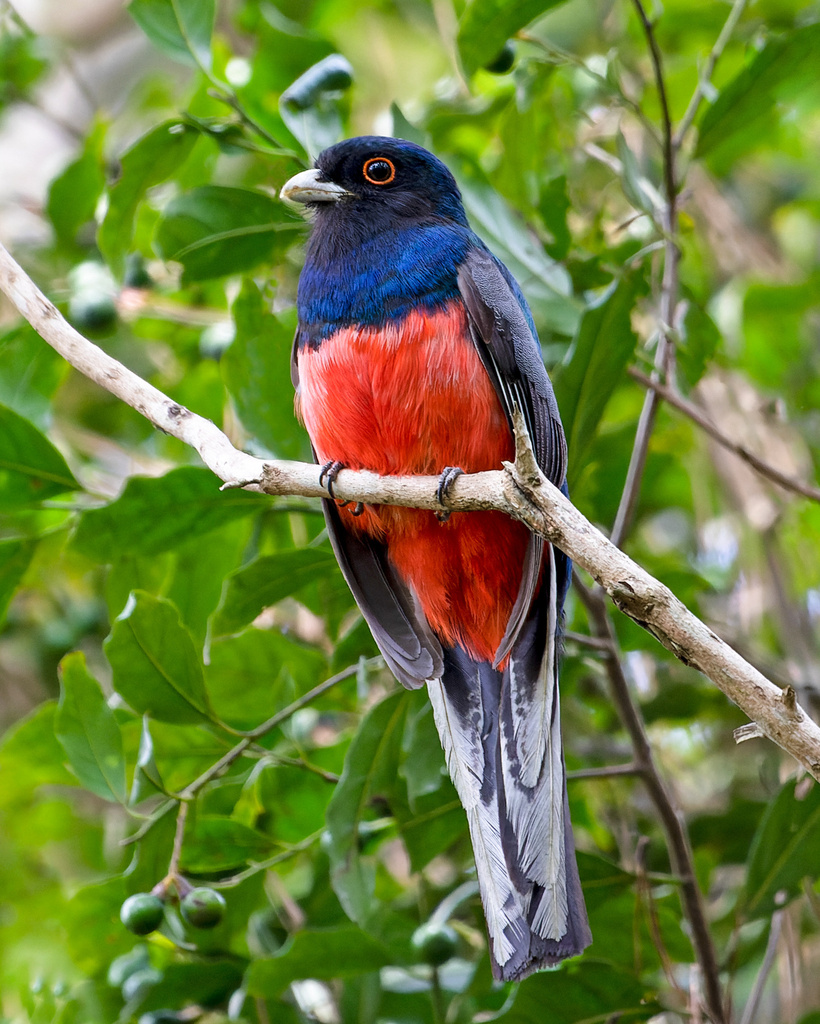
Surucua Trogon
Photo © Paulo Mascaretti
Photo © Paulo Mascaretti — CC0 1.0 — Source: iNaturalist photo #239893876Identification
The Surucua trogon is a compact bird measuring 26–28 cm in length, with males and females showing striking differences. Males of the nominate subspecies display a blackish face and throat contrasted by a distinctive orange eye-ring, royal blue crown, neck, and breast, and a coppery-green back that transitions to turquoise-green on the tail coverts. The belly is pinkish-red with gray flanks, while the underside of the tail is white with a black terminal bar. Females are mostly gray with red beginning lower on the belly, white spots before and after the eye, and a black-and-white patterned undertail. The subspecies T. s. aurantius differs in having a yellow eye-ring and orange belly in males, while females show yellowish-white to orange-yellow underparts.
Range & Habitat
The Surucua trogon is found across southeastern South America, including Argentina, Brazil, Paraguay, and Uruguay. The nominate subspecies ranges from eastern Paraguay and northeastern Argentina eastward into Uruguay and northern Brazil as far as southeastern Tocantins, occurring at elevations up to 1,150–1,550 m depending on location. The subspecies T. s. aurantius occupies a more restricted range in east-central and eastern Brazil from Bahia south to São Paulo, reaching elevations up to 2,000 m. Both subspecies inhabit the mid-story levels of primary and well-developed secondary forests and semideciduous woodlands, with T. s. aurantius frequently associating with bamboo stands.
Behaviour & Diet
The Surucua trogon is mostly sedentary, though southernmost populations migrate northward during the austral winter, while the northern subspecies appears to be a permanent resident. The species feeds on a diverse diet of insects—both adults and larvae—supplemented by fruits and occasionally flowers, and regularly joins mixed-species foraging flocks. Breeding occurs from September through December and possibly into January, with birds nesting in cavities within decayed trees or arboreal termite nests; documented clutches contain three eggs. The species' song consists of an ascending sequence of 14–20 moderately high-pitched 'diu' or 'kwa' notes with gradually increasing amplitude, while a sharp 'kiarr' call serves as a warning.
Best Time & Places to See It
The breeding season from September through December offers optimal opportunities to locate Surucua trogons, as birds are more vocal and active during this period. Look for them in mid-story forest levels within protected areas and well-developed secondary forests across their range. In Brazil, key regions include the forests of Rio de Janeiro state, Minas Gerais, Bahia, and São Paulo. The species can also be found in the Atlantic Forest regions of Paraguay and northeastern Argentina. Mixed-species foraging flocks may provide additional chances of encounter, particularly in areas where the birds congregate.
Photography Tips
The Surucua trogon's small size and preference for mid-story perches present moderate photographic challenges. Position yourself in or beneath the canopy during early morning hours when the birds are most vocal and active. The male's vibrant blue breast and pinkish-red belly offer striking color opportunities, while the contrasting facial patterns are particularly photogenic. Use a telephoto lens of at least 300–400 mm to capture detail from distance without disturbing the bird. Patience is essential; wait quietly near suspected feeding or breeding areas and listen for the distinctive song to locate individuals. Overcast conditions will reduce harsh shadows and help render the blue plumage accurately.
Tijuca National Park
Brazil
+317 birds+13 mammals
Where the Atlantic forest rises steeply from Rio de Janeiro's urban edge, Tijuca National Park encompasses a landscape of dramatic granite peaks, cascading waterfalls, and closed-canopy…
VIEW NATIONAL PARKSerra do Cipó National Park
Brazil
+379 birds+5 mammals
Where granite escarpments rise above the Atlantic Forest transition zone in southeastern Brazil, Serra do Cipó National Park unfolds across a landscape of dramatic ridges, cascading…
VIEW NATIONAL PARKItatiaia National Park
Brazil
+519 birds+12 mammals
Where granite peaks pierce the Atlantic rainforest canopy in southeastern Brazil, Itatiaia National Park rises as one of the country's oldest and most ecologically vital protected…
VIEW NATIONAL PARKSuperagui National Park
Brazil
+246 birds+2 mammals
Where the Atlantic rainforest meets the subtropical coast of Paraná, Superagui National Park sprawls across more than 1,000 square kilometres of one of Brazil's most biodiverse…
VIEW NATIONAL PARKSerra do Itajaí National Park
Brazil
+227 birds+2 mammals
Where the Atlantic rainforest rises steeply from the coastal plains of Santa Catarina, Serra do Itajaí National Park spreads across 1,136 square kilometres of montane wilderness…
VIEW NATIONAL PARKSerra da Bocaina National Park
Brazil
+441 birds+5 mammals
Where the escarpment of the Serra da Bocaina rises sharply from the Atlantic coastal plain, tropical rainforest cloaks steep mountainsides that climb toward peaks exceeding 2,000…
VIEW NATIONAL PARKIguaçu National Park
Brazil
+387 birds+17 mammals
Where the Paraná Plateau plunges toward the Atlantic watershed, six thousand square kilometers of subtropical rainforest cling to steep gorges and river valleys in this corner…
VIEW NATIONAL PARKSão Joaquim National Park
Brazil
+222 birds+9 mammals
Where the southern Brazilian highlands rise above the Atlantic Forest, São Joaquim National Park protects nearly 1,000 square kilometers of montane terrain that shifts between temperate…
VIEW NATIONAL PARKSerra dos Órgãos National Park
Brazil
+446 birds+13 mammals
Granite peaks thrust skyward through the Atlantic Forest canopy in the mountains immediately north of Rio de Janeiro, their bare rock faces rising above a landscape…
VIEW NATIONAL PARKChapada dos Veadeiros National Park
Brazil
+324 birds+6 mammals
Where granite plateaus rise above the cerrado savanna in central Brazil, Chapada dos Veadeiros National Park unfolds across 6,665 square kilometres of some of the world's…
VIEW NATIONAL PARKChapada Diamantina National Park
Brazil
+346 birds+5 mammals
Where granite peaks and sandstone cliffs rise abruptly from the Brazilian interior, Chapada Diamantina National Park sprawls across 4,215 square kilometers of some of Brazil's most…
VIEW NATIONAL PARKSerra do Gandarela National Park
Brazil
+333 birds+3 mammals
Where granite massifs rise through Atlantic Forest in southeastern Brazil's highlands, Serra do Gandarela National Park protects nearly 1,000 square kilometres of montane terrain that few…
VIEW NATIONAL PARKBrasília National Park
Plano Piloto, Brazil
+338 birds+15 mammals
Cerrado grassland and scattered woodland sweep across the central Brazilian plateau where this national park sprawls across more than a thousand square kilometres of the Federal…
VIEW NATIONAL PARKAraucárias National Park
Brazil
+231 birds+3 mammals
Where the southern Brazilian highlands rise into cool temperate forest, Araucárias National Park protects one of the Atlantic Forest's most distinctive ecosystems across 506 square kilometres…
VIEW NATIONAL PARKSerra Geral National Park
Brazil
+211 birds+2 mammals
Where basalt cliffs and sandstone escarpments rise above the subtropical forests of southern Brazil, Serra Geral National Park preserves one of the Atlantic region's most dramatic…
VIEW NATIONAL PARKCampos Gerais National Park
Brazil
+143 birds
Where rolling plateaus rise above the Atlantic forest escarpment in Paraná's interior, Campos Gerais National Park unfolds across 539 square kilometers of highland grassland and forest…
VIEW NATIONAL PARKRío Pilcomayo National Park
Argentina
+271 birds+13 mammals
Where the Río Pilcomayo cuts through northeastern Argentina's subtropical lowlands, a sprawling mosaic of wetlands, grasslands, and seasonally flooded forests creates one of South America's most…
VIEW NATIONAL PARKIguazú National Park
Puerto Iguazú, Argentina
+346 birds+15 mammals
Where the Paraná Plateau plunges toward the Atlantic watershed, nearly 800 square kilometers of subtropical rainforest drape across Misiones Province in a landscape carved by millennia…
VIEW NATIONAL PARKParque Provincial Pampa del Indio
Laguna Limpia, Argentina
+231 birds+4 mammals
Across the flat horizons of Chaco Province, where the Paraná River system spills into vast wetlands and grasslands, Parque Provincial Pampa del Indio protects one of…
VIEW NATURE RESERVENo community photos yet. Log in to add the first one.
No community observations of this species yet.