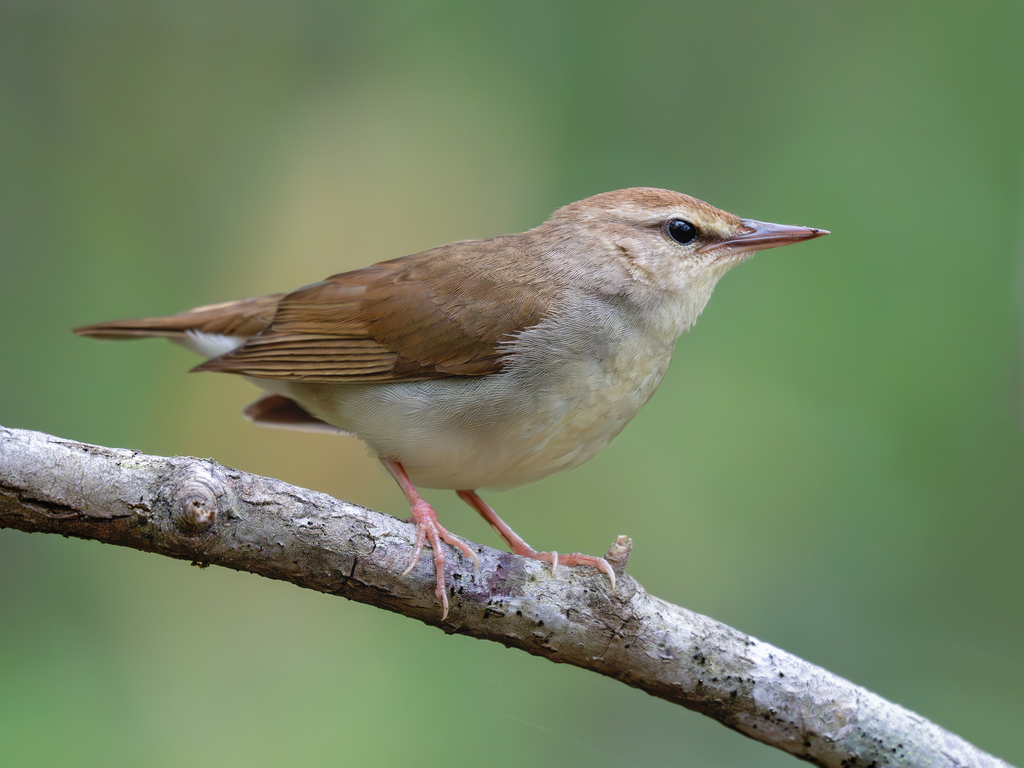
Swainson’s Warbler
Photo © Karen Szafrajda
Photo © Karen Szafrajda — CC BY 4.0 — Source: iNaturalist photo #430950506Identification
Swainson's warbler is a small but relatively large member of the New World warbler family, measuring 12.5–16 cm in length with a wingspan averaging 23 cm and weighing 11–20.5 g. Despite its modest size, it is a rather plain bird: olive-brown above with pale yellow-white underparts. The most distinctive feature is a whitish eyebrow stripe running above the eye, combined with a rusty-brown crown. Unlike most New World warblers, males and females are identical in appearance, making field identification based on plumage alone challenging.
Range & Habitat
This uncommon and elusive warbler is primarily found in the south-eastern United States, where it favours flooded swamplands and canebrakes as its preferred breeding habitat. Less commonly, it occurs in rhododendron thickets of the southern Appalachian Mountains. Swainson's warbler is migratory, with populations splitting into two distinct wintering routes: some birds travel south-eastward to the Greater Antilles, including the Blue Mountains of Jamaica, while others migrate south-westward to the Yucatán Peninsula region. This division in migratory behaviour appears to be hereditary and may be driving subtle genetic divergence between populations.
Behaviour & Diet
Breeding pairs form and establish territories for nesting, constructing large, bulky nests from moss, grass, and small leaves positioned above ground within tangles of tall reeds or vines. Females lay three to five white eggs, sometimes with rare brown speckling. Incubation is performed solely by the female and lasts approximately 14 days, with young fledging about 12 days after hatching. Breeding commences at around 10 months of age. While the duration of pair-bonds remains unknown, established pairs typically do not breed with other individuals during the current nesting season. These warblers can live for at least eight years in the wild.
Best Time & Places to See It
Finding Swainson's warbler requires patience and knowledge of its habitat preferences. Focus on flooded swamplands and extensive canebrake systems of the south-eastern United States during the breeding season. The bird's elusive nature and preference for dense cover make it challenging to observe. Timing your visit during breeding season increases your chances, and visiting known breeding territories in states with suitable swamp habitat offers the best opportunities. Birders should also consider wintering grounds in Jamaica's Blue Mountains or the Yucatán Peninsula if pursuing this species outside the breeding season.
Photography Tips
Photographing Swainson's warbler presents considerable challenges due to its preference for dense, tangled vegetation and its secretive behaviour. Use a telephoto lens (at least 400–600mm) to capture distant subjects without disturbing the bird. Early morning light in swampy habitats can be dim, so prioritize a fast shutter speed and higher ISO settings to avoid motion blur. The bird's plain plumage means that capturing the subtle rusty crown and eyebrow stripe is key to a satisfying photograph. Patience is essential—positioning yourself quietly near known territories and waiting for the bird to emerge from cover is more effective than active searching.
Alligator River National Wildlife Refuge
Biscayne National Park
Bombay Hook National Wildlife Refuge
Cape May Point State Park
Carlsbad Caverns National Park
Cedar Keys National Wildlife Refuge
Chassahowitzka National Wildlife Refuge
Chincoteague National Wildlife Refuge
Congaree National Park
Nothing matches these filters.
No community photos yet. Log in to add the first one.
No community observations of this species yet.