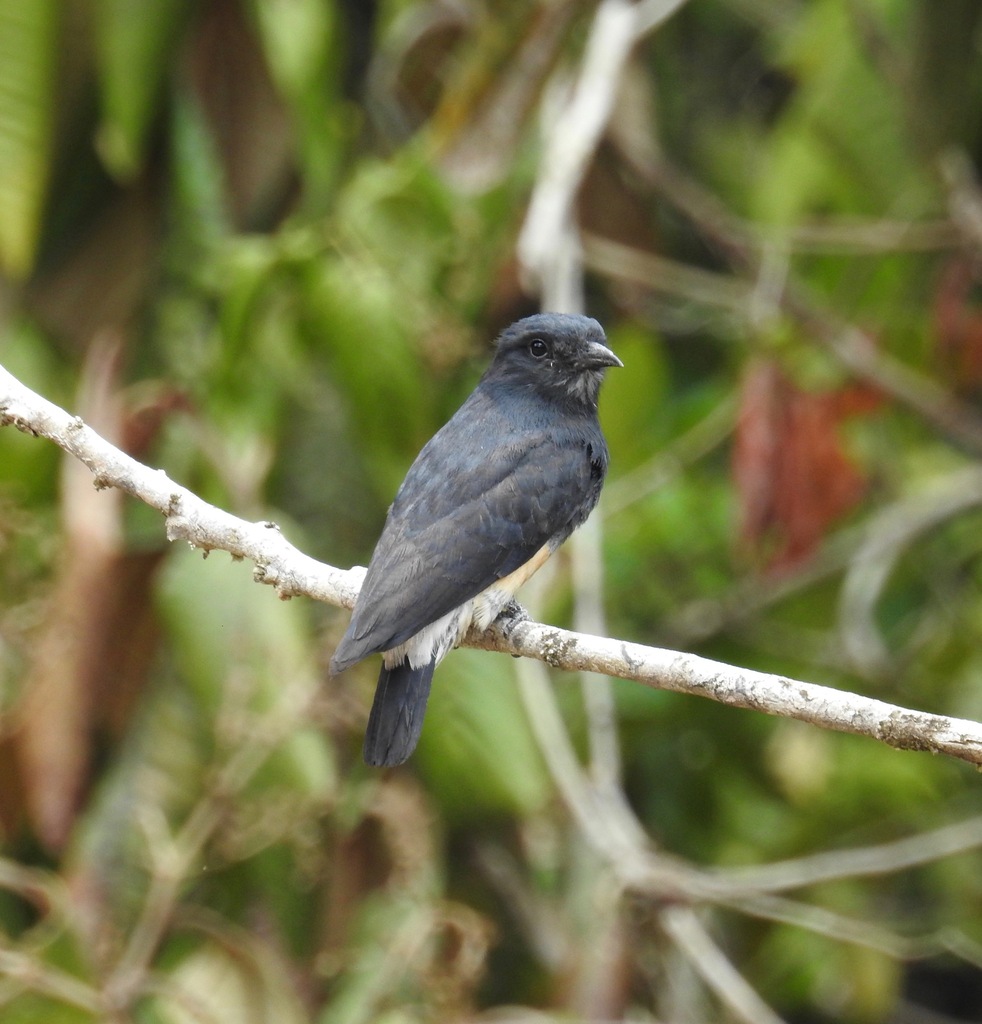
Swallow-winged Puffbird
Photo © Laura Gaudette
Photo © Laura Gaudette — CC BY 4.0 — Source: iNaturalist #194368069Identification
The swallow-winged puffbird is a small bird measuring 14 to 15 cm in length and weighing 30 to 41.5 grams. Despite its diminutive size, it is highly distinctive. The nominate subspecies displays sooty black upperparts with a subtle bluish iridescence, while the lower back and rump are white—a striking contrast that aids identification. The bird's wings are notably long and pointed, reflecting its aerial hunting prowess. Its short tail is black with white-tipped feathers, though these white tips wear away quickly. The underparts show a pattern of whitish chin, grayish throat, sooty black breast that fades to gray on the lower breast, and an orange-chestnut belly. The bill is black, the eye dark brown, and the feet dark gray or black.
Two additional subspecies show subtle variation. The larger C. t. brasiliensis features a distinct whitish band separating the grey lower breast from a more ochraceous belly, while C. t. pallida has paler underparts overall with a clear white breast band.
Range & Habitat
The swallow-winged puffbird is found throughout the Amazon Basin and beyond, occurring in Bolivia, Brazil, Colombia, Ecuador, French Guiana, Guyana, Peru, Suriname, and Venezuela. The widespread nominate subspecies ranges across most of Venezuela, south through eastern Colombia, Ecuador, and Peru to northern Bolivia, and eastward through the Guianas and much of interior Brazil. A separate population exists along the southeastern Brazilian coast, while C. t. pallida is restricted to Venezuela's northwestern state of Zulia.
This adaptable species inhabits a variety of open and semi-open landscapes, showing a preference for open areas with scattered bushes on sandy soils within generally forested regions. It also occurs in savanna, forest edges (transitional, secondary, and deciduous), várzea forest, and gallery forest. Elevations typically range from sea level to 1,000 meters, though it can locally be found as high as 1,750 meters.
Behaviour & Diet
The swallow-winged puffbird is an aerial insectivore with a distinctive hunting technique. It hunts by making sorties from an exposed perch, sallying out to snatch flying insects from the air and consuming them in flight—a behavior typical of flycatchers despite its classification among the puffbirds. This feeding method explains its long, pointed wings and swift, agile flight.
Breeding occurs at varying times across its wide range. The bird excavates tunnel nests in flat sandy ground or earthen banks, including human-made structures such as road cuts. Clutches consist of one or two whitish eggs. Vocally, the species produces a twittering song often given in flight, along with distinctive calls including a repeated "'tsi-tsi-tsi'" and a high, clear "'dí-didi dí-didi dí-didi…'" pattern.
Best Time & Places to See It
The swallow-winged puffbird is characterized as locally common throughout its extensive range, with populations believed to be increasing. Its presence depends largely on habitat availability. The species is widespread across the Amazon Basin and adjacent regions, making it accessible to travelers visiting much of northern South America, particularly in Venezuela, Colombia, Ecuador, Peru, Brazil, and the Guiana Shield countries. Look for it in open areas with scattered bushes, forest edges, and savanna habitats rather than dense forest.
Since the species' breeding season varies across its range, timing your visit according to local conditions will optimize your chances of observation. The bird's habit of perching openly while hunting makes it reasonably conspicuous where present, and its vocal displays, particularly the distinctive flight song, can aid in locating individuals.
Photography Tips
Photographing the swallow-winged puffbird presents interesting challenges and opportunities. The bird's preference for exposed perches while hunting makes it more approachable than many forest species. Its small size and swift movements demand a fast shutter speed; aim for at least 1/1000th of a second to freeze its aerial sorties. The contrast between its dark upperparts and white lower back provides excellent compositional potential.
The bird's habit of vocalizing in flight offers unique opportunities for action photography. Its long, pointed wings are particularly striking in flight photographs. Early morning and late afternoon light will best reveal the subtle bluish iridescence of its black plumage. Open habitat preferences mean good lighting conditions are often available. Patience at known perch sites may yield excellent shots of the bird launching from its hunting post to capture insects.
Emas National Park
Brazil
+333 birds+23 mammals
Across the high plateaux of central Brazil, where the cerrado grasslands roll toward distant horizons under an immense sky, Emas National Park anchors one of South…
VIEW NATIONAL PARKYasuní National Park
Aguarico, Ecuador
+601 birds+43 mammals
Where the western Amazon basin converges with Ecuador's Orellana Province, lowland rainforest reaches toward the horizon in an unbroken canopy of staggering botanical density. Yasuní National…
VIEW NATIONAL PARKNatural Sierra de Chiribiquete National Park
Solano, Colombia
+359 birds+27 mammals
Massive table-top mountains rise abruptly from the lowland rainforest of southeastern Colombia, their sheer sandstone cliffs and isolated summits creating some of the most dramatic topography…
VIEW NATIONAL PARKNatural la Paya National Park
Puerto Leguízamo, Colombia
+262 birds+4 mammals
Where the Amazon's western reaches fold into the Andes foothills, La Paya National Park sprawls across more than 8,500 square kilometers of pristine Amazonian rainforest in…
VIEW NATIONAL PARKNatural Río Puré National Park
La Pedrera, Colombia
+40 birds+1 mammals
Where the Río Puré carves through northwestern Amazonia on the Colombia–Peru border, a landscape of flooded forests, terra firme ridges, and whitewater tributaries protects nearly 14,600…
VIEW NATIONAL PARKEl Tamá National Park
Toledo, Colombia
+435 birds
Where the Andes descend toward the Caribbean coastal lowlands of northern Colombia, El Tamá National Park sprawls across nearly 3,800 square kilometres of montane forest, cloud…
VIEW NATIONAL PARKNatural Sierra de la Macarena National Park
Vista Hermosa, Colombia
+566 birds+15 mammals
Across nearly 20,000 square kilometres of Colombia's Meta Department, the terrain rises from lowland savanna into Andean foothills through a mosaic of gallery forests, palm-fringed wetlands,…
VIEW NATIONAL PARKAmacayacu National Park
Leticia, Colombia
+567 birds+25 mammals
Where the Rio Amazonas curves through the tri-border region where Colombia, Peru, and Brazil converge, Amacayacu National Park sprawls across more than 5,250 square kilometres of…
VIEW NATIONAL PARKViruá National Park
Brazil
+389 birds+6 mammals
Across the northern frontier of Roraima, where the forest canopy rises from ancient Amazonian lowlands, Viruá National Park protects nearly 3,700 square kilometres of terra firme…
VIEW NATIONAL PARKSerra do Pardo National Park
Brazil
+153 birds
Vast upland forests and weathered plateaus define this 7,129-square-kilometre protected expanse in the heart of Pará's remote interior, where ancient bedrock and swollen rivers have carved…
VIEW NATIONAL PARKPau Brasil National Park
Brazil
+211 birds
Tropical Atlantic forest cloaks the rolling terrain of northeastern Bahia, where Pau Brasil National Park protects nearly 390 square kilometers of one of Brazil's most biodiverse…
VIEW NATIONAL PARKMonte Roraima National Park
Brazil
+226 birds+1 mammals
Where the tepuis rise from the Amazon basin like islands in a sea of forest, Monte Roraima National Park sprawls across 3,714 square kilometres of one…
VIEW NATIONAL PARKChapada dos Guimarães National Park
Brazil
+450 birds+1 mammals
Where weathered sandstone plateaus rise above the cerrado grasslands of central Brazil, Chapada dos Guimarães National Park protects 624 square kilometres of ecological transition zone that…
VIEW NATIONAL PARKChapada dos Veadeiros National Park
Brazil
+324 birds+6 mammals
Where granite plateaus rise above the cerrado savanna in central Brazil, Chapada dos Veadeiros National Park unfolds across 6,665 square kilometres of some of the world's…
VIEW NATIONAL PARKPantanal Matogrossense National Park
Brazil
+322 birds+17 mammals
Where the flooded forests of central Brazil meet vast seasonally inundated grasslands, Pantanal Matogrossense National Park sprawls across nearly 2,900 square kilometers of one of the…
VIEW NATIONAL PARKBrasília National Park
Plano Piloto, Brazil
+338 birds+15 mammals
Cerrado grassland and scattered woodland sweep across the central Brazilian plateau where this national park sprawls across more than a thousand square kilometres of the Federal…
VIEW NATIONAL PARKAmazônia National Park
Brazil
+439 birds+6 mammals
Where the Rio Amazonas and its tributaries weave through the heart of Pará state, a vast tapestry of rainforest stretches across 23,611 square kilometers of unbroken…
VIEW NATIONAL PARKMapinguari National Park
Brazil
+354 birds
Vast tracts of western Amazonian rainforest blanket the remote terrain of this 56,827 square kilometre national park in Amazonas state, where seasonal rivers wind through dense…
VIEW NATIONAL PARKJaú National Park
Brazil
+354 birds+3 mammals
Vast floodplain forests and blackwater rivers define this remote corner of western Amazonas, where the Rio Negro and its tributaries have carved an intricate mosaic of…
VIEW NATIONAL PARKPacaás Novos National Park
Brazil
+279 birds+1 mammals
Across the border between Rondônia and Amazonas, vast tracts of humid tropical forest rise and fall in gentle undulations, carved by clear-flowing rivers that feed into…
VIEW NATIONAL PARKAnavilhanas National Park
Brazil
+468 birds+8 mammals
Across the Rio Negro in central Amazonas, an archipelago of over a thousand islands rises from the world's largest rainforest river system, creating a labyrinth of…
VIEW NATIONAL PARKCampos Amazónicos National Park
Amazonas, Brazil
+434 birds+7 mammals
Sprawling across the southwestern Amazon basin in Amazonas state, this 27,263-square-kilometre national park encompasses some of the region's most pristine lowland rainforest, where terra firme forest…
VIEW NATIONAL PARKSerra do Divisor National Park
Brazil
+448 birds+10 mammals
Where the western Amazon meets the Andes foothills, Serra do Divisor National Park sprawls across one of South America's most biodiverse and least accessible frontiers. Spanning…
VIEW NATIONAL PARKPico da Neblina National Park
Brazil
+103 birds
Where the Amazon's western rampart rises into perpetual mist, Pico da Neblina National Park sprawls across more than 33,000 square kilometres of some of Earth's least…
VIEW NATIONAL PARKYanachaga–chemillén National Park
Palcazu, Peru
+639 birds+6 mammals
Where the eastern slopes of Peru's central cordillera plunge into cloud forest, Yanachaga–Chemillén National Park protects nearly three thousand square kilometres of montane wilderness that few…
VIEW NATIONAL PARKManu National Park
Manu, Peru
+892 birds+26 mammals
Across the eastern slopes of the Peruvian Andes, tropical rainforest descends into the Amazon basin with a complexity that few terrestrial ecosystems match. Manu National Park…
VIEW NATIONAL PARKSierra del Divisor National Park
Alto Tapiche, Peru
+298 birds+2 mammals
Where the western Amazon meets the Andes foothills, nearly 41,000 square kilometres of pristine rainforest rise across Peru's Alto Tapiche region in a landscape of extraordinary…
VIEW NATIONAL PARKBahuaja Sonene National Park
San Pedro de Putina Punco, Peru
+602 birds+8 mammals
Where the Madre de Dios and Heath rivers converge in southeastern Peru rises one of South America's most biodiverse wilderness regions: a vast protected realm of…
VIEW NATIONAL PARKTingo Maria National Park
Mariano Dámaso Beraún, Peru
+423 birds
Where the eastern slopes of the Peruvian Andes descend toward the Amazon basin, the landscape fractures into a maze of limestone ridges, humid gorges, and cloud-wrapped…
VIEW NATIONAL PARKCordillera Azul National Park
Pampa Hermosa, Peru
+322 birds+1 mammals
Where the eastern Andes descend into the western Amazon basin, Cordillera Azul National Park sprawls across nearly 38,000 square kilometres of some of Peru's most pristine…
VIEW NATIONAL PARKNo community photos yet. Log in to add the first one.
No community observations of this species yet.