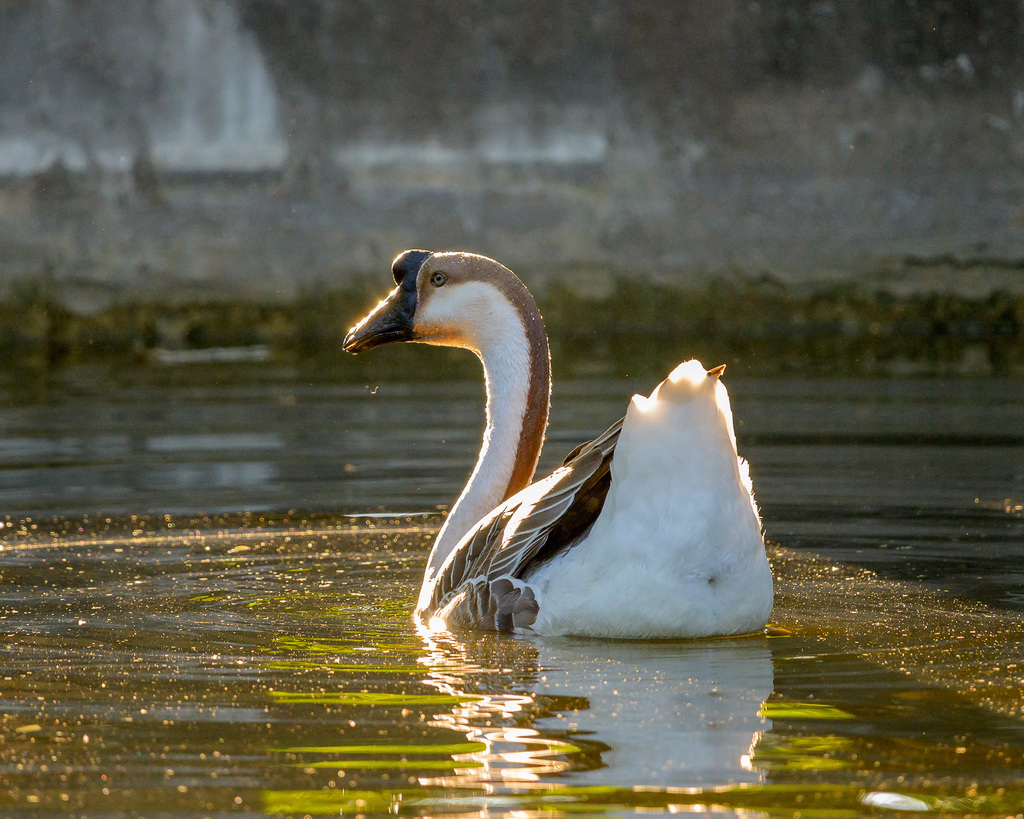
Swan Goose
Photo © Shiva Shenoy
Photo © Shiva Shenoy — CC BY 4.0 — Source: iNaturalist #48906287Identification
The swan goose is a large and long-necked goose, among the longest in its genus at 81–94 cm, with a distinctive appearance that sets it apart from other Anser geese. Males are noticeably larger than females, with proportionally longer bills and necks. The plumage features greyish-brown upperparts with a striking maroon hindneck and cap that reaches just below the eye, contrasting sharply with the pale buff underside, particularly on the lower head and foreneck. The remiges and underwing are blackish, while the rectrices are white-tipped. Uniquely among its genus, the swan goose has a completely black bill, whereas most relatives have orange legs and feet. The eyes display maroon irides, and a thin white stripe encircles the bill base. In flight, the wings appear uniformly dark without conspicuous patterning. Juveniles are duller and lack the distinctive white bill base and dark belly streaks of adults. The species produces a loud, drawn-out and ascending honking call, with a more barking variant used as a warning.
Range & Habitat
The swan goose has a natural breeding range in inland Mongolia, Northeast China, and the Russian Far East, where it inhabits steppe to taiga and mountain valleys near freshwater. It is highly migratory, wintering mainly in central and eastern China, particularly around Lake Dongting, Lake Poyang, the Yancheng Coastal Wetlands, and the lower Yangtze River region. Vagrant birds are occasionally encountered in Japan, Korea, Kazakhstan, Laos, coastal Siberia, Taiwan, Thailand, and Uzbekistan. The species has been extensively domesticated as the Chinese goose, and introduced and feral populations now occur in many places outside its natural range.
Behaviour & Diet
Swan geese are grazers, feeding primarily on sedges, grasses, and water plants, and rarely swimming. They form small flocks outside the breeding season, grazing on plains and stubble fields in winter, sometimes far from water. The breeding season begins around May, with birds returning from winter quarters in April. They breed as single pairs or loose groups near marshes and other wetlands, constructing shallow nests from plants directly on the ground, often on small knolls to maintain dryness. Clutches typically contain 5–6 eggs, though sometimes up to 8. The precocial young hatch after approximately 28 days and reach sexual maturity at 2–3 years of age. In late August and early September, birds depart for winter quarters, where they gather in small groups to moult.
Best Time & Places to See It
The swan goose is uncommon in the wild, with fewer than 500 pairs possibly remaining in Russia and unknown numbers in Mongolia. The most reliable locations for viewing are the wintering grounds in central and eastern China, where approximately 60,000 individuals may be found annually, potentially representing nearly the entire world population. Important wintering sites include Lake Dongting, Lake Poyang, and the Yancheng Coastal Wetlands. Birds return to breeding areas around April and depart for winter quarters in late August and early September. Once present in Japan and Korea in greater numbers, the species is now rarely encountered there due to habitat destruction, though vagrant sightings remain possible.
Photography Tips
Photographing swan geese requires patience, as the species is uncommon and often wary. The distinctive maroon cap and hindneck provide excellent identification markers and photographic subjects. The completely black bill, orange legs, and contrasting pale underside create striking compositional elements. Winter flocking behaviour in key Chinese wetlands offers opportunities for capturing group dynamics. The birds' large size and long necks are best showcased in profile shots. In flight, the uniformly dark wings become visible, though the lack of conspicuous wing patterns means that ground and water settings are preferable for highlighting the bird's distinctive plumage. Early morning and late afternoon light will enhance the rich maroon tones of the head and the subtle greyish-brown of the upperparts.
Schleswig-Holsteinisches Wattenmeer National Park
Germany
+378 birds+49 mammals
Where the North Sea ebbs and flows across a vast expanse of exposed mud and sand, the Schleswig-Holsteinisches Wattenmeer National Park reveals one of Europe's most…
VIEW NATIONAL PARKSaxon Switzerland National Park
Sebnitz, Germany
+118 birds+9 mammals
Sandstone cliffs and narrow gorges define this corner of eastern Saxony, where the Elbe River has carved a dramatic landscape of towering rock formations and densely…
VIEW NATIONAL PARKBannau Brycheiniog National Park
Powys, United Kingdom
+178 birds+36 mammals
Where sandstone ridges rise above the rolling moorlands of mid-Wales, Bannau Brycheiniog National Park protects one of Britain's most compelling upland landscapes. The park's dramatic peaks,…
VIEW NATIONAL PARKDartmoor National Park
West Devon, United Kingdom
+162 birds+33 mammals
Across the high moorlands of Devon, where granite tors pierce through rolling heather and acid grassland, Dartmoor rises as one of Britain's most expansive upland wilderness…
VIEW NATIONAL PARKGreat Smoky Mountains National Park
Sevier County, United States
+244 birds+40 mammals
Where the southern Appalachian ridgeline reaches its most densely forested expression, over 4,200 square kilometres of temperate woodland rise and fall across Tennessee and North Carolina,…
VIEW NATIONAL PARKCévennes National Park
Vebron, France
+187 birds+63 mammals
Where granite gorges slice through the limestone plateaux of southern France, the Cévennes Cœur National Park unfolds across nearly 3,500 square kilometres of one of Europe's…
VIEW NATIONAL PARKKhangai Nuruu National Park
Erdenetsogt, Mongolia
+136 birds+7 mammals
Where granite ridges pierce Mongolia's central steppe, alpine meadows give way to dense coniferous forests that climb toward windswept summits. Khangai Nuruu sweeps across 1.2 million…
VIEW NATIONAL PARKHustai National Park
Altanbulag, Mongolia
+198 birds+16 mammals
Where the steppe rolls endlessly beneath vast Mongolian skies, Hustai National Park preserves one of Central Asia's most dynamic grassland ecosystems. Rolling hills and open prairie…
VIEW NATIONAL PARKGobi Gurvan Saikhan National Park
Tsagaan Subarga Hural, Mongolia
+183 birds+23 mammals
Where rust-coloured badlands rise from the southern Gobi steppe, the terrain transforms into a landscape of geological drama that few visitors expect to find in Mongolia's…
VIEW NATIONAL PARKYancheng National Nature Reserve
Yancheng, China
+208 birds+4 mammals
Where the East China Sea's tidal rhythms sculpt the Jiangsu coast, Yancheng National Nature Reserve sprawls across one of Asia's most dynamic wetland complexes. This vast…
VIEW NATURE RESERVEPoyang Lake National Nature Reserve
Shangrao, China
+270 birds+7 mammals
Where the Yangtze River's massive floodplain spreads across central China, Poyang Lake National Nature Reserve encompasses one of the continent's most dynamic and water-rich wetland systems.…
VIEW NATURE RESERVEBaima Snow Mountain National Nature Reserve
Diqing Tibetan Autonomous Prefecture, China
+204 birds+3 mammals
High-altitude ridges and steep-sided valleys define this reserve in northwestern Yunnan, where elevations surge from around 3,000 metres to peaks above 4,100 metres. The terrain supports…
VIEW NATURE RESERVEJ.N. “Ding” Darling National Wildlife Refuge
Sanibel, United States
+277 birds+6 mammals
Mangrove channels and coastal marshlands dominate this 6,400-acre sanctuary on Florida's Gulf coast, where brackish waterways weave between dense stands of red, black, and white mangrove…
VIEW WILDLIFE SANCTUARYMerritt Island National Wildlife Refuge
Brevard County, United States
+341 birds+19 mammals
Brackish marshes and palmetto scrub define this wildlife sanctuary spanning the coastal lowlands of central Florida, where the Atlantic tide meets freshwater systems in a dynamic…
VIEW WILDLIFE SANCTUARYMalheur National Wildlife Refuge
Harney County, United States
+309 birds+24 mammals
Across the high desert plateau of southeastern Oregon, where sagebrush scrubland stretches toward distant ridgelines under an enormous sky, lies a sanctuary shaped by water in…
VIEW WILDLIFE SANCTUARYSt. Marks National Wildlife Refuge
Saint Marks, United States
+324 birds+16 mammals
Where the Apalachee Bay begins to define the Florida coastline, salt marshes and freshwater impoundments merge into one of the southeastern United States' most productive wildlife…
VIEW WILDLIFE SANCTUARYChassahowitzka National Wildlife Refuge
Homosassa, United States
+299 birds+14 mammals
Where the Gulf of Mexico's coastal marshes dissolve into brackish tidal flats and mangrove thickets, the Chassahowitzka National Wildlife Sanctuary near Homosassa represents one of Florida's…
VIEW WILDLIFE SANCTUARYRibble Estuary National Nature Reserve
Southport, United Kingdom
+197 birds+17 mammals
Where the Ribble flows into the Irish Sea, a landscape of mudflats, salt marshes and shallow pools creates one of northwest England's most dynamic estuarine ecosystems.…
VIEW NATURE RESERVENo community photos yet. Log in to add the first one.
No community observations of this species yet.