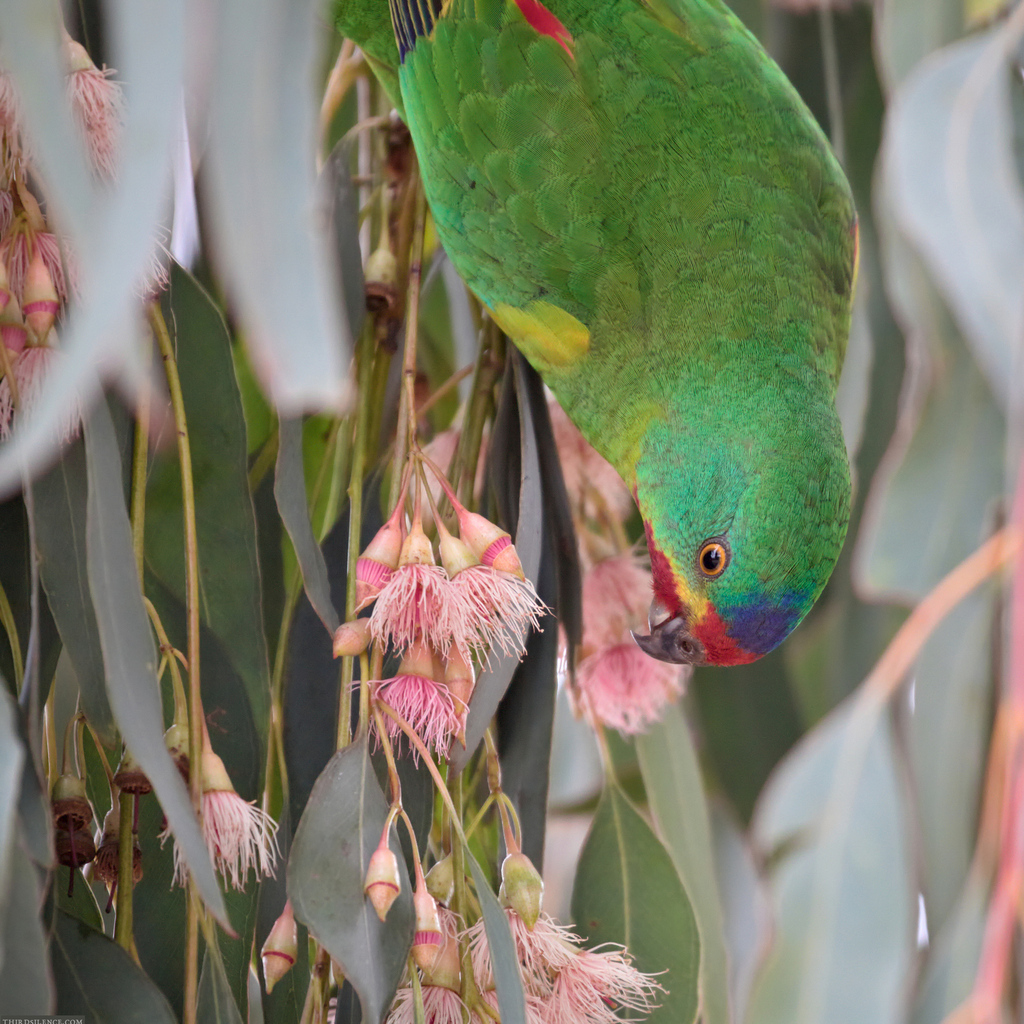
Swift Parrot
Photo © Third Silence
Photo © Third Silence — CC BY-SA 4.0 — Source: iNaturalist #195490813Identification
The swift parrot is a small parrot, approximately 25 centimetres long, with distinctive long pointed wings and tapering tail feathers that reflect its aerial prowess. Its plumage is predominantly green with a bluish crown and striking crimson markings on the face above and below the beak, extending from the forehead to the throat. A crimson patch also adorns the edge of the wing. Adult females are slightly duller than males, while juveniles can be identified by their dark brown iris and pale orange bill. These are notably noisy, active and showy birds, recognisable by their characteristically fast, direct flight.
Despite superficial resemblance to lorikeets in appearance and behaviour, the swift parrot belongs to the tribe Platycercini, making it more closely related to rosellas. Like lorikeets, they possess brush-tipped tongues, though the papillae are shorter and more localised—a fascinating example of convergent evolution among distantly-related parrot genera.
Range & Habitat
Found only in southeastern Australia, the swift parrot is a remarkable nomadic migrant. It breeds in Tasmania during the southern summer from September to February, then migrates north to mainland Australia during winter, ranging from Griffith-Warialda in New South Wales west to Adelaide. This single, genetically mixed population moves across the landscape each year, settling only where food is available.
In Tasmania, swift parrots breed in areas where preferred food sources—nectar from flowering Eucalyptus globulus and Eucalyptus ovata—are abundant and suitable nesting sites exist nearby. They are highly selective nesters, preferring tree cavities with small entrances, deep chambers and wide floors, traits found in only 5% of available cavities and more likely in large trees. Such cavities provide passive defence against native predators but are highly vulnerable to disturbance.
Behaviour & Diet
Swift parrots are entirely dependent on eucalyptus nectar, particularly from E. globulus and E. ovata during breeding season. Their nomadic nature means they track flowering resources across Tasmania and mainland Australia, settling wherever conditions allow them to raise young successfully. Successful nests produce a mean clutch of 3.8 eggs and fledge 3.2 young, with overall breeding success of 86.9% under optimal conditions.
These parrots are noted for being noisy, always active and highly visible. Their behaviour is driven by resource availability rather than territory, allowing them to breed in the most resource-rich patches available each year and rear nestlings in the best conditions possible.
Best Time & Places to See It
Swift parrots arrive in Tasmania during September to breed through February, making spring and early summer the prime season for observation in their breeding range. Winter offers opportunities to see them on the mainland from November onwards as they migrate north to southeastern Australia. However, the species' nomadic habits mean that sightings are unpredictable and depend entirely on local eucalyptus flowering patterns. Birdwatchers and travellers should consult current flowering reports and local birding guides to locate active populations.
The swift parrot was voted 2023 Bird of the Year by The Guardian Australia and BirdLife Australia, reflecting growing conservation interest in the species. Its critically endangered status makes any sighting particularly significant for wildlife enthusiasts.
Photography Tips
Swift parrots present a challenging but rewarding photography subject. Their fast, direct flight and active nature demand quick reflexes and a camera capable of tracking rapid movement. The striking crimson and green plumage provides excellent colour contrast, particularly when birds are active in flowering eucalyptus canopies. Early morning and late afternoon light will enhance the visibility of the subtle blue crown and red facial markings.
Since swift parrots are nomadic and settle only where eucalyptus trees are flowering abundantly, photograph locations should focus on flowering E. globulus and E. ovata trees in Tasmania during September–February or in mainland southeastern Australia during the winter months. The birds' preference for flowering trees makes them relatively conspicuous when present, but patience and positioning near suitable food sources will greatly increase photographic opportunities.
Greater Bendigo National Park
Whipstick, Australia
+202 birds+8 mammals
Across the red volcanic plains of inland Victoria, Greater Bendigo National Park sprawls across more than 1,000 square kilometres of eucalyptus woodland, open grassland, and scattered…
VIEW NATIONAL PARKChiltern-Mt Pilot National Park
Australia
+229 birds+12 mammals
Granite ridges and eucalyptus woodlands define this 869-square-kilometre park straddling the border between Victoria and New South Wales, where rugged terrain rises sharply from gentler foothill…
VIEW NATIONAL PARKRoyal National Park
Sydney, Australia
+296 birds+46 mammals
Where sandstone ridges plunge toward the Tasman Sea, Royal National Park unfolds across 343 square kilometres of southeastern Australian coastal wilderness. The park's defining character emerges…
VIEW NATIONAL PARKLittle Desert National Park
Australia
+200 birds+11 mammals
Across northwestern Victoria's semi-arid interior, sandstone ridges and heathland plateaus rise from red earth in a landscape sculpted by fire and drought rather than water. Little…
VIEW NATIONAL PARKMorton National Park
Australia
+253 birds+57 mammals
Across nearly 4,800 square kilometers of New South Wales's Southern Tablelands, rugged sandstone plateaus rise above sheltered valleys where cool-climate eucalypt woodland meets grassy heath and…
VIEW NATIONAL PARKHeathcote National Park
Sydney, Australia
+119 birds+16 mammals
Sandstone ridges and eucalypt woodlands rise from the Cumberland Plain southwest of Sydney, where Heathcote National Park unfolds across 82 square kilometres of bushland shaped by…
VIEW NATIONAL PARKWilsons Promontory National Park
Australia
+210 birds+21 mammals
Where granite headlands plunge toward Bass Strait, Wilson's Promontory National Park sprawls across nearly 1,300 square kilometers of southeastern Victoria's most rugged coastal wilderness. The park's…
VIEW NATIONAL PARKBlue Mountains National Park
Australia
+220 birds+43 mammals
Dramatic sandstone cliffs rise in tiers across this mountainous plateau west of Sydney, their rust-coloured faces weathered into amphitheatres and gorges where eucalyptus forest clings to…
VIEW NATIONAL PARKKosciuszko National Park
Australia
+211 birds+52 mammals
Where the Great Dividing Range reaches its highest peaks in southeastern Australia, Kosciuszko National Park encompasses a landscape of windswept plateaus, rocky ridges, and deep river…
VIEW NATIONAL PARKKu-ring-gai Chase National Park
Sydney, Australia
+216 birds+39 mammals
Where Hawkesbury sandstone cliffs plunge toward sheltered bays and creeks, Ku-ring-gai Chase National Park unfolds across rugged terrain just north of Sydney, a mosaic of eucalyptus…
VIEW NATIONAL PARKWarrumbungle National Park
Coonabarabran, Australia
+183 birds+22 mammals
Volcanic peaks and weathered ridges rise abruptly from the inland tablelands of central New South Wales, their exposed rock faces glowing ochre and rust in the…
VIEW NATIONAL PARKBen Boyd National Park
Eden, Australia
+255 birds+47 mammals
Where the temperate forests of the far south coast meet towering sea cliffs, Ben Boyd National Park unveils one of New South Wales' most dramatic coastal…
VIEW NATIONAL PARKGrampians National Park
Australia
+214 birds+18 mammals
Where sandstone ridges rise above the Western District of Victoria, Grampians National Park unfolds across rolling terrain sculpted by ancient geology and sustained by a temperate…
VIEW NATIONAL PARKGreat Otway National Park
Australia
+255 birds+42 mammals
Temperate rainforest and wet eucalyptus woodland cloak the ridges and gullies of Victoria's Great Otway National Park, where persistent moisture and mild year-round temperatures sustain a…
VIEW NATIONAL PARKCradle Mountain-Lake St Clair National Park
Australia
+72 birds+8 mammals
Where glacial valleys plunge between quartzite peaks, Tasmania's Cradle Mountain-Lake St Clair National Park unfolds as a temperate wilderness of uncommon grandeur. The park's terrain ranges…
VIEW NATIONAL PARKFreycinet National Park
Coles Bay, Australia
+115 birds+9 mammals
Granite peaks rise abruptly from the Tasmanian coast where Coles Bay opens into the Freycinet Peninsula, sculpting one of southeastern Australia's most dramatically vertical national parks.…
VIEW NATIONAL PARKNo community photos yet. Log in to add the first one.
No community observations of this species yet.