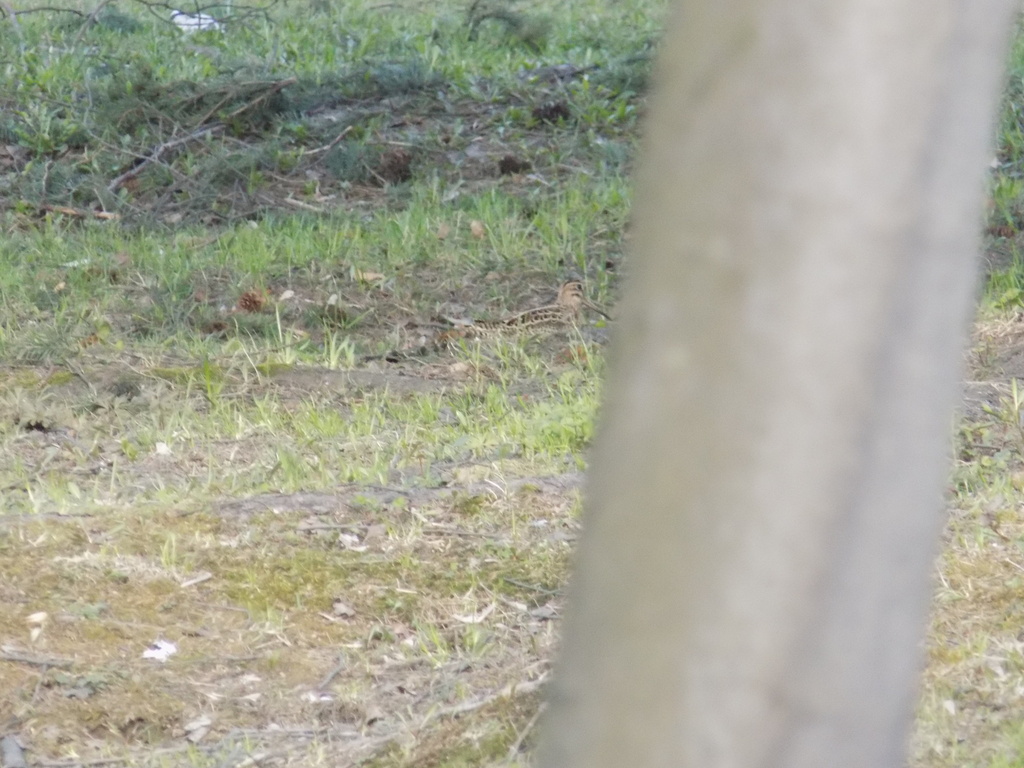
Swinhoe’s Snipe
Photo © Marina Potapova
Photo © Marina Potapova — CC0 1.0 — Source: iNaturalist #210748992Swinhoe's snipe (Gallinago megala), also known as forest snipe or Chinese snipe, is a medium-sized (length 27–29 cm, wingspan 38–44 cm, weight 120 gm), long-billed, migratory wader. The common name commemorates the British naturalist Robert Swinhoe who first described the species in 1861. == Identification == It is identifiable as a Gallinago snipe by its cryptically patterned black, brown, buff and white plumage, but it is not easily distinguished from Latham's and pin-tailed snipe in the field. The species is commonly referred to as a cho suekyung in South Korea. == Distribution == It breeds mainly in central and southern Siberia and Mongolia. The entire population migrates and spends the non-breeding season principally in eastern and southern India, Sri Lanka, south-eastern China, South-East Asia and New Guinea. It has been recorded on migration in eastern China and occasionally in Japan. Records in Australia are mainly from the Top End of the Northern Territory and from north-western Western Australia. == Habitat == Breeding habitat: forest glades and meadows. Non-breeding habitat: shallow freshwater wetlands of various kinds including paddy fields and sewage farms, with bare mud or shallow water for feeding, with nearby vegetation cover. == Food == Mainly small invertebrates including…
Kakadu National Park
Kakadu, Australia
+273 birds+46 mammals
Kakadu National Park is Australia’s largest national park and one of the world’s most remarkable protected areas, covering nearly 20,000 square kilometres in the tropical north…
VIEW NATIONAL PARKGorkhi-Terelj National Park
Ulaanbaatar, Mongolia
+137 birds+5 mammals
Where granite monoliths rise abruptly from rolling steppe grasslands, Gorkhi-Terelj National Park unfolds across the landscape north of Ulaanbaatar, a sanctuary where forest and alpine meadow…
VIEW NATIONAL PARKGobi Gurvan Saikhan National Park
Tsagaan Subarga Hural, Mongolia
+183 birds+23 mammals
Where rust-coloured badlands rise from the southern Gobi steppe, the terrain transforms into a landscape of geological drama that few visitors expect to find in Mongolia's…
VIEW NATIONAL PARKNo community photos yet. Log in to add the first one.
No community observations of this species yet.