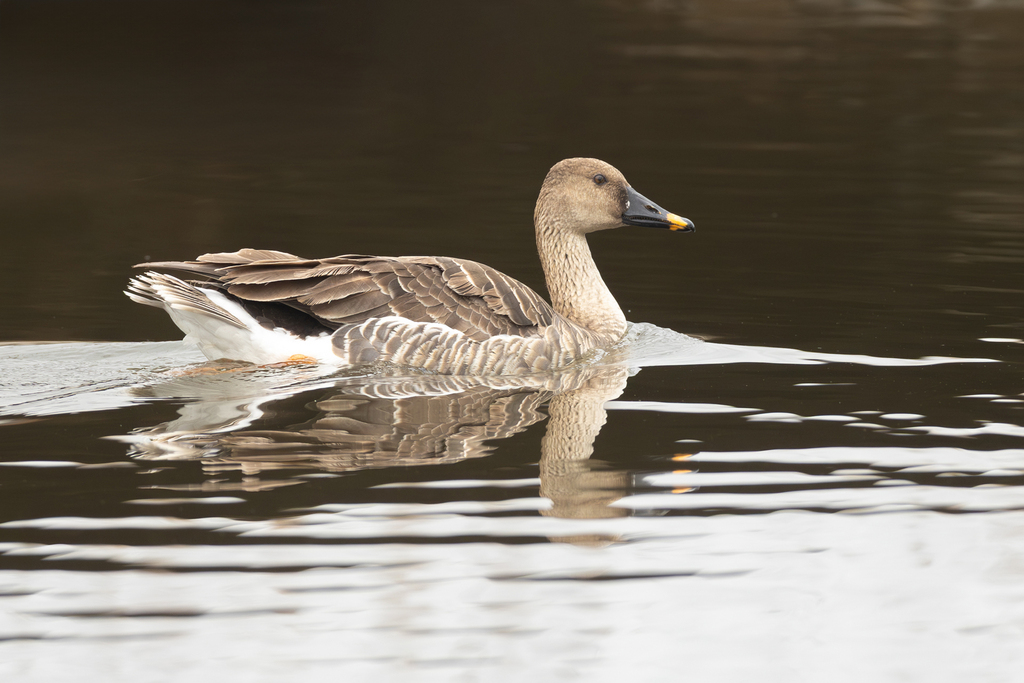
Taiga Bean Goose
Photo © egorbirder
Photo © egorbirder — CC BY 4.0 — Source: iNaturalist photo #656133755Identification
The taiga bean goose is a large goose, ranging from 68 to 90 cm in length with a wingspan of 140 to 174 cm. Its most distinctive feature is its bicolored bill: black at both the base and tip, with a bright orange band across the middle. The legs and feet are also bright orange, providing reliable identification in the field. The upper wing-coverts are dark brown with characteristic narrow white fringes to the feathers, distinguishing it from the similar white-fronted and lesser white-fronted geese. Males are noticeably larger than females, averaging 3.2 kg compared to females at 2.84 kg. In flight and at rest, this species produces a loud, distinctive honking call.
Range & Habitat
The taiga bean goose breeds across northern Europe and Asia, occupying taiga and boreal forest regions. As a migratory species, it winters further south in both Europe and Asia, following established flyway routes. In Europe, the western subspecies migrates across three distinct flyways: the Western, Central, and Eastern routes. The species is a rare winter visitor to Great Britain, with two regular wintering flocks established in the Yare Valley, Norfolk and the Avon Valley between Glasgow and Edinburgh, Scotland. A formerly regular wintering population in Dumfries and Galloway is no longer present.
Behaviour & Diet
The taiga bean goose takes its name from its historical habit of grazing in bean field stubbles during winter, a behavior that inspired both its English and scientific names. The species is highly migratory, undertaking substantial seasonal movements between breeding grounds in the north and wintering areas further south. Research using stable isotope analysis of flight feathers has confirmed the distinct migratory routes used by different populations, demonstrating the species' strong fidelity to particular migration corridors and wintering sites.
Best Time & Places to See It
Winter is the best season to observe taiga bean geese in Europe, when migratory populations move south to their wintering grounds. For British observers, the Yare Valley in Norfolk and the Avon Valley between Glasgow and Edinburgh represent the most reliable locations to encounter regular wintering flocks. The species' rarity as a winter visitor to Great Britain makes sightings notable events, and dedicated birdwatchers often monitor these established sites during the winter months.
Photography Tips
The taiga bean goose's striking orange bill and legs provide excellent photographic subjects with strong color contrast against its dark plumage. Photographers should aim to capture the characteristic bicolored bill pattern and the white fringes on the dark upper wing-coverts in good light. Winter visits to established wintering sites offer the best opportunities for photography, as birds tend to be more predictable in their daily movements and feeding locations. The bird's large size and vocal behavior make it relatively conspicuous when present, though patience is required given its rarity as a winter visitor to Britain.
Stenshuvuds National Park
Skåne län, Sweden
+224 birds+19 mammals
Where limestone cliffs rise sharply above the Øresund Strait, Stenshuvuds National Park commands the southeastern tip of Skåne, a landscape carved by glaciation into rolling beech…
VIEW NATIONAL PARKMuddus / Muttos National Park
Norrbottens län, Sweden
+128 birds+7 mammals
Where boreal forest meets wetland across the high plateaus of Swedish Lapland, Muddus National Park unfolds as one of northern Europe's most pristine wilderness sanctuaries. Vast…
VIEW NATIONAL PARKFärnebofjärden National Park
Gävleborgs län, Sweden
+170 birds+20 mammals
Where the Gävle River widens into a sprawling delta before meeting the Gulf of Bothnia, Färnebofjärden National Park unfolds across a landscape of exceptional ecological complexity.…
VIEW NATIONAL PARKLower Oder Valley National Park
Schwedt/Oder, Germany
+216 birds+21 mammals
Where the Oder River winds through northeastern Brandenburg, the Lower Oder Valley National Park protects one of Central Europe's most vital wetland systems. This sprawling mosaic…
VIEW NATIONAL PARKSchleswig-Holsteinisches Wattenmeer National Park
Germany
+378 birds+49 mammals
Where the North Sea ebbs and flows across a vast expanse of exposed mud and sand, the Schleswig-Holsteinisches Wattenmeer National Park reveals one of Europe's most…
VIEW NATIONAL PARKPallas-Yllästunturi National Park
Muonio, Finland
+137 birds+19 mammals
Where boreal forest meets fell, across the Finnish Arctic frontier, nearly 3,650 square kilometres of pristine subarctic wilderness unfold in a landscape sculpted by glacial epochs…
VIEW NATIONAL PARKKauhaneva–pohjankangas National Park
Kauhajoki, Finland
+72 birds+1 mammals
Across the boreal flatlands of South Ostrobothnia rises a landscape shaped by ice-age geology and millennia of ecological succession—Kauhaneva–pohjankangas National Park, spanning some 208 square kilometres…
VIEW NATIONAL PARKUrho Kekkonen National Park
Sodankylä, Finland
+122 birds+11 mammals
Across nearly 2,700 square miles of boreal wilderness in Lapland, where the Arctic Circle's influence shapes every ecosystem, lies a landscape dominated by dense spruce and…
VIEW NATIONAL PARKHortobágy National Park
Hortobágy, Hungary
+260 birds+17 mammals
Across the North Great Plain of Hungary stretches one of Europe's most expansive semi-natural grassland systems, where horizon-wide vistas of steppe and wetland create a landscape…
VIEW NATIONAL PARKDuna-Ipoly National Park
Dömös, Hungary
+208 birds+19 mammals
Where the Danube curves through central Hungary, the limestone hills and forested valleys of Duna-Ipoly National Park create a landscape that feels caught between seasons and…
VIEW NATIONAL PARKSkuleskogen
Nätra District, Sweden
+158 birds+11 mammals
Where boreal forest meets the raw Höga Kusten coastline, Skuleskogen National Park unfolds across nearly 47 square kilometers of one of northern Sweden's most dramatic landscapes.…
VIEW NATIONAL PARKStora Sjöfallet
Norrbotten County, Sweden
+150 birds+10 mammals
Where granite plateaus rise above boreal forest and ice-carved valleys plunge toward rushing rivers, Stora Sjöfallet unfolds across nearly 3,300 square kilometres of pristine subarctic wilderness…
VIEW NATIONAL PARKCamargue Regional Nature Park
Saintes-Maries-de-la-Mer, France
+378 birds+48 mammals
Where the Rhône Delta sprawls into the Mediterranean, a landscape of stark and haunting beauty emerges—vast salt marshes punctuated by shallow lagoons, reed beds, and scrubland…
VIEW NATURAL PARKSoomaa National Park
Viljandi County, Estonia
+172 birds+20 mammals
Across the boglands of south-central Estonia, where water dominates more than half the landscape, lies one of northern Europe's most hydrologically dynamic national parks. The terrain…
VIEW NATIONAL PARKLahemaa National Park
Lääne-Viru County, Estonia
+237 birds+25 mammals
Where the Baltic coast meets temperate forest in northwestern Estonia, Lahemaa National Park sprawls across more than 1,300 square kilometers of deeply character-filled terrain. Coastal wetlands…
VIEW NATIONAL PARKSt. Paul Island
Saint Paul, United States
+255 birds+8 mammals
Windswept tundra rolls across this remote Pribilof island, where volcanic basalt cliffs plunge into the Bering Sea and fog rolls in thick enough to erase the…
VIEW PROTECTED LANDSCAPELosiny Ostrov National Park
Balashikhinsky District, Russia
+173 birds+20 mammals
Across the forested plateaus of Moscow Oblast, where the Losinka River winds through mixed woodland and marshy clearings, lies a national park that captures the ecological…
VIEW NATIONAL PARKBiebrza National Park
Goniądz, Poland
+242 birds+33 mammals
Where the Narew River sprawls across northeastern Poland's flatlands, Biebrza National Park unfolds as one of Europe's largest and most ecologically vital wetland complexes. Encompassing roughly…
VIEW NATIONAL PARKKhoridol Saridag National Park
Khatgal, Mongolia
+164 birds+6 mammals
Where granite peaks thrust skyward across Mongolia's remote southeastern reaches, a landscape of raw geological drama unfolds. Deep river gorges carved through ancient stone create a…
VIEW NATIONAL PARKRussian Arctic National Park
Russia
+23 birds+3 mammals
Across the stark tundra of Russia's northwestern Arctic, where permafrost defines the land and sunlight dictates the rhythm of life, lies a landscape sculpted by ice…
VIEW NATIONAL PARKPleshcheyevo Lake National Park
Pereslavl-Zalessky, Russia
+137 birds+4 mammals
Where the continental forests of western Russia meet the glacial imprint of the last ice age, Pleshcheyevo Lake sprawls across the landscape near Pereslavl-Zalessky like a…
VIEW NATIONAL PARKNortheast China Tiger and Leopard National Park
Mu Dan Jiang Shi, China
+202 birds+19 mammals
Across the temperate forests of northeastern China, where winters grip the landscape in subzero silence and summers remain cool and brief, the Mudanjiang region supports a…
VIEW NATIONAL PARKYancheng National Nature Reserve
Yancheng, China
+208 birds+4 mammals
Where the East China Sea's tidal rhythms sculpt the Jiangsu coast, Yancheng National Nature Reserve sprawls across one of Asia's most dynamic wetland complexes. This vast…
VIEW NATURE RESERVEPoyang Lake National Nature Reserve
Shangrao, China
+270 birds+7 mammals
Where the Yangtze River's massive floodplain spreads across central China, Poyang Lake National Nature Reserve encompasses one of the continent's most dynamic and water-rich wetland systems.…
VIEW NATURE RESERVEAlaska Maritime National Wildlife Refuge
Alaska, United States
+391 birds+58 mammals
Where the North Pacific collides with Alaska's rugged coastline, a sprawling archipelago of islands, rocky outcrops, and coastal headlands forms one of North America's most remote…
VIEW WILDLIFE SANCTUARYNewport Wetlands National Nature Reserve
Goldcliff, United Kingdom
+153 birds+7 mammals
Across the Severn Estuary's southern reaches, where the Gwent Levels meet tidal mud and reedbed in a mosaic of wet grassland and shallow pools, lies one…
VIEW NATURE RESERVENo community photos yet. Log in to add the first one.
No community observations of this species yet.