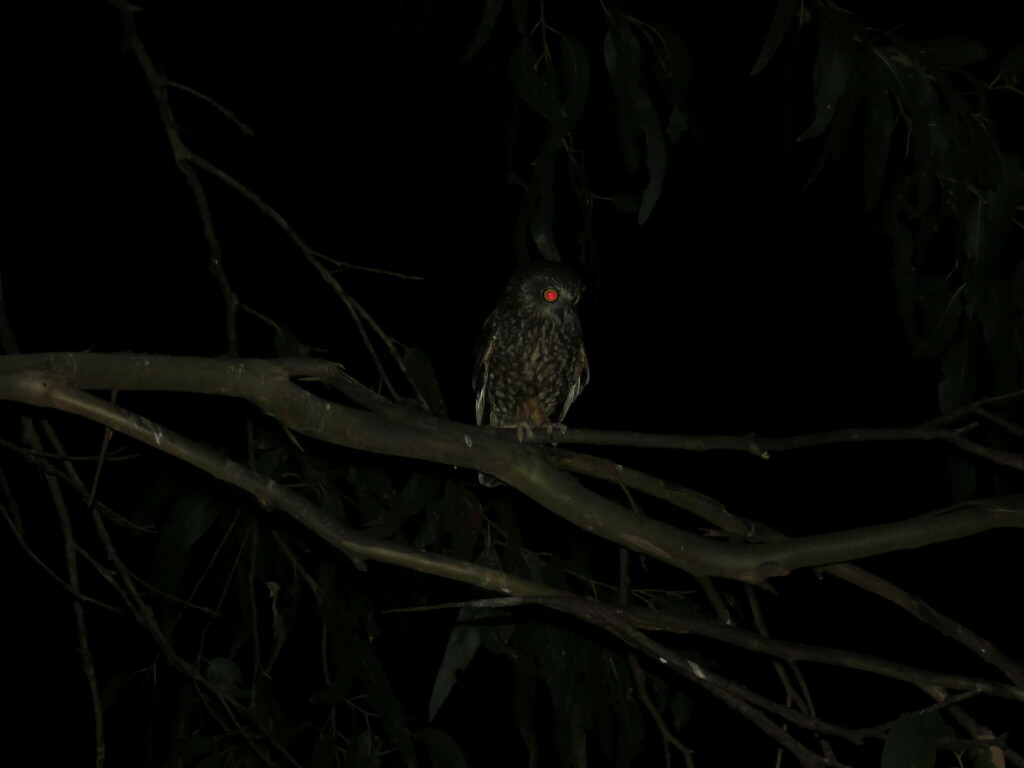
Tasmanian Boobook
Photo © Donald Hobern
Photo © Donald Hobern — CC BY 4.0 — Source: iNaturalist #188430604The Tasmanian boobook (Ninox leucopsis), also known as the Tasmanian spotted owl, is a species of owl in the family Strigidae. It is native to Tasmania. Formerly considered conspecific with the morepork (N. novaeseelandiae), phylogenetic studies have affirmed its status as a distinct species by analyzing genetic and morphologic characteristics. It was reclassified as distinct by the International Ornithological Congress in 2022. It is widespread in Tasmania and on King Island and other islands of Bass Strait. It has been recorded in southern Victoria, once from New South Wales, and once from Lord Howe Island. It predominantly occurs in eucalypt forests. It is carnivorous, and a nest predator. The Tasmanian boobook is sexually dimorphic, with males typically being smaller than females.
Wilsons Promontory National Park
Australia
+210 birds+21 mammals
Where granite headlands plunge toward Bass Strait, Wilson's Promontory National Park sprawls across nearly 1,300 square kilometers of southeastern Victoria's most rugged coastal wilderness. The park's…
VIEW NATIONAL PARKGreat Otway National Park
Australia
+255 birds+42 mammals
Temperate rainforest and wet eucalyptus woodland cloak the ridges and gullies of Victoria's Great Otway National Park, where persistent moisture and mild year-round temperatures sustain a…
VIEW NATIONAL PARKCradle Mountain-Lake St Clair National Park
Australia
+72 birds+8 mammals
Where glacial valleys plunge between quartzite peaks, Tasmania's Cradle Mountain-Lake St Clair National Park unfolds as a temperate wilderness of uncommon grandeur. The park's terrain ranges…
VIEW NATIONAL PARKFreycinet National Park
Coles Bay, Australia
+115 birds+9 mammals
Granite peaks rise abruptly from the Tasmanian coast where Coles Bay opens into the Freycinet Peninsula, sculpting one of southeastern Australia's most dramatically vertical national parks.…
VIEW NATIONAL PARKNo community photos yet. Log in to add the first one.
No community observations of this species yet.