Tasmanian Thornbill
Photo © Don Wellmann
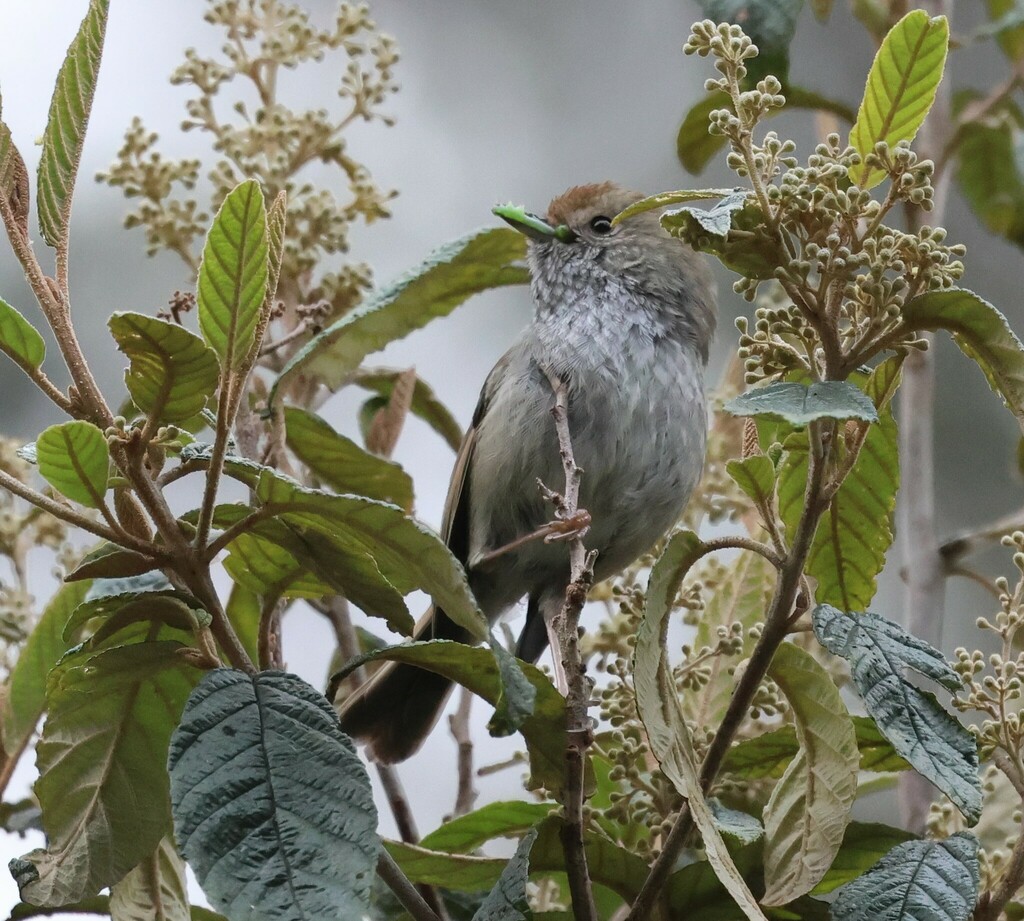
Photo © Don Wellmann — CC0 1.0 — Source: iNaturalist #189621716The Tasmanian Thornbill (Acanthiza ewingii) is a small bushland member of the Acanthizidae (Australian warbler) family, endemic to Tasmania and the Bass Strait Islands. It is a common bird in these regions and is often found occupying the colder, wetter portions of them. The brown thornbill (Acanthiza pusilla) will typically occupy the correspondingly drier portions of habitat. == Description == The Tasmanian Thornbill is olive-brown above, darkening toward the back and tail, and can exhibit a patch of reddish-brown colouration on the forehead. The wings are dark grey with olive-brown edge lining. Grey on light grey scalloping is present from the chin to breast, with similar scalloping occurring on the sides of the head. The bill, feet, and legs are all dark grey and the eyes are distinctly large and dark, with red irises. It's long, thin, thorn-shaped beak is a distinguishing characteristic of the Acanthiza (thornbill) family. Visibly fluffy, white under-tail coverts are a distinguishing feature of the species. The Tasmanian Thornbill averages in size at around 10 cm and shows no significant coloration or size differentiation between sexes. === Differentiating from Brown Thornbill === The Tasmanian and Brown Thornbills both occupy similar habitat, and are strikingly similar in…
Cradle Mountain-Lake St Clair National Park
Australia
+72 birds+8 mammals
Where glacial valleys plunge between quartzite peaks, Tasmania's Cradle Mountain-Lake St Clair National Park unfolds as a temperate wilderness of uncommon grandeur. The park's terrain ranges…
VIEW NATIONAL PARKFreycinet National Park
Coles Bay, Australia
+115 birds+9 mammals
Granite peaks rise abruptly from the Tasmanian coast where Coles Bay opens into the Freycinet Peninsula, sculpting one of southeastern Australia's most dramatically vertical national parks.…
VIEW NATIONAL PARKNo community photos yet. Log in to add the first one.
No community observations of this species yet.