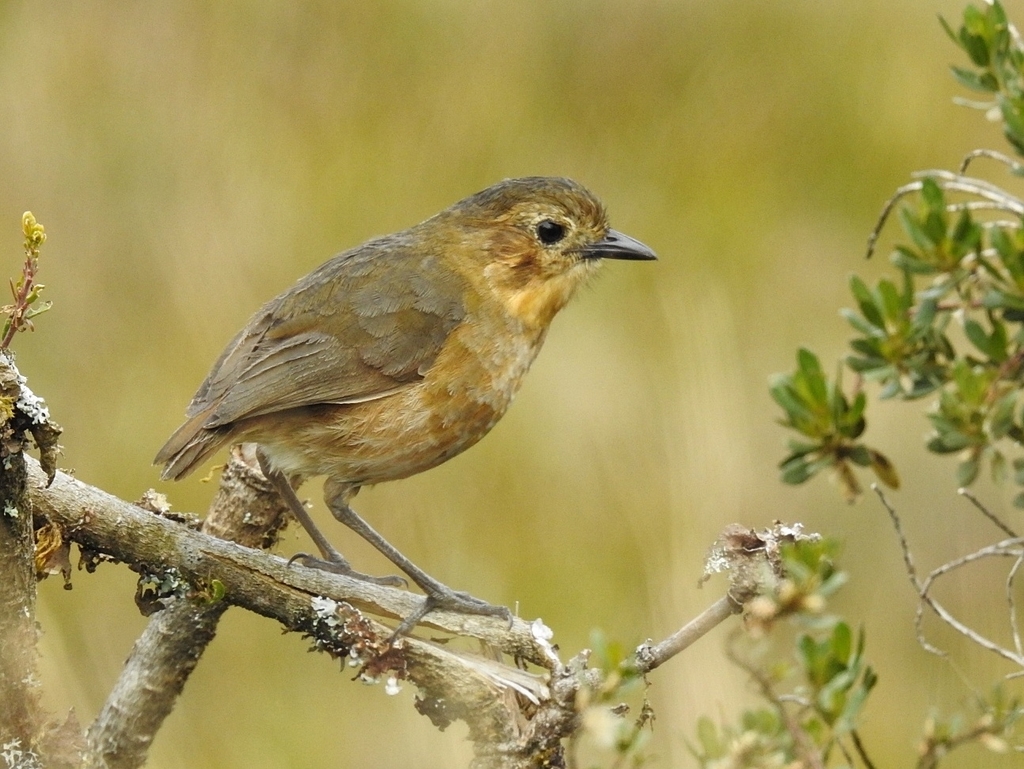
Tawny Antpitta
Photo © Esteban Poveda
Photo © Esteban Poveda — CC BY 4.0 — Source: iNaturalist photo #110448474Identification
The tawny antpitta is a small ground-dwelling bird, measuring 16–18 cm in length and weighing 58–81 g. Both sexes share identical plumage. The species is characterized by an olive-brown to rufous-olive face with pale buff lores and whitish eye-rings. The crown, nape, back, wings, and tail are mostly pale to olive brown with a slight gray wash, while the rump is notably browner and clay-colored. The primaries show distinctive pale buff leading edges with blackish or olive-black trailing vanes. The underparts are predominantly tawny brown with indistinct white mottling, a whitish belly center, paler flanks, and rich rufescent-tawny undertail coverts. The species has a chestnut-brown iris, black to blackish-gray bill (sometimes with a brownish mandible base), and dark brownish-black legs and feet.
Range & Habitat
The tawny antpitta is found along the Andean spine from Caldas Department in west-central Colombia south through Ecuador and slightly into northern Peru, north and west of the Marañón River. This species inhabits páramo grasslands and semi-open edges of elfin forest and Polylepis (queñoa) woodland. It shows a preference for lakeshores and swampy areas. The elevational range varies by country: 2,200–4,000 m in Colombia, primarily 3,000–4,500 m in Ecuador, and 2,850–3,400 m in Peru. The species is considered common in Colombia and numerous in Ecuador, and appears relatively tolerant of habitat disturbance, even occurring in shrubby second growth near human habitations.
Behaviour & Diet
The tawny antpitta is a year-round resident throughout its range. Although cryptic in nature, it is more often heard than seen. Its diet includes various insects, other invertebrates, and small vertebrates. The bird typically forages alone on the ground, hopping and pausing to flick aside leaf litter, probe mosses, and glean from vegetation. It apparently breeds year-round, constructing a deep open cup nest of moss and sticks lined with grass, placed on bunch grass or other low plants; both sexes participate in nest building. Clutches consist of two sky-blue to blue-green eggs with variable darker flecking. The recorded incubation period is 21.5 days, with fledging occurring 15–16 days after hatching.
Best Time & Places to See It
The tawny antpitta is most vocal around dawn but vocalizes at any time of day, making auditory detection key to locating this elusive species. Optimal viewing occurs in Ecuador, where the species is most numerous, particularly within páramo habitats and at the edges of elfin and Polylepis forests between 3,000 and 4,500 m elevation. The species' year-round residency means it can be encountered in suitable habitat at any season. Lake margins and wetland areas within this elevation range should be targeted. Patience and familiarity with the bird's distinctive three-note song will greatly improve encounter rates.
Photography Tips
Photographing the tawny antpitta requires patience and audio reconnaissance. Listen for its distinctive simple three-note vocalization—a short even note followed by a pause and two slightly longer notes at a lower pitch, lasting 1.1–1.3 seconds—to locate birds before attempting photography. Early morning sessions around dawn offer the highest vocalization rates. The species' tendency to perch on the ground or low, prominent vantage points means working at ground level may be necessary. Given its preference for open páramo and scrubby habitats, relatively open compositions are possible. The bird's cryptic olive-brown and tawny plumage blends well with mountain grassland backgrounds, so positioning to separate the subject from habitat is advantageous. A telephoto lens (400mm+) helps capture intimate portraits while maintaining safe distance from this ground-foraging species.
Antisana National Park
Cajas National Park
Cotopaxi National Park
Llanganates National Park
Natural Chingaza National Park
Natural Sumapaz National Park
Podocarpus National Park
Puracé National Natural Park
Sangay National Park
Nothing matches these filters.
No community photos yet. Log in to add the first one.
No community observations of this species yet.