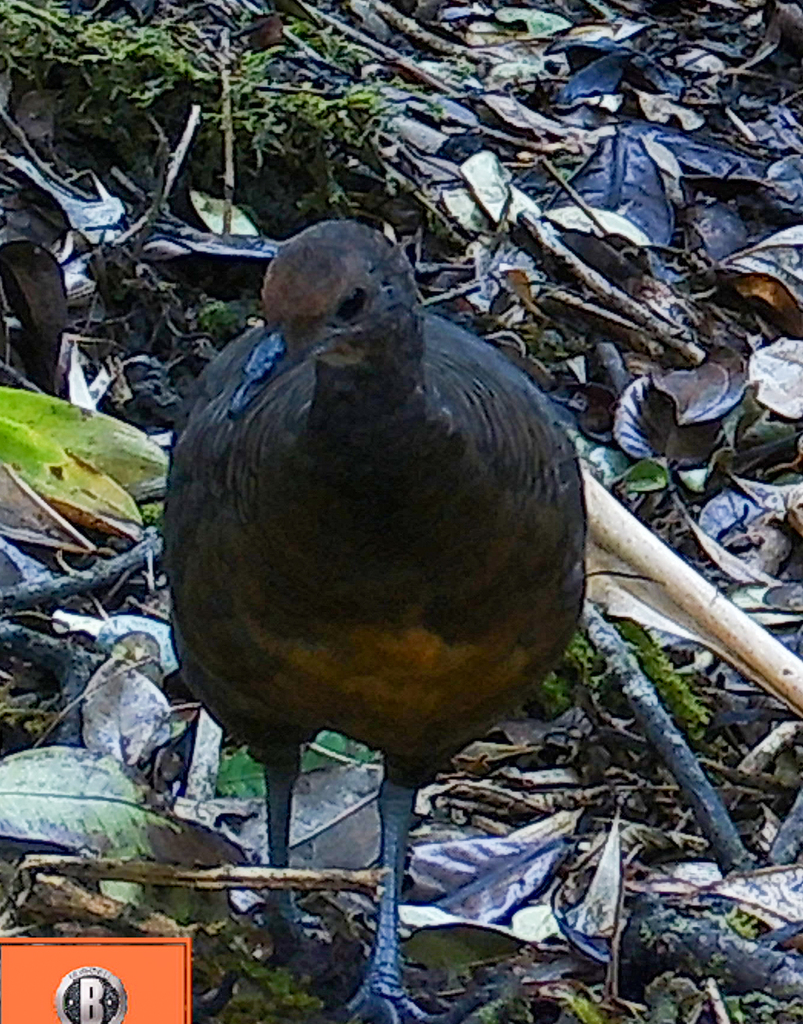
Tawny-breasted Tinamou
Photo © Francisco Sánchez Karste
Photo © Francisco Sánchez Karste — CC BY 4.0 — Source: iNaturalist photo #580224655Identification
The tawny-breasted tinamou is a compact ground bird measuring 35.5–38 cm (14.0–15.0 in) in length. Its plumage is distinctively patterned: brown upperparts are barred with black, while the wings display buff spots. The head is a bright chestnut colour, contrasting sharply with a white throat below. The breast and flanks are olivaceous brown, and the remaining underparts are bright rufous, giving the species its common name. As a tinamou, this bird belongs to an ancient lineage of ratites—the closest living relatives of prehistoric flying birds—and, unlike most other ratites, tinamous retain the ability to fly, though they are not strong fliers.
Range & Habitat
The tawny-breasted tinamou is native to the Andes in far western Venezuela, central Colombia, Ecuador, and southern Peru, making it a bird of northwestern South America. The species inhabits montane moist forest at elevations between 880 and 2,350 m (2,890–7,710 ft), where it remains restricted to this specialised cloud-forest environment. Its global extent of occurrence is estimated at 110,000 km² (42,000 sq mi), and the species is listed as Least Concern by the IUCN.
Behaviour & Diet
The tawny-breasted tinamou is primarily a frugivore, foraging on the ground or from low-lying bushes for fallen fruit. Its diet is supplemented with small amounts of invertebrates, flower buds, tender leaves, seeds, and roots, allowing it to exploit the varied resources of its montane habitat. The species exhibits a remarkable breeding system in which males provide sole parental care: a single male may incubate eggs from as many as four different females. After hatching, the male tends the chicks until they are independent, typically at 2–3 weeks of age. The nest is placed on the ground in dense brush or among raised root buttresses, offering concealment and protection in the forest understory.
Best Time & Places to See It
The tawny-breasted tinamou can be found throughout the year in the montane moist forests of the Andes, from Venezuela through Colombia and Ecuador to southern Peru. Birdwatchers and nature travellers seeking this species should focus on cloud forests within the elevation range of 880–2,350 m, particularly in areas with dense understory vegetation and abundant fruiting trees. Early morning hours are generally the most productive for encounters, as the birds are more active when foraging on the forest floor.
Photography Tips
Photographing the tawny-breasted tinamou presents both challenges and rewards. As a ground-dwelling forest bird, it is often obscured by dense vegetation, so patient observation from established trails or clearings offers the best opportunities. The species' cryptic brown and black plumage provides excellent camouflage in its montane habitat, so photographers should listen for movement in leaf litter and low brush. The bird's distinctive chestnut head and white throat are key identifying features to capture. Given the dim light conditions of montane cloud forests, a fast lens and elevated ISO settings will improve success, while avoiding sudden movements will increase the likelihood of close approaches.
Podocarpus National Park
Zamora, Ecuador
+496 birds+6 mammals
Where the Andes descend toward the Amazon basin, Podocarpus National Park sprawls across nearly 2,800 square kilometres of the most biodiverse terrain in Ecuador's southern highlands.…
VIEW NATIONAL PARKSumaco Napo-Galeras National Park
Loreto, Ecuador
+563 birds+4 mammals
Where Ecuador's Amazon transitions into cloud forest, a massive shield volcano rises from the emerald lowlands of Orellana Province, anchoring one of the continent's most biodiverse…
VIEW NATIONAL PARKNatural Farallones de Cali National Park
Buenaventura, Colombia
+733 birds+27 mammals
Where the Pacific coastal plain meets the western slopes of the Andes, Farallones de Cali National Park sprawls across nearly 3,500 square kilometers of dramatic topography…
VIEW NATIONAL PARKNatural Chingaza National Park
Junín, Colombia
+285 birds+6 mammals
Where the Andes rise above three thousand metres in the Cundinamarca region, high-altitude grasslands and cloud forests converge in a landscape shaped by both geology and…
VIEW NATIONAL PARKNatural el Cocuy National Park
Güicán, Colombia
+313 birds+3 mammals
Where the Andes rise to their highest peaks in Colombia's eastern cordillera, El Cocuy National Park sprawls across more than 6,600 square kilometers of some of…
VIEW NATIONAL PARKPuracé National Natural Park
Puracé, Colombia
+327 birds+2 mammals
Where the Andes thrust upward across southwestern Colombia, Puracé National Natural Park spans nearly 2,631 square kilometers of some of South America's most dramatic montane terrain.…
VIEW NATIONAL PARKGuácharos Cave National Natural Park
Acevedo, Colombia
+359 birds
High in the Andean foothills of southern Huila, where mist-laden slopes rise above 1,600 metres, lies a landscape carved by underground rivers and crowned by karst…
VIEW NATIONAL PARKEl Tamá National Park
Toledo, Colombia
+435 birds
Where the Andes descend toward the Caribbean coastal lowlands of northern Colombia, El Tamá National Park sprawls across nearly 3,800 square kilometres of montane forest, cloud…
VIEW NATIONAL PARKNo community photos yet. Log in to add the first one.
No community observations of this species yet.