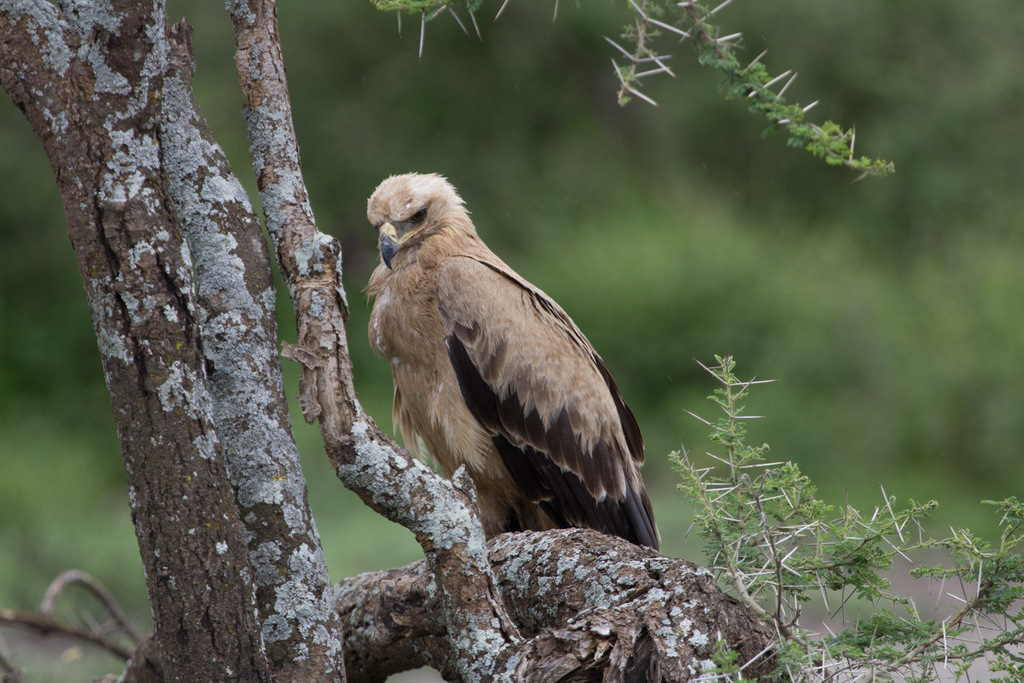
Identification
The tawny eagle is a large bird of prey belonging to the booted eagles, a subfamily distinguished by feathering that extends down their legs. Adult tawny eagles are typically rufous-brown in plumage, though coloration varies among subspecies and individuals. The nominate African race (A. r. rapax) tends to be relatively more strongly rufous than other races, sometimes with dark streaking below, while juveniles are generally lighter and more rufous overall. Body mass ranges roughly from 1.6 to 3.1 kg (3.5 to 6.8 lb), with females noticeably larger than males. Wing chord lengths in males measure 485 to 540 mm (19.1 to 21.3 in), while females range from 509 to 565 mm (20.0 to 22.2 in).
The tawny eagle can be distinguished from its closest relative, the steppe eagle, by its smaller, more compact frame, less pronounced gape, and different coloration patterns at all developmental stages. Genetic research has shown that despite superficial similarities to other Aquila eagles, the tawny eagle represents a distinct lineage within the genus.
Range & Habitat
Tawny eagles have an extensive but discontinuous breeding range across much of the African continent and the Indian subcontinent, with rare residency in the southern Middle East. Three recognized subspecies occupy different geographic regions: the nominate A. r. rapax ranges from central Kenya and the southern Democratic Republic of the Congo southwards, and may extend northwards to Ethiopia; A. r. belisarius occupies west Africa to Ethiopia and southwest Arabia, extending south to northern Kenya and the northern Democratic Republic of the Congo; and a third subspecies rounds out the species' distribution.
Throughout its range, the tawny eagle strongly favours open dry habitats including semideserts, deserts, steppes, and savanna plains. Despite its preference for arid conditions, the species seldom occurs in areas completely devoid of trees, typically nesting in the crowns of scattered woodland.
Behaviour & Diet
The tawny eagle is perhaps the most highly opportunistic of all booted eagles, employing diverse feeding strategies to survive in harsh environments. It is both a bold and active predator, taking relatively large and diverse prey, while also readily scavenging carrion and engaging in kleptoparasitism—stealing food from other carnivorous animals. This flexible approach to foraging allows the species to exploit whatever food sources are available across its arid range.
As a resident breeder, the tawny eagle lays one to three eggs in stick nests, most commonly constructed in the crown of a tree. The species can live to an estimated age of 16 years old in the wild.
Best Time & Places to See It
Tawny eagles are resident breeders throughout their range, making them potentially observable year-round across African savannas and arid regions, as well as in the Indian subcontinent. However, specific seasonal patterns and population densities vary by location and subspecies. Your best opportunities will be in open savanna and semi-arid landscapes where scattered trees provide nesting habitat, particularly during breeding season when birds are most visible and territorial.
As the national animal of Ghana, the tawny eagle holds special significance in West Africa, though its populations have declined precipitously throughout its range due to habitat loss, persecution, and anthropogenic mortality.
Photography Tips
The tawny eagle's preference for open dry habitats and scattered trees means excellent visibility and photography opportunities in suitable terrain. Look for birds soaring over savanna plains or perched prominently in isolated trees, where their large silhouette and rufous plumage stand out clearly. Early morning light often enhances the warm tones of their feathering.
Patient observation near suspected nesting sites during breeding season may reward you with images of birds delivering prey or tending to their stick nests high in tree crowns. The species' opportunistic feeding behaviour means scanning open ground for birds descending to scavenge can yield dynamic flight photography capturing this eagle's bold and active nature.
Bwindi Impenetrable National Park
Kanha Tiger Reserve
Lake Mburo National Park
Mabamba Swamp
Murchison Falls National Park
Queen Elizabeth National Park
Aberdare National Park
Abijata-Shalla Lakes National Park
Amboseli National Park
Nothing matches these filters.
No community photos yet. Log in to add the first one.
No community observations of this species yet.