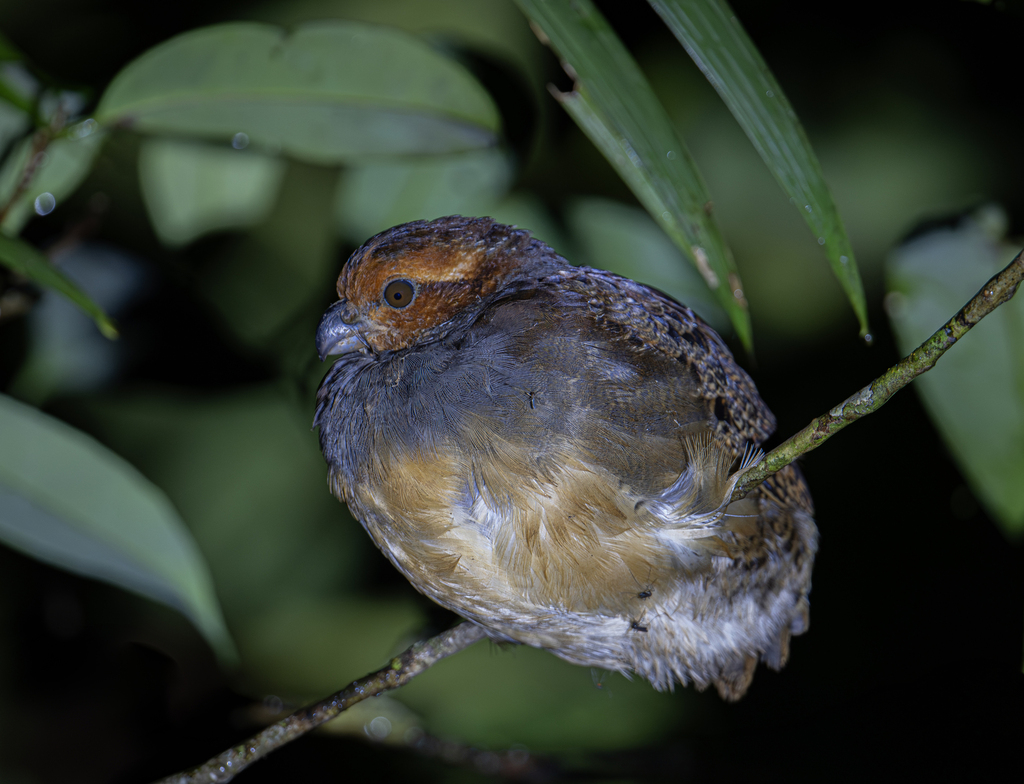
Tawny-faced Quail
Photo © Marcia Morris
Photo © Marcia Morris — CC BY 4.0 — Source: iNaturalist #290850427Identification
The tawny-faced quail is a small New World quail, measuring 17 to 20 cm in length and weighing around 150–165 g. Males and females show distinct plumage differences. Adult males of the nominate subspecies display a striking reddish face marked by a black streak through the eye, with a dark brown crown and hindneck. The back and rump are gray to brown with black streaks, while the throat and upper breast are gray; the remaining undersides are tawny buff with white markings between the legs. Females follow a similar pattern but are noticeably browner overall, with dark brown crowns and backs, mottled brown and chestnut rumps, and reddish-brown faces and upper breasts contrasting with white eyelines, chins, and throats. The lower breast and belly are pale with black barring. Two other subspecies occur across the range: R. c. pudibundus is paler overall, while R. c. australis is darker.
Range & Habitat
The tawny-faced quail inhabits Central and South America across a discontinuous range spanning Colombia, Costa Rica, Ecuador, Honduras, Nicaragua, and Panama. Different subspecies occupy specific regions: the nominate form occurs in Costa Rica and Panama; R. c. pudibundus is found in northeastern Honduras and eastern Nicaragua; and R. c. australis inhabits the Pacific coasts of Colombia and far northern Ecuador. The species is a lowland tropical forest specialist, occurring up to approximately 1,450 m in elevation. Though primarily terrestrial, it roosts in trees and bushes positioned near the ground.
Behaviour & Diet
This quail is a ground forager that feeds by pecking, consuming seeds, worms, and insects. The tawny-faced quail is notably vocal, particularly at dusk and while roosting at night. Its song consists of a distinctive series of pure monotonous whistles followed by whistles at lower and/or higher pitches, bearing a striking resemblance to the calls of tinamous or doves. Members of a covey maintain contact through soft peeping calls. The breeding season has been documented in March and April in Panama, though breeding phenology remains poorly understood elsewhere in its range.
Best Time & Places to See It
Finding the tawny-faced quail requires patience and timing. The species is rather rare throughout much of its range, making sightings challenging. Visitors should focus on lowland tropical forests within its range, particularly in Costa Rica, Panama, and Colombia. The best opportunities come during the breeding season (March–April in Panama) when birds are most vocal. Dawn and especially dusk are ideal times, as the species is often vocal during these periods. Listening for its distinctive whistled song is often more productive than visual searching.
Photography Tips
Photography of this elusive species demands specialized techniques. Since the tawny-faced quail is primarily terrestrial and remains largely hidden in forest undergrowth, ground-level positioning offers the best vantage points. Use audio playback of the species' distinctive whistled song cautiously to draw birds closer, though ethical guidelines should be observed. Early morning and dusk provide optimal lighting for forest photography. A longer lens (400 mm or greater) is advisable given the bird's shy nature and the dense vegetation it frequents. Patient waiting near roosting sites may yield opportunities as birds settle in for the night.
Natural Utría National Park
Alto Baudó (Pie de Pató), Colombia
+372 birds+11 mammals
Where the Chocó's coastal mountains plunge toward the Pacific, Utría National Park preserves one of Colombia's most biodiverse and least-visited wilderness expanses. Sprawling across 1,287 square…
VIEW NATIONAL PARKChagres National Park
Caimitillo, Panama
+486 birds+19 mammals
Where the Chagres River carves through the humid tropics of central Panama, a vast montane and lowland forest sprawls across more than 2,300 square kilometers, anchoring…
VIEW NATIONAL PARKDarién National Park
Tucutí, Panama
+534 birds+13 mammals
Where the spine of Central America crumbles into wetland and rainforest, Darién National Park sprawls across more than 20,000 square kilometres of some of the tropics'…
VIEW NATIONAL PARKVolcán Tenorio National Park
Guatuso, Costa Rica
+480 birds+12 mammals
Where volcanic slopes rise through Costa Rica's northwestern borderlands, Volcán Tenorio National Park sprawls across terrain shaped by ancient lava flows and mineral-rich springs. The park's…
VIEW NATIONAL PARKNo community photos yet. Log in to add the first one.
No community observations of this species yet.