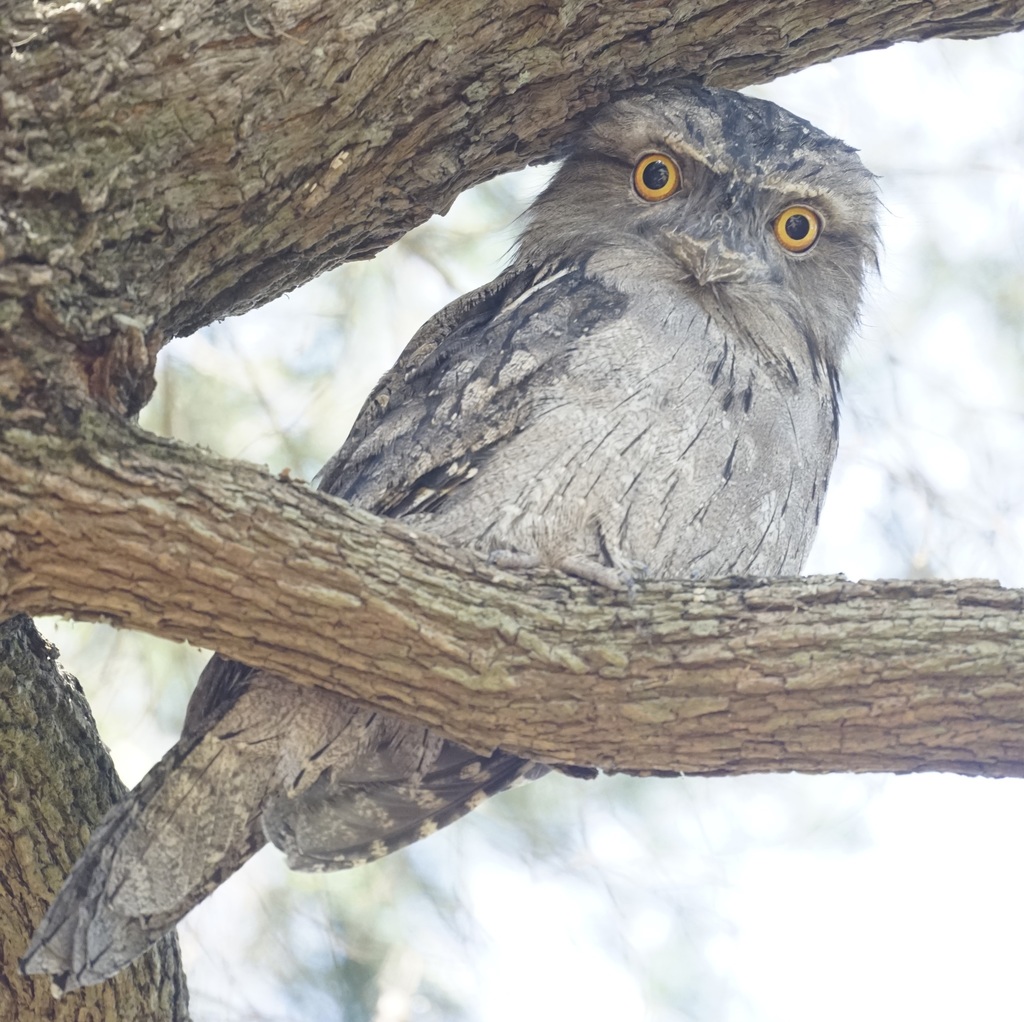
Tawny Frogmouth
Photo © Tim
Photo © Tim — CC BY 4.0 — Source: iNaturalist #38355339Identification
The tawny frogmouth is a large, big-headed, stocky bird measuring 34 to 53 cm in length, often mistaken for an owl due to its nocturnal habits and similar colouring. Adults typically weigh between 250 and 400 grams. The species is characterized by its wide, heavy, olive-grey to blackish bill that is hooked at the tip and topped with distinctive tufts of bristles. Their large yellow eyes are positioned to the sides of the face rather than forward-facing like an owl's. Tawny frogmouths have rounded wings and short legs, giving them a compact appearance.
The species displays three distinct colour morphs, with grey being the most common in both sexes. Grey-morph males possess silver-grey upperparts with black streaks and slightly paler underparts with white barring and brown to rufous mottling, while females are often darker with more rufous mottling. Some females of the subspecies P. s. strigoides display a chestnut morph, while females of P. s. phalaenoides show a rufous morph. Rare leucistic or albinistic all-white plumage variants have been documented.
Range & Habitat
Tawny frogmouths are found throughout most of the Australian mainland and Tasmania. Three subspecies are recognized: P. s. phalaenoides inhabits Northern Australia southwards to the Great Sandy Desert, Barkly Tableland, and the Gulf of Carpentaria in Queensland; P. s. brachypterus is found in Western Australia extending to the Channel Country of Queensland and the Murray Mallee in Victoria; and P. s. strigoides occupies eastern and south-eastern Australia from north of Cooktown westward to the inland fringes of the Great Dividing Range, and throughout Tasmania.
Behaviour & Diet
Tawny frogmouths are insectivores that catch their prey with their beaks rather than talons, distinguishing them from owls. These nocturnal birds employ remarkable cryptic camouflage strategies, strategically perching themselves on low tree branches during daylight hours. Their silvery-grey plumage, adorned with patterns of white, black, and brown streaks and mottles, enables them to blend seamlessly into fractured tree branches. They typically select branches displaying signs of breakage and perch with their heads inclined upwards at a distinctive angle, often positioning themselves side by side with their mates in this posture.
When threatened, adult tawny frogmouths emit a distinctive alarm call that signals their chicks to remain silent and immobile, preserving their camouflage. Only when closely approached will they take flight or issue warning signals. In the wild, these birds have an average life expectancy of up to 14 years, with captive birds living 30 years or more.
Best Time & Places to See It
Tawny frogmouths are widespread across Australia and Tasmania, making them accessible to travellers throughout much of the country. Since they are nocturnal and rely on camouflage during the day, the best viewing opportunities occur at dusk and during the night when they become active. Daylight observation requires patience and a careful eye, as these birds are remarkably well-concealed among tree branches where they roost.
Photography Tips
Photographers seeking tawny frogmouths should focus on their daytime roosts on low tree branches, where their remarkable camouflage makes them challenging but rewarding subjects. Search for birds perched with their heads angled upwards on branches showing signs of breakage or damage. Pairs roosting side by side offer particularly compelling compositional opportunities. Early morning or late afternoon light will help reveal their subtle plumage patterns of streaks and mottles. Patience is essential, as these birds remain motionless for extended periods. Night photography during their active feeding periods requires specialized equipment but captures their nocturnal behaviour and the distinctive yellow eye-shine.
Bald Rock National Park
Barrington Tops National Park
Belair National Park
Ben Boyd National Park
Blue Mountains National Park
Boodjamulla National Park
Bouddi National Park
Bribie Island National Park
Budawang National Park
Nothing matches these filters.
No community photos yet. Log in to add the first one.
No community observations of this species yet.