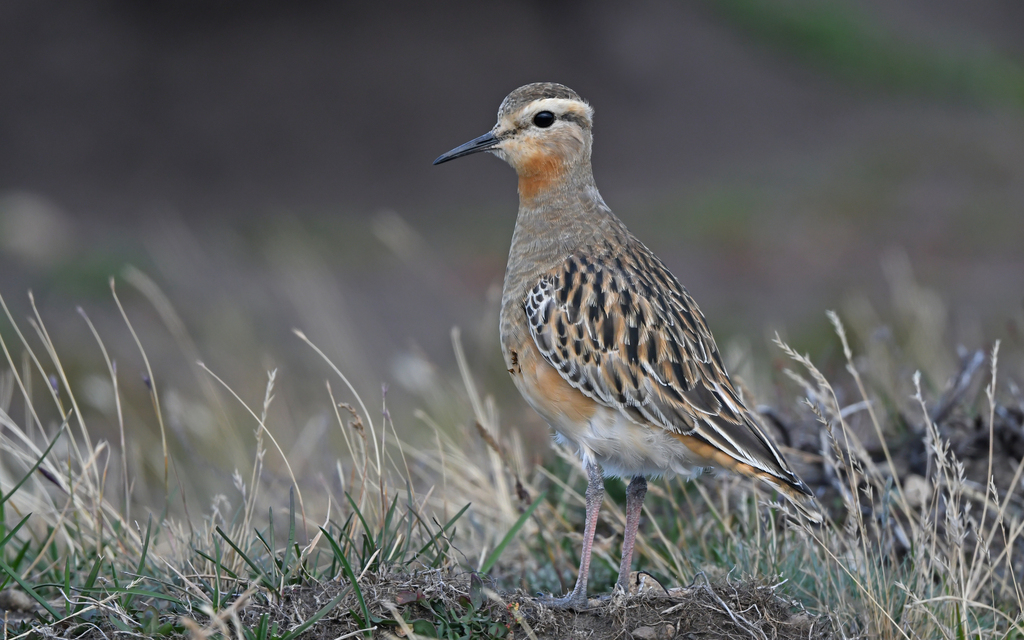
Tawny-throated Dotterel
Photo © Christoph Moning
Photo © Christoph Moning — CC BY 4.0 — Source: iNaturalist photo #394724010Identification
The tawny-throated dotterel is a medium-sized plover measuring 25 to 29 cm in length, with a weight of 120 to 154 g. The most distinctive feature is its orange-tawny throat, which contrasts with a white chin and gray neck and breast. Adults are predominantly rich buff with heavy dark streaking on the back, a small black patch on the belly, and white underwings visible in flight. Males and females are identical, with no seasonal plumage changes. Juveniles are duller, with a buff throat, less dense back streaking, and paler underparts featuring a brown belly patch. The paler subspecies O. r. pallidus is overall smaller and lighter in coloration than the nominate form.
Range & Habitat
This species is endemic to South America, found across Argentina, Bolivia, Brazil, Chile, Peru, and Uruguay, with occasional vagrant records in Ecuador and the Falkland Islands. The nominate subspecies inhabits the high-altitude puna of the Andes, ranging up to 4,600 m, and spreads southward through western regions into Tierra del Fuego and eastward across southern Argentina and into Brazil and Uruguay. The rarer O. r. pallidus has a restricted distribution along Peru's northern coastal plain, from the coast southward only to the Department of La Libertad. The species favors grasslands, heath shrublands, and open fields and meadows.
Behaviour & Diet
The nominate subspecies is altitudinal and latitudinal migrant, breeding in the high Andes and descending to lower elevations seasonally, with some populations reaching coastal Chile. Southern populations migrate north through Argentina and beyond to southern Brazil. O. r. pallidus appears to be resident year-round within its coastal Peruvian range. The species feeds in flocks of up to 100 birds during the non-breeding season, though little is known about specific feeding behavior or dietary preferences. The tawny-throated dotterel is not particularly vocal; in flight it produces a vibrating drawn-out whistle and rhythmic calls, with an emphatic alarm call when disturbed.
Best Time & Places to See It
The nesting season spans June to January with variation across its latitudinal range, making this the period when birds are most localized and observable in their breeding habitat. The Andean puna offers the best opportunity to encounter the nominate subspecies, particularly during breeding season at higher elevations. For the coastal subspecies O. r. pallidus, Peru's northern coast provides the most reliable viewing. Migration periods present opportunities to observe this species at lower elevations and coastal regions as populations shift seasonally. Several protected areas within its range support populations of this species.
Photography Tips
The tawny-throated dotterel's subtle coloration and small size require patience and careful approach. Focus on capturing the diagnostic orange-tawny throat against the white chin and gray breast to aid identification. When photographing in flight, try to include the white underwings, a useful field mark. Flocking behavior in non-breeding season offers opportunities for compositional shots, though individual portraits will better showcase the species' streaked plumage and characteristic throat pattern. High-altitude Andean habitats demand early morning light to contend with harsh alpine conditions, while coastal areas may offer more stable lighting. Use a minimum 400 mm focal length for frame-filling portraits of this small plover.
Campos del Tuyú National Park
Lauca National Park
Los Cardones National Park
Los Glaciares National Park
Monte León National Park
Parque Nacional de Galápagos
Parque Provincial Península de Magallanes
Peixe National Park Lagoon
Perito Moreno National Park
Nothing matches these filters.
No community photos yet. Log in to add the first one.
No community observations of this species yet.