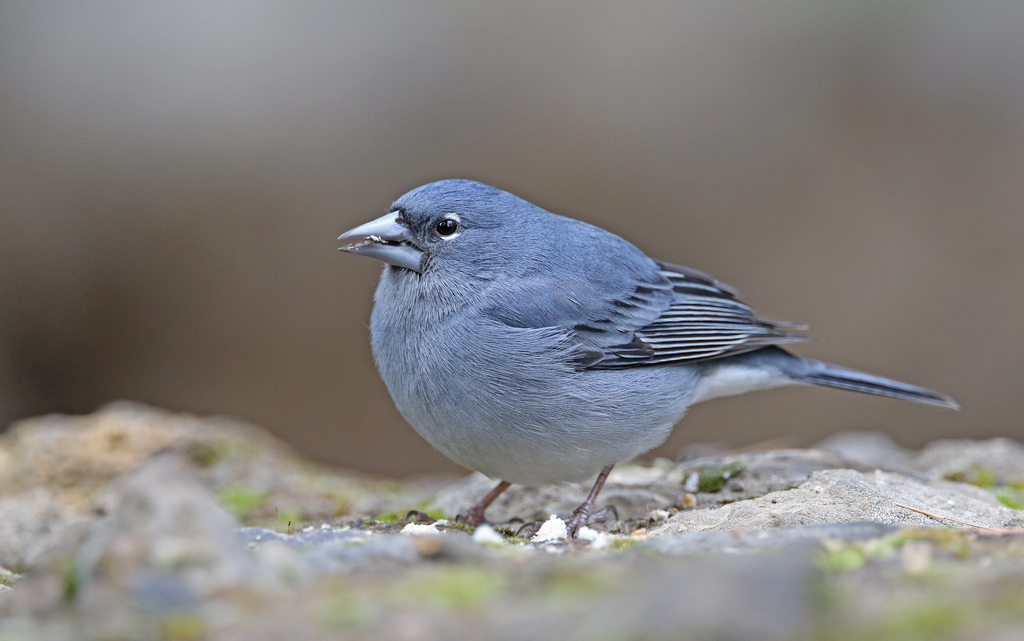
Tenerife Blue Chaffinch
Photo © Christoph Moning
Photo © Christoph Moning — CC BY 4.0 — Source: iNaturalist photo #185026750Identification
The Tenerife blue chaffinch is noticeably larger than the common chaffinch with a distinctly thicker bill. Males in breeding plumage are unmistakable, displaying the species' characteristic largely blue plumage with a grey bill. Females are dull grey-brown and lack the dark cap seen in common chaffinches; they can be distinguished from related species by their weaker wing bars. Overall, these birds are more uniform in plumage than common chaffinches.
Range & Habitat
This species is endemic to the highlands of Tenerife in Spain's Canary Islands, where it is the natural symbol of the island. The Tenerife blue chaffinch inhabits mountain Canary Island pine forest, occupying elevations between 300–2,300 metres. It is most common in coniferous forest areas with dense undergrowth but also frequents laurel and pine woodland, tree-heath, and scrub habitats.
Behaviour & Diet
Unlike the common chaffinch, the Tenerife blue chaffinch is not migratory. Its song is notably shorter and weaker than that of common chaffinches, and its flight call is croakier. The species primarily feeds on Canary Island pine seeds. Like common chaffinches but unlike most other finches, breeding pairs feed their young extensively on insects. Breeding occurs from late April through late July or early August, with pairs constructing nests from pine needles and broom branches and typically laying two eggs. Outside the breeding season, individuals may form small flocks, sometimes associating with common chaffinches and other finch species.
Best Time & Places to See It
Year-round residents of Tenerife's highlands, blue chaffinches are present throughout the year. The best opportunities to observe them occur in coniferous forest areas with dense undergrowth at higher elevations. During the breeding season (late April to early August), males in their striking blue plumage are easier to spot and identify. Small flocks may be more easily located outside the breeding season when birds are more gregarious.
Photography Tips
Breeding males in full blue plumage offer the most striking photographic subjects and should be prioritised during spring and early summer months. Focus on capturing the bird's distinctive larger size and thicker bill compared to common chaffinches, along with the characteristic grey bill of males. The dense undergrowth and coniferous forest habitat can present challenging lighting conditions; early morning light in forest clearings often provides the best opportunities. Patience and fieldcraft are essential when working in highland pine forest, where these birds may be heard before they are seen.
No community photos yet. Log in to add the first one.
No community observations of this species yet.