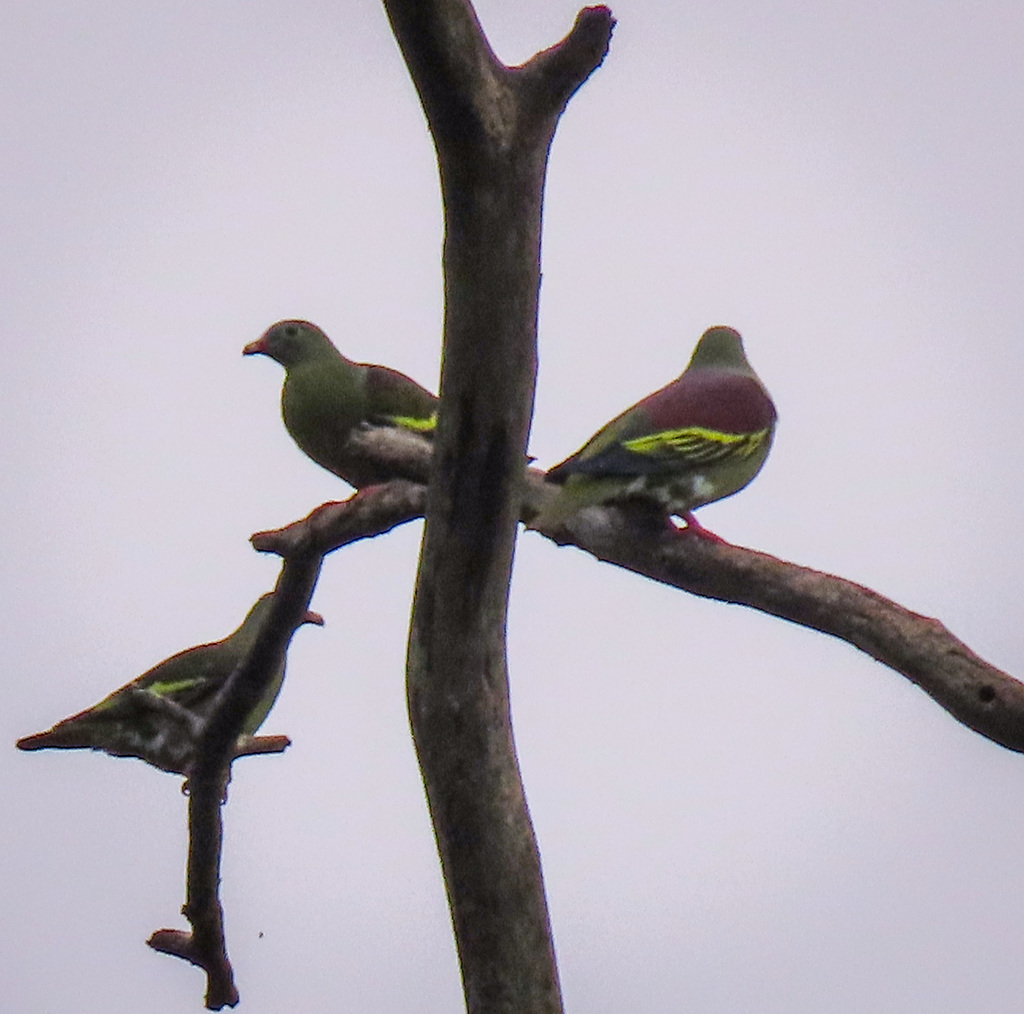
Thick-billed Green Pigeon
Photo © Sevin Dee
Photo © Sevin Dee — CC BY 4.0 — Source: iNaturalist #111902108Identification
The Thick-billed Green Pigeon is a rather small pigeon, measuring under 26 centimetres, making it noticeably petite compared to other green pigeons. Its most distinctive features are immediately recognizable: a thick, pale greenish bill with a red base, a broad bluish-green eye ring, a grey crown, and a maroon mantle. The wings display striking black primary and secondary feathers edged with yellow on the outer portions. Both sexes share a green underside, and the thighs are dark green with whitish scales.
Sexual dimorphism is evident in the plumage details. Males display a maroon dorsum with dull chestnut undertail coverts, while females have greenish undertail coverts with whitish scales. These subtle differences, combined with the species' characteristic curved bill—from which its scientific name curvirostra derives—allow experienced birders and photographers to confidently identify this elegant pigeon in the field.
Range & Habitat
The Thick-billed Green Pigeon ranges across the eastern regions of the Indian subcontinent and Southeast Asia, stretching from the Eastern Himalayas to Borneo and Sumatra. This species is found throughout Bangladesh, Bhutan, Brunei, Cambodia, Hong Kong, India, Laos, Malaysia, Myanmar, Nepal, the Philippines, Singapore, Thailand, Tibet, and Vietnam, as well as on various Indonesian islands. Seven recognized subspecies occupy different regions across this broad range, reflecting the species' adaptation to diverse environments across its distribution.
The species inhabits subtropical and tropical moist lowland forests and mangrove forests, preferring the canopy and mid-storey levels where food sources are abundant. Its affinity for forested habitats makes it an inhabitant of lush, wet environments rather than arid or open landscapes.
Behaviour & Diet
The Thick-billed Green Pigeon is known to feed on the syconia (fleshy fig inflorescences) of fig trees, moving slowly and deliberately along branches as it forages. This specialized feeding behaviour makes the species a valuable seed disperser for fig trees throughout its range, playing an important ecological role in forest ecosystems. The bird's deliberate, methodical movements through the canopy make it relatively easy to locate once a productive fig tree has been found.
Best Time & Places to See It
To encounter this species, seek out subtropical and tropical moist lowland forests and mangrove forests throughout its range. Productive fig trees are particularly reliable locations, especially when fruiting. The species' broad distribution across multiple countries means that travellers visiting forested regions from Nepal and northeast India through Myanmar and Southeast Asia to the Malaysian Peninsula, Sumatra, and Borneo have opportunities to encounter it. Hong Kong, Thailand, and Malaysia are particularly accessible destinations for witnessing this pigeon in its natural habitat.
Photography Tips
The Thick-billed Green Pigeon's small size and preference for canopy feeding present both challenges and rewards for photographers. Position yourself beneath fruiting fig trees during fruiting season and wait patiently for the bird to move slowly through the branches—its deliberate feeding behaviour provides extended viewing and shooting opportunities. The bird's subtle green colouration blends remarkably well with foliage, so look for movement rather than colour contrast. The distinctive grey crown, maroon mantle, and striking eye ring are key features to capture. Early morning light filtering through the canopy will reveal the delicate colour palette of the plumage to best effect.
Orang National Park
Rangagarapathar, India
+298 birds+1 mammals
Where the Brahmaputra's floodplains meet the foothills of Assam, Orang National Park unfolds across a mosaic of riverine grasslands, forests and wetlands that pulse with the…
VIEW NATIONAL PARKPhou Khao Khouay National Protected Area
Thaphabath District, Thailand
+113 birds
Where the Annamite Mountains descend into central Thailand's monsoon forests, Phou Khao Khouay National Protected Area sprawls across rugged limestone terrain interlaced with river valleys and…
VIEW NATIONAL PARKHat Noppharat Thara-Mu Ko Phi Phi National Park
Ao Nang, Thailand
+253 birds+9 mammals
Where limestone karsts rise dramatically from turquoise waters, Hat Noppharat Thara-Mu Ko Phi Phi National Park unfolds across a mosaic of beach, mangrove forest, and island…
VIEW NATIONAL PARKKhao Yai National Park
Prachantakham District, Thailand
+377 birds+46 mammals
Evergreen dipterocarp forest blankets the rolling terrain of this national park in eastern Thailand, where limestone hills rise abruptly from the forest floor and seasonal streams…
VIEW NATIONAL PARKKhao Laem National Park
Sangkhla Buri District, Thailand
+197 birds
Where the Vajiralongkorn Reservoir sprawls across the forested valleys of Kanchanaburi's northern borderlands, Khao Laem National Park protects a landscape where limestone ridges rise dramatically from…
VIEW NATIONAL PARKKaziranga National Park
Kohora, India
+422 birds+26 mammals
Dawn breaks over the floodplains of the Brahmaputra, where tall grasslands stretch endlessly beneath monsoon-heavy skies. This sprawling wilderness of northeastern Assam is a mosaic of…
VIEW NATIONAL PARKBako National Park
Kuching, Malaysia
+210 birds+17 mammals
Weathered sandstone cliffs rise dramatically from the South China Sea, their ochre faces sculpted by millennia of wind and tide into a landscape of extraordinary geological…
VIEW NATIONAL PARKTaman Negara National Park
Kampong Samas, Malaysia
+393 birds+48 mammals
Where ancient rainforest meets limestone peaks, one of Southeast Asia's oldest protected wilderness preserves sprawls across 4,343 square kilometers of primordial landscape. Dipterocarp giants tower overhead,…
VIEW NATIONAL PARKPenang National Park
Balik Pulau, Malaysia
+107 birds+2 mammals
Granite peaks rise abruptly from the Andaman Sea where tropical rainforest clings to steep slopes in one of Malaysia's oldest protected landscapes. Mangrove forests fringe the…
VIEW NATIONAL PARKTaman Negara Bukit Lambir National Park
Miri, Malaysia
+153 birds+7 mammals
Rainforest cascades down sandstone ridges where crystal streams carve through ancient geology, creating a landscape of profound biological richness in Sarawak's interior. This 68-square-kilometre sanctuary protects…
VIEW NATIONAL PARKGunung Mulu National Park
Long Seridan, Malaysia
+280 birds+39 mammals
Where granite monoliths pierce the rainforest canopy of Sarawak, an ancient limestone karst landscape reveals one of Southeast Asia's most biodiverse strongholds. Soaring peaks cloaked in…
VIEW NATIONAL PARKWay Kambas National Park
Lampung Timur, Indonesia
+237 birds+20 mammals
Across the low swamplands of eastern Lampung, where freshwater wetlands merge into tidal mangrove forests along the Sunda Strait, sprawls one of Sumatra's most vital sanctuaries.…
VIEW NATIONAL PARKHainan Tropical Rainforest National Park
Haikou, China
+69 birds+1 mammals
Tropical forests blanket the volcanic slopes of central Hainan, where moisture-laden winds from the South China Sea collide with mountainous terrain to create some of China's…
VIEW NATIONAL PARKXishuangbanna National Nature Reserve
Xishuangbanna Dai Autonomous Prefecture, China
+173 birds+2 mammals
Where subtropical monsoon forests meet the margins of the Yunnan plateau, Xishuangbanna National Nature Reserve sprawls across a landscape of dramatic relief—deep river valleys carved by…
VIEW NATURE RESERVEGaoligong Mountain National Nature Reserve
Nujiang Lisu Autonomous Prefecture, China
+443 birds+13 mammals
VIEW NATURE RESERVENo community photos yet. Log in to add the first one.
No community observations of this species yet.