Thicket Tinamou
Photo © Christoph Moning
Photo © Christoph Moning — CC BY 4.0 — Source: iNaturalist photo #102472292Identification
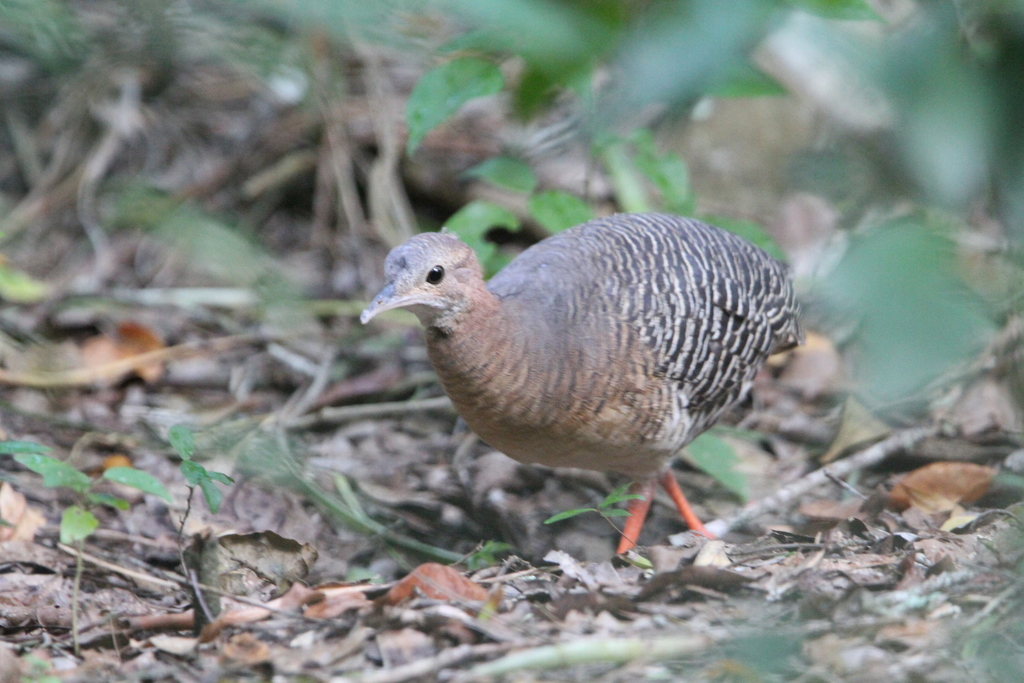
The thicket tinamou, also known as the rufescent tinamou, is a compact ground-dwelling bird measuring 27 to 29 cm in length and weighing approximately 440 g. Despite its small size, it shares the distinctive characteristics of the tinamou family, being one of the few ratites capable of flight, though not particularly strong in the air. Its plumage is characterized by brown upper parts heavily barred with black across the back, rump, and wings, while the underparts are pale brown with cinnamon coloring on the breast, grey on the belly, and whitish undertail coverts marked with dark barring. The head is brown with a prominent buff supercilium and a well-defined ear covert patch, complemented by a brownish bill and striking red legs.
Range & Habitat
The thicket tinamou ranges from Sinaloa on the western Mexican coast south through Central America to Costa Rica, and along the eastern Mexican coast from the United States border into Belize. Eight recognized subspecies occupy different regions throughout this broad range, from the Yucatan Peninsula to the Pacific slopes of southern Mexico, Guatemala, Honduras, Nicaragua, and into Costa Rica. This wide distribution reflects the species' adaptability to varied forest conditions across subtropical and tropical zones.
The species shows a clear preference for moist lowland forests, gallery forests, deciduous forests, and secondary growth in subtropical and tropical regions. It also inhabits shrubland and drier forest types, demonstrating considerable ecological flexibility. Elevations where the thicket tinamou is found range up to 1,850 meters, with the species venturing into highlands in the southern portions of its range.
Behaviour & Diet
The thicket tinamou is a relatively inconspicuous bird with a distinctive monotonous call described as 'whoo-oo', reminiscent of a steam engine. This vocalisation is often the most reliable way to detect the species in its forest habitat. The bird may be encountered singly, in pairs, in family groups, or as solitary individuals. Like most tinamous, it strongly prefers to walk rather than fly, spending much of its time foraging on the forest floor.
The species feeds on fruit, seeds, and invertebrates, typical of tinamous. For breeding, it follows the tinamou pattern of placing its nest on the ground near raised tree roots. A clutch typically contains around three eggs, though up to seven may be laid. The eggs are glossy and distinctive purple in color, a characteristic feature of tinamou reproduction. Interestingly, this species can hybridize with the slaty-breasted tinamou where their ranges overlap.
Best Time & Places to See It
The thicket tinamou is commonly found throughout its range in suitable habitat, making it a reasonably accessible species for patient birdwatchers. Early morning hours are ideal for detecting this forest dweller, when it is most vocal. Moist lowland and secondary forests offer the best chances of encounter, particularly in protected reserves and national parks throughout Mexico, Guatemala, Honduras, Nicaragua, Costa Rica, and Belize. The species' preference for walking on the forest floor means observers should listen carefully for its distinctive call and watch for movement along forest paths and near dense vegetation.
Photography Tips
Photographing the thicket tinamou presents both challenges and opportunities. The species' preference for dense forest understory and its habit of remaining close to the ground mean that patient positioning and waiting at likely locations will be more productive than active searching. Early morning light filtering through the forest canopy can beautifully illuminate the bird's subtle plumage patterns, particularly the buff supercilium and the cinnamon breast coloring. A longer lens is recommended to maintain distance and avoid disturbing the bird, which may flush into flight if approached too closely. The striking red legs offer a striking color accent in photographs and should be included when possible. Recording the distinctive 'whoo-oo' call is also a worthwhile complement to visual documentation, capturing an essential aspect of the species' natural history.
Santa Rosa National Park
Santa Elena, Costa Rica
+359 birds+30 mammals
Where Pacific-facing slopes descend from volcanic uplands toward the Guanacaste lowlands, Santa Rosa National Park unfolds across a mosaic of tropical dry forest, gallery woodland, and…
VIEW NATIONAL PARKGuanacaste National Park
Santa Elena, Costa Rica
+461 birds+17 mammals
Where the Pacific slopes of northwestern Costa Rica rise toward the Continental Divide, dry tropical forest gives way to cloud-laden peaks and misty ridges—a landscape that…
VIEW NATIONAL PARKLagunas de Montebello National Park
Laguna de Montebello, Mexico
+360 birds+2 mammals
Where turquoise lagoons pierce the limestone plateau of southeastern Chiapas, the Lagunas de Montebello National Park unfolds across roughly 174 square kilometers of spectral water and…
VIEW NATIONAL PARKSierra de Tamaulipas
El Porvenir, Mexico
+98 birds+19 mammals
Where limestone peaks thrust skyward through dense subtropical forest, Mexico's northeastern frontier reveals one of the continent's most biodiverse mountain ranges. Canyons carved by perennial rivers…
VIEW NATURE RESERVETikal National Park
Tikal, Guatemala
+399 birds+16 mammals
Dense rainforest canopy rises above the limestone plateau of Petén, where archaeological wonder and ecological richness merge seamlessly across one of Central America's most biodiverse landscapes.…
VIEW NATIONAL PARKLaguna del Tigre National Park
Petén, Guatemala
+399 birds+29 mammals
Where the Petén lowlands dissolve into wetland and forest, Laguna del Tigre National Park protects one of Guatemala's most ecologically vital landscapes. This sprawling reserve encompasses…
VIEW NATIONAL PARKSierra del Lacandón National Park
Petén, Guatemala
+348 birds+7 mammals
Where the Petén rainforest rises into limestone ridges and deep ravines, Sierra del Lacandón National Park protects one of Central America's most intact tropical wilderness zones.…
VIEW NATIONAL PARKPalo Verde National Park
Bagaces, Costa Rica
+318 birds+24 mammals
Dry forest spreads across Palo Verde's low-lying terrain in northwestern Guanacaste, where seasonal rivers and lagoons etch through deciduous woodland that sheds its canopy each winter.…
VIEW NATIONAL PARKRincón de la Vieja National Park
Liberia, Costa Rica
+451 birds+30 mammals
Where volcanic slopes rise abruptly from the Guanacaste lowlands, Rincón de la Vieja National Park sprawls across a landscape shaped by geothermal drama and seasonal extremes.…
VIEW NATIONAL PARKVolcán Tenorio National Park
Guatuso, Costa Rica
+480 birds+12 mammals
Where volcanic slopes rise through Costa Rica's northwestern borderlands, Volcán Tenorio National Park sprawls across terrain shaped by ancient lava flows and mineral-rich springs. The park's…
VIEW NATIONAL PARKMarino Las Baulas National Park
Santa Cruz, Costa Rica
+246 birds+9 mammals
Where the Pacific meets a mosaic of dry forest and mangrove estuary, this coastal national park protects one of Central America's most dynamic wildlife theatres. The…
VIEW NATIONAL PARKCurú National Wildlife Refuge
Paquera, Costa Rica
+249 birds+8 mammals
Where the Pacific coast of Puntarenas dissolves into dry deciduous forest and mangrove fringe, Curú Wildlife Sanctuary holds one of Costa Rica's most ecologically vital yet…
VIEW WILDLIFE SANCTUARYNo community photos yet. Log in to add the first one.
No community observations of this species yet.