Three-banded Plover
Photo © Wynand Uys
Photo © Wynand Uys — CC BY 4.0 — Source: iNaturalist photo #109193051Identification
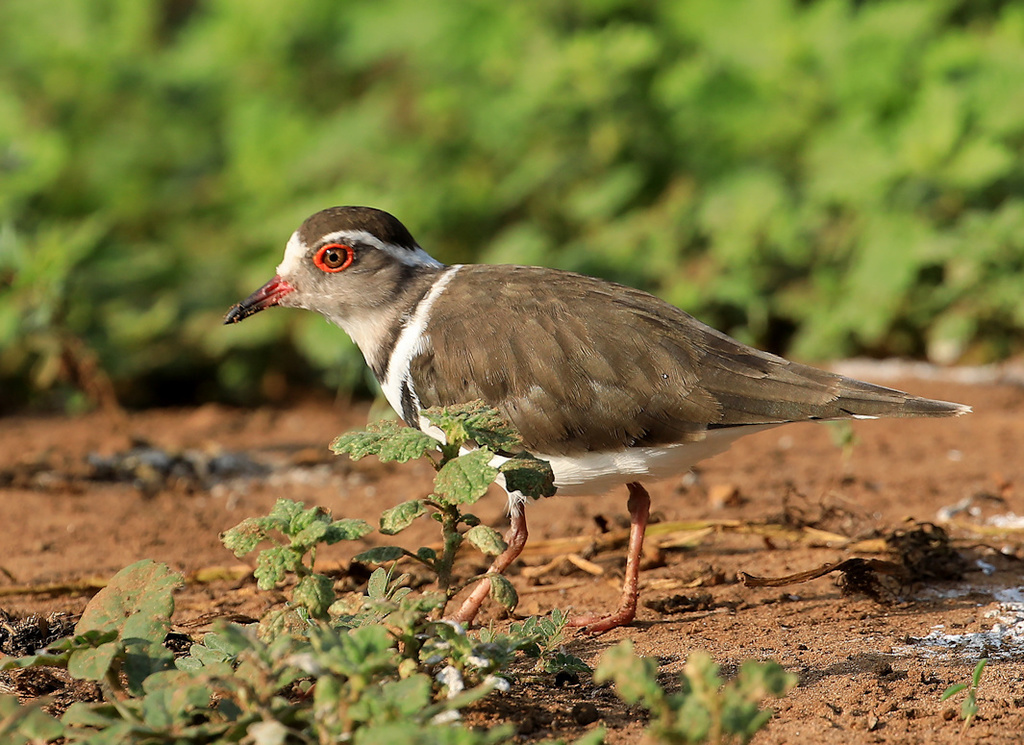
The three-banded plover is a small wader measuring 18 cm in length, instantly recognizable by its distinctive double breast bands. The species has medium brown upperparts and white underparts interrupted by two black breast bands separated by a white band—the markings that give it both its common and scientific names. The head is strikingly patterned with a black crown, white supercilia that extend from the white forehead to meet on the back of the neck, and a grey face that becomes brown on the neck. Look for the distinctive orange-red orbital ring and the rosy-red base of the otherwise black bill. In flight, the three-banded plover presents an unusually elongated profile due to its proportionally long tail and wings, a feature shared only with its sister species, Forbes's plover. The Malagasy subspecies differs slightly, displaying a grey band between the bill and white forehead, with grey sides to the head. Juveniles resemble adults closely, though they briefly show a brownish forehead and buff fringes on the wing coverts. Males and females are similar in plumage and size.
Range & Habitat
The three-banded plover is a resident and generally sedentary species found throughout much of East Africa, southern Africa, and Madagascar. It favors inland freshwater habitats, occurring mainly on the exposed shores of rivers, pools, lakes, and pans. Unlike its larger and darker sister species, Forbes's plover, which replaces it in West Africa and moist tropical regions, the three-banded plover maintains a largely separate breeding range from its close relative.
Behaviour & Diet
Three-banded plovers typically forage as solitary individuals, though they occasionally gather in small flocks. They hunt by sight, actively seeking out insects, worms, and other invertebrates along waterside habitats. The species is vocal, producing sharp whistled weeet-weet calls that help identify them in the field.
Best Time & Places to See It
To locate three-banded plovers, focus your efforts on inland waterside habitats with exposed shores—rivers, pools, lakes, and seasonal pans offer the best chances. In the tropics, egg-laying occurs from March to June, while in southern Africa the peak breeding season spans late winter to early spring, from July to October, when birds are most active and visible. The species' sedentary nature means populations are relatively predictable in their localities throughout the year.
Photography Tips
The three-banded plover's distinctive markings and colorful facial features—particularly the orange-red orbital ring and rosy bill base—reward close photography. The bird's elongated profile in flight, with its proportionally long wings and tail, creates striking silhouette opportunities. Patient observation of individuals foraging along shorelines will yield excellent opportunities to capture the bold breast bands and intricate head patterning that make this species so visually distinctive.
Arusha National Park
Tanzania
+555 birds+16 mammals
Where the slopes of Mount Mawenzi rise above the Arusha region, a compact yet ecologically rich national park unfolds across montane forest, moorland, and alpine zones.…
VIEW NATIONAL PARKMapungubwe National Park
Musina Local Municipality, South Africa
+358 birds+29 mammals
Where the Limpopo River cuts through sandstone ridges at the convergence of South Africa, Botswana, and Zimbabwe, Mapungubwe National Park preserves a landscape of profound ecological…
VIEW NATIONAL PARKChobe National Park
Botswana
+446 birds+45 mammals
Where the Chobe River cuts a sinuous path through northern Botswana, the landscape transforms into one of Africa's most dynamic wetland-savanna mosaics. This national park encompasses…
VIEW NATIONAL PARKLake Mburo National Park
Uganda
+505 birds+24 mammals
Rolling acacia woodland and scattered lakes define this intimate savanna preserve in southwestern Uganda, where the rift valley's geological drama shapes every water source and grassland.…
VIEW NATIONAL PARKTsavo West National Park
Mwatate, Kenya
+513 birds+49 mammals
Where volcanic ridges and weathered lava flows meet the semi-arid lowlands of south-central Kenya, Tsavo West National Park unfolds across a landscape sculpted by fire and…
VIEW NATIONAL PARKAmboseli National Park
Etonet/Lenkism ward, Kenya
+501 birds+43 mammals
Where the Amboseli basin opens toward the Tanzanian frontier, a shallow alkaline lake mirrors vast skies across one of East Africa's most iconic savanna landscapes. The…
VIEW NATIONAL PARKNgorongoro Conservation Area
Tanzania
+626 birds+55 mammals
Volcanic calderas and open grassland dominate this high plateau in northern Tanzania, where the landscape rises above 2,000 metres and ancient geological forces have shaped both…
VIEW WILDLIFE MANAGEMENT AREAPilanesberg National Park
Moses Kotane Local Municipality, South Africa
+364 birds+49 mammals
Granite peaks and volcanic ridges rise unexpectedly from the savanna floor across this 734-square-kilometre expanse in the North West province, creating a landscape of profound ecological…
VIEW NATIONAL PARKMokala National Park
Siyancuma Local Municipality, South Africa
+246 birds+35 mammals
Across the semi-arid savanna of the Northern Cape, where red earth meets sparse acacia woodland and open grassland punctuated by rocky outcrops, lies a landscape shaped…
VIEW NATIONAL PARKKruger National Park
Ba-Phalaborwa Local Municipality, South Africa
+540 birds+91 mammals
Across the low-lying savanna of northeastern South Africa unfolds one of Africa's largest and most ecologically intact protected areas, where acacia woodlands merge into mopane scrub…
VIEW NATIONAL PARKTankwa-Karoo National Park
Hantam Local Municipality, South Africa
+201 birds+20 mammals
Across the semi-arid heartland of the Northern Cape, where winter rains carve ephemeral watercourses through endless ochre plains, Tankwa-Karoo National Park sprawls across more than 3,100…
VIEW NATIONAL PARKMountain Zebra National Park
Inxuba Yethemba Local Municipality, South Africa
+265 birds+35 mammals
Across the windswept plateaus and deeply incised valleys of the Eastern Cape's interior, Mountain Zebra National Park unfolds as a landscape of geological drama and ecological…
VIEW NATIONAL PARKBontebok National Park
Swellendam Local Municipality, South Africa
+204 birds+11 mammals
Where the Cape Fold Mountains give way to coastal lowlands, a landscape of rolling sandstone hills and fynbos heathland creates one of South Africa's most compact…
VIEW NATIONAL PARKAugrabies Falls National Park
Kai !Garib Local Municipality, South Africa
+176 birds+20 mammals
Where the Orange River cuts a dramatic scar through the Northern Cape's arid interior, Augrabies Falls National Park sprawls across nearly 1,200 square kilometers of raw,…
VIEW NATIONAL PARKAddo Elephant National Park
Sundays River Valley Local Municipality, South Africa
+388 birds+55 mammals
Where the Eastern Cape's semi-arid scrublands meet transitional woodland, Addo sprawls across 13,478 square kilometres of one of southern Africa's most biodiverse landscapes. The terrain rises…
VIEW NATIONAL PARKCamdeboo National Park
Camdeboo Local Municipality, South Africa
+272 birds+24 mammals
Granite ridges and weathered sandstone cliffs rise across a semi-arid landscape where the Karoo transitions into the eastern escarpment of South Africa, creating Camdeboo National Park's…
VIEW NATIONAL PARKDorob National Park
Henties Bay, Namibia
+230 birds+13 mammals
Where the Skeleton Coast meets the Namib Desert's inland reaches, Dorob National Park sprawls across 34,021 square kilometres of one of southern Africa's most austere and…
VIEW NATIONAL PARKNo community photos yet. Log in to add the first one.
No community observations of this species yet.