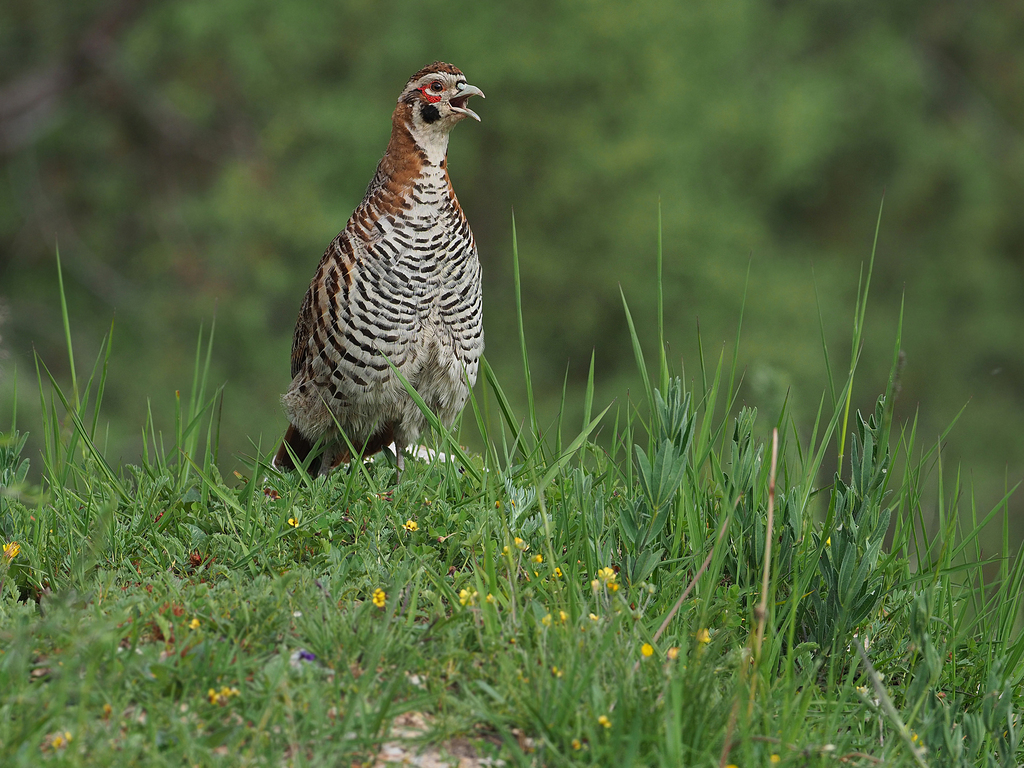
Tibetan Partridge
Photo © James Eaton
Photo © James Eaton — CC0 1.0 — Source: iNaturalist #207907622Identification
The Tibetan Partridge is a striking 28–31 cm gamebird with a distinctive appearance that sets it apart from other Perdix species. Its most distinctive feature is a bold black and white facial pattern: a white forehead, broad supercilium, face and throat contrasts sharply with a broad black stripe running down the face from below the eyes. A broad chestnut hind-neck collar completes this striking head pattern. The body is rufous and black-barred above, with pale buff underparts closely barred in black and broad chestnut bars on the flanks. Males display a solid black belly patch, while females show a barred version. Despite the eye-catching head and breast pattern, this plumage provides excellent cryptic camouflage in the rocky high-altitude habitat. Females are duller than males but similar in size, and juveniles are nondescript buff-brown, lacking the distinctive adult markings. Unlike most other partridges, Tibetan Partridges have only 16 tail feathers, and neither sex possesses leg spurs.
Range & Habitat
The Tibetan Partridge is found widely across the Tibetan Plateau, breeding from northwestern India through Kashmir and the Himalayas (including Nepal, Sikkim, and Bhutan) to western China and Tibet. Three subspecies show plumage variation across this range, becoming progressively darker from west to east. These birds inhabit high mountain slopes and alpine meadows typically between 3,600 and 4,250 metres elevation, where scattered Rhododendron bushes, dwarf juniper, and other low scrub provide essential cover in otherwise sparsely vegetated terrain. The species is non-migratory but makes altitudinal movements, descending to lower desert plains in winter and occasionally ascending to the snowline in summer. The species appears secure across its extensive and often inaccessible range.
Behaviour & Diet
Tibetan Partridges are terrestrial birds that prefer to run rather than fly. In summer, beginning around mid-March, they form monogamous pairs that stay close together. Outside the breeding season, they gather in flocks of 10–15 birds that scatter noisily when disturbed, flying short distances on rounded wings before gliding downhill to regroup. These are seed-eating birds, though young birds rely heavily on insects for essential protein. Breeding pairs nest in grass-lined depressions on bare rocky plateaus, near low scrub, or occasionally in standing crops, often positioning nests close to paths. A typical clutch of 8–10 brownish-buff eggs is laid between May and June, with the male assisting in chick-rearing. The usual morning call is a distinctive rattling 'scherrrrreck-scherrrrreck', while the flight call is a shrill 'chee chee chee'.
Best Time & Places to See It
Tibetan Partridges are best observed during the breeding season from mid-March onwards, when pairs are active and vocal in the early mornings—the prime time to hear their characteristic rattling calls. During winter months, look for flocks on south-facing slopes and open fields at lower elevations. In places like Lhasa, these birds favour stream belts with scrub during winter, and they may be found resting under bushes during the day. Dawn and dusk are productive times, as birds are most vocal and active in the early morning hours. The high-altitude Tibetan plateau habitat requires good acclimatization and physical fitness to explore effectively.
Photography Tips
The Tibetan Partridge's striking facial pattern and chestnut markings are best captured in clear, natural light that emphasizes the contrast between the white face, black stripe, and rufous collar. Early morning light is ideal for both visibility and behavioral activity. Photograph stationary birds when they rest under bushes or on open ground, as they prefer running to flying. When flocks are disturbed, be ready to capture the dramatic scatter with birds taking flight; use a faster shutter speed to freeze the action as they launch from the ground or glide downhill. The cryptic upper-parts plumage blends into rocky terrain, so position yourself to backlight or side-light the birds when possible to separate them from their habitat. A telephoto lens (400–600mm) is essential for working at distance in open alpine terrain where these birds are naturally wary.
Giant Panda National Park
Huanglong Scenic and Historic Interest Area
Langtang National Park
Qinghai Lake National Nature Reserve
Sanjiangyuan National Park
Wolong National Nature Reserve
Nothing matches these filters.
No community photos yet. Log in to add the first one.
No community observations of this species yet.