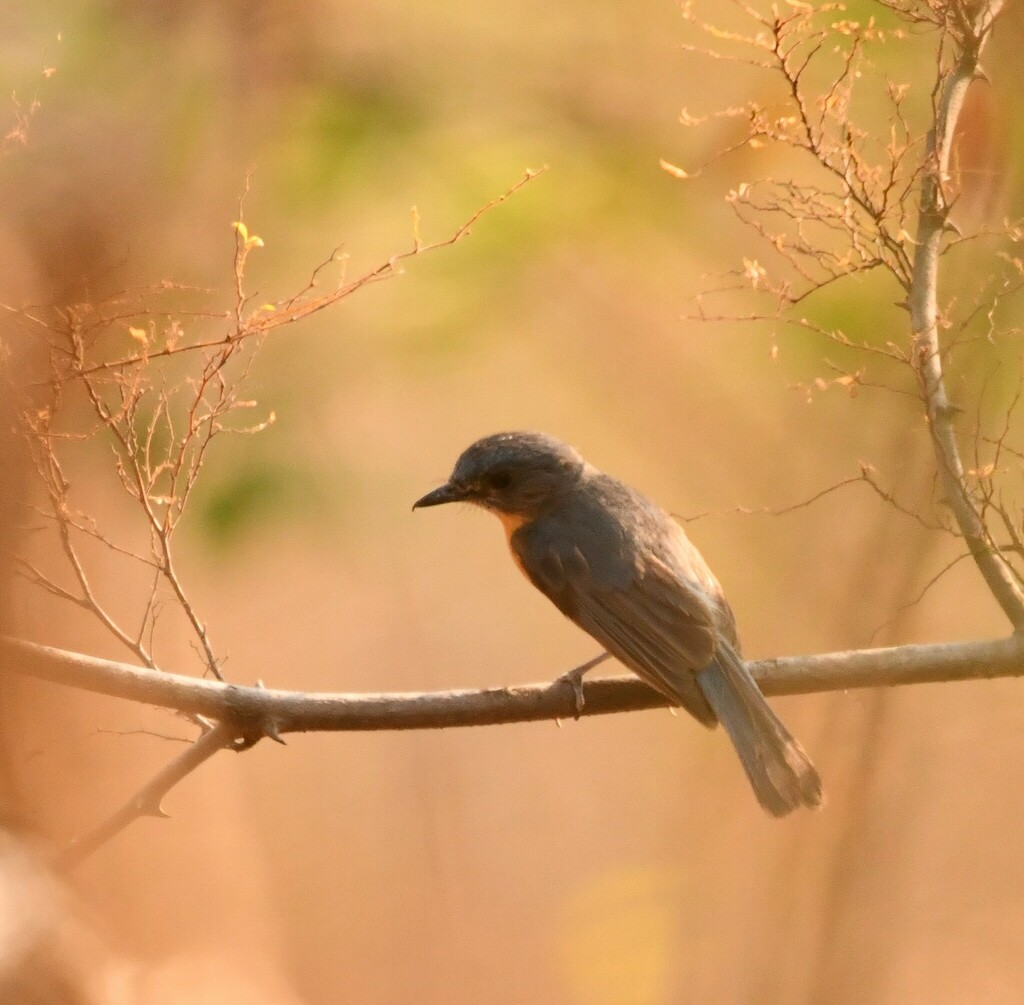
Tickell’s Blue Flycatcher
Photo © Surabhi Srivastava
Photo © Surabhi Srivastava — CC BY 4.0 — Source: iNaturalist #209438139Identification
Tickell's blue flycatcher is a small passerine, measuring just 11–12 cm in length. The males are strikingly colourful, with bright blue upperparts contrasting sharply with a distinctive rufous throat and breast, while the remaining underparts are white. Females are considerably duller, displaying a more subdued blue plumage, though they retain a brighter blue brow, shoulder, rump, and tail that distinguishes them from the males. Juveniles are quite different in appearance, showing streaked plumage and a spotted mantle with scaly brown upperparts, head and breast; only the wings and tail display the characteristic blue colouration seen in adults.
The species shows regional variation, with several subspecies recognized across its range. The nominate form occurs in India, Nepal and Myanmar, while the Sri Lankan population (jerdoni) is notably darker with a longer bill. The bird has sometimes been confused with the blue-throated blue flycatcher, which closely resembles it but possesses a blue throat rather than the rufous throat characteristic of Tickell's blue flycatcher.
Range & Habitat
Tickell's blue flycatcher breeds across tropical Asia, from the Indian subcontinent eastwards through Bangladesh and western Myanmar, with populations extending further east through Thailand, Cambodia and Vietnam. The Sri Lankan population is geographically separated as a distinct subspecies, while additional populations occur in peninsular Malaysia and northeast Sumatra. The bird inhabits dry forest, scrub, bamboo and gardens, showing a preference for dense vegetation and thick cover.
This is a forest-loving species that particularly favours the banks of wooded streams, though it adapts readily to small gardens and other cultivated areas. Recent observations suggest the bird is increasingly found inhabiting garbage places, indicating some capacity to exploit human-modified landscapes.
Behaviour & Diet
Tickell's blue flycatcher is a wary species, yet surprisingly easy to observe even in small gardens where it maintains an upright posture while foraging mainly in overgrowth. The bird produces a distinctive metallic song consisting of short clicks followed by five or six notes that resemble those of the Spot-breasted fantail, ending abruptly. Alarm calls include churr and clicking notes.
The species is primarily insectivorous, capturing flying insects as its main food source, though it also gleans or picks crawling insects such as termites and earwigs from the ground. They have been known to feed even after dusk. During the breeding season (April to August, or March to June in Sri Lanka), they take larger prey including small vertebrates; a bush frog has been documented as prey in Sri Lanka. Breeding birds construct nests in tree holes or amongst rocks, lined with fine grass and fibres, where they lay 3–5 eggs.
Best Time & Places to See It
The breeding season from April to August (March to June in Sri Lanka) offers the best opportunity to observe this species, when birds are most active and vocal. Visitors should focus on wooded streams, dense scrub, and forest edges throughout its range from India and Nepal eastwards to Myanmar, Thailand, Cambodia and Vietnam, as well as in Sri Lanka, peninsular Malaysia and Sumatra.
The bird's preference for thick cover and shade means careful observation in suitable habitat is rewarded; even small, well-vegetated gardens can harbour this species. Early morning visits when the bird is most vocal will increase chances of sighting.
Photography Tips
The striking colour contrast of male birds makes them rewarding photographic subjects, though the species' wariness and preference for dense cover present challenges. Position yourself quietly near wooded streams and thick vegetation, allowing time for the bird to become accustomed to your presence. The wary nature of the bird means sudden movements should be avoided.
Males' bright blue upperparts and rufous breast are best captured in good natural light, so aim for early morning or late afternoon sessions. The bird's upright posture and habit of foraging in overgrowth mean varied angles and compositions are possible, though patience is essential given the dense habitats it favours.
Lunugamvehera National Park
Sri Lanka
+204 birds+14 mammals
Dry scrubland and shallow wetlands converge in Sri Lanka's southeastern lowlands, where Lunugamvehera National Park anchors one of the island's most ecologically vital landscapes. The park's…
VIEW NATIONAL PARKMinneriya National Park
Sri Lanka
+158 birds+9 mammals
Across the dry zone of Sri Lanka's North Central Province spreads a landscape of shallow tanks, grassland margins, and scattered dry forest—a mosaic of water and…
VIEW NATIONAL PARKWasgamuwa National Park
Sri Lanka
+156 birds+8 mammals
Dry deciduous forest and open grassland sweep across the North Central lowlands where Wasgamuwa National Park protects one of Sri Lanka's largest remaining tracts of this…
VIEW NATIONAL PARKRanthambhore National Park
Sawai Madhopur, India
+294 birds+20 mammals
Granite ridges and ravines carved through the Aravalli Range frame this protected landscape in eastern Rajasthan, where deciduous forest mingles with open scrubland and seasonal water…
VIEW NATIONAL PARKEravikulam National Park
Devikulam, India
+192 birds+7 mammals
High in the Western Ghats of Kerala, where monsoon mists cling to slopes that rise above 2,000 metres, Eravikulam National Park preserves one of South India's…
VIEW NATIONAL PARKKanha Tiger Reserve
Kanha Kisli F.V., India
+321 birds+23 mammals
Where sal forests give way to emerald meadows and crystalline streams carve through ancient valleys, one of India's finest wilderness reserves unfolds across the Maikal Range.…
VIEW NATIONAL PARKTadoba National Park
Palasgaon Singru, India
+270 birds+20 mammals
Where sal forests meet open grasslands and rocky outcrops rise from red laterite soil, central India's landscape unfolds in raw, untamed beauty. Ancient teak woodlands and…
VIEW NATIONAL PARKBandhavgarh National Park
Garhpuri, India
+285 birds+17 mammals
Where granite ridges rise dramatically above sal and bamboo forests, one of India's most pristine tiger reserves unfolds across the Vindhyan plateau. Ancient rock formations tower…
VIEW NATIONAL PARKPanna National Park
Badgadi Kalan, India
+271 birds+17 mammals
Where granite gorges slice through central India's Vindhyan plateau, a landscape of stark beauty unfolds across nearly six hundred square kilometers. The Ken River carves through…
VIEW NATIONAL PARKKeoladeo National Park
Shreenagar Rural, India
+326 birds+14 mammals
Where shallow wetlands shimmer beneath vast Rajasthani skies, one of Asia's finest bird sanctuaries pulses with extraordinary life. This former maharaja's hunting reserve, now spanning 29…
VIEW NATIONAL PARKPeriyar National Park
Mlappara, India
+232 birds+4 mammals
Dawn breaks over mist-shrouded ridges where the Western Ghats tumble toward Kerala's spice-scented lowlands. Here, ancient tropical forests envelope a glittering artificial lake, creating a mosaic…
VIEW NATIONAL PARKPampadum Shola National Park
Vattavada, India
+258 birds+14 mammals
Where misty shola forests cling to the high plateaus of the Nilgiri Mountains, ancient evergreen remnants create a world apart. This 2,316-hectare reserve protects one of…
VIEW NATIONAL PARKBandipur National Park
Hirehalli, India
+302 birds+19 mammals
Where the Western Ghats descend into the Deccan plateau, ancient deciduous forests blanket a landscape carved by the Nugu River. Bandipur unfolds across 880 square kilometres…
VIEW NATIONAL PARKNagarahole Tiger Reserve
Nalkeri Forest, India
+323 birds+23 mammals
Where granite escarpments rise above dense deciduous forests and the Kabini River carves through pristine wilderness, one of India's most biodiverse landscapes unfolds across the Western…
VIEW NATIONAL PARKGir National Park
Asundrali, India
+258 birds+13 mammals
Dry deciduous forests cloak the rolling hills of western Gujarat where the Gir landscape rises as a final sanctuary for one of the world's rarest felids:…
VIEW NATIONAL PARKNo community photos yet. Log in to add the first one.
No community observations of this species yet.